
Man working in a shop in Vietnam © Pexels/ Thành Đỗ

Phu Huynh
Senior Employment Specialist, ILO Decent Work Technical Support Team for East and South-East Asia and the Pacific

Felix Weidenkaff
Employment and Labour Market Policy Specialist, ILO Country Office for Viet Nam
ILO employment specialists in Asia analyse the impact by sector, occupation, gender, and education level and explore implications for future policy responses.
Last November, when the Philippines launched its ASEAN 2026 Chairship with artificial intelligence (AI) as a central theme, it signalled the region’s most forward-looking agenda yet. President Ferdinand Marcos Jr. framed the Chairship theme ‘Navigating Our Future, Together” as a call to harness AI ethically and responsibly to boost economic integration, digital transformation and inclusive growth. [1]
As AI adoption accelerates across ASEAN, our analyses on generative AI (GenAI) [2] help answer a central question for the region: How will GenAI reshape jobs, and how can GenAI be shaped to be a driver of inclusive growth and decent work? The evidence is clear. GenAI will likely transform occupational roles and tasks more than eliminate jobs, but the distribution of exposure to GenAI and potential impacts across occupations, sectors and gender will shape the future of the region’s labour markets.
A region in transformation
Regional diversity persists. Across ASEAN countries with comparable data, 21–28 per cent of jobs are exposed to GenAI (Figure 1). The Philippines sits at the upper end of this range due to the country’s service‑oriented economy and global leadership in information technology and business process management (IT‑BPM). Conversely, at the other end, GenAI exposure in Thailand and Viet Nam features somewhat lower overall. In Viet Nam, despite advancements in AI preparedness and digital infrastructure, GenAI exposure remains strongly concentrated in key urban areas of Hà Nội, Hồ Chí Minh City and Đà Nẵng.
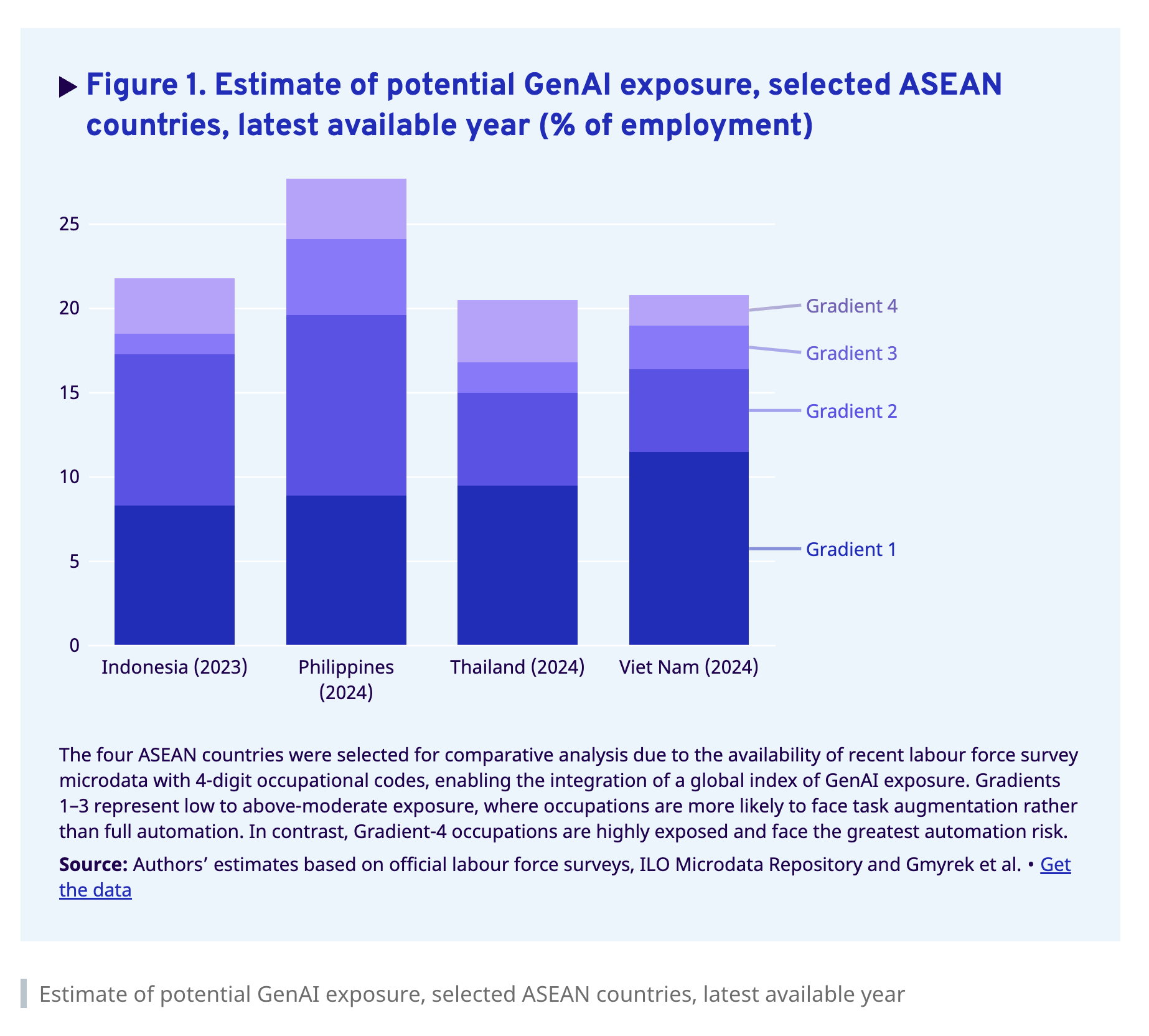
Despite public attention to potential risks, only a small share of jobs – 3 to 4 per cent in Indonesia, Philippines and Thailand and less than 2 per cent in Viet Nam – fall into the highest GenAI exposure category with the elevated risk of job displacement. The vast majority face partial task automation, meaning work will evolve rather than disappear. These patterns reflect ASEAN’s shift toward knowledge‑based activities, where GenAI can automate or augment cognitive and administrative tasks.
Impacts across occupation
Across ASEAN, clerical support jobs face the most significant exposure. In the Philippines, for example, 93.7 per cent of clerical roles are exposed to GenAI, with 37.8 per cent facing the highest risk. Likewise, in Indonesia, GenAI exposure among clerical support workers is 93.9 per cent, and 67.5 per cent are in the highest exposure group. In Viet Nam, 64.9 per cent of clerical roles fall into the highest exposure category.
These occupations, which encompass data entry clerks, record‑keeping and administrative support, are dominated by routine, structured tasks that GenAI can automate efficiently. Because they form a considerable share of service‑sector employment across ASEAN, any transformation in these roles will have far‑reaching effects.

© Unsplash / Fajar Herlambang STUDIO
Woman at a clerical job in Indonesia
Impacts across sectors
Across ASEAN, the share of the service sector in GDP ranges from 35.6 per cent in Cambodia to 73 per cent in Singapore, with a median of 43.8 per cent [3]. The potential for GenAI transformation is greatest in key service sub-sectors. In the Philippines, nearly nine in ten finance and insurance jobs are exposed to GenAI. Similarly, in Viet Nam, finance and insurance (82.6 per cent), wholesale and retail trade (76.3 per cent) and information and communication (74.3 per cent) face particularly high exposure.
Together, services underpin ASEAN’s growing digital economy, and their rapid transformation will shape the region’s future competitiveness.
Impacts across demographics
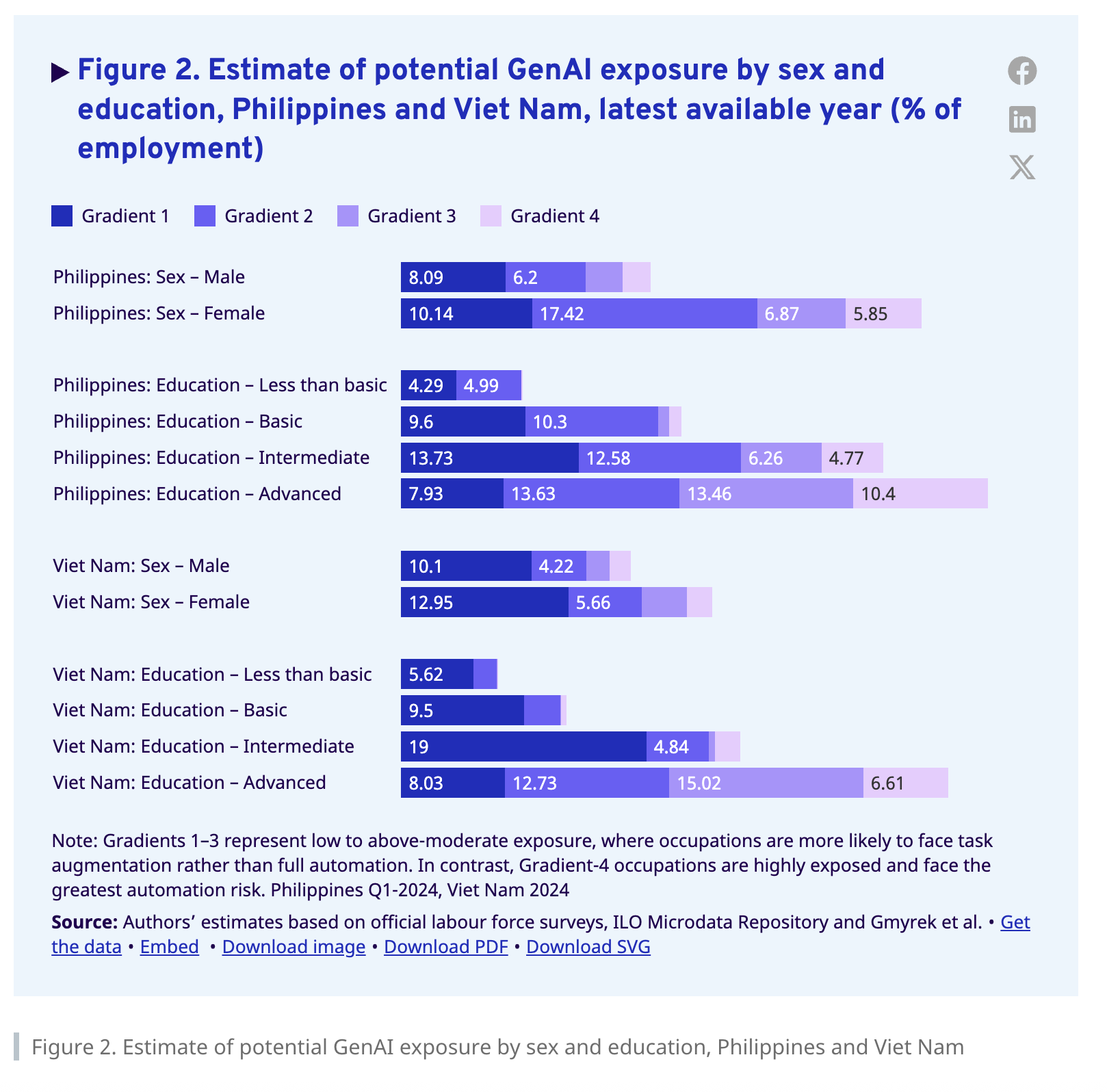
The potential impact of GenAI across the labour market is starkly uneven. Women face substantially higher GenAI exposure than men (Figure 2). This is driven by occupational segregation: women are more concentrated in clerical, administrative, and sales occupations – the very roles GenAI can most easily automate.
In parts of ASEAN, young workers are also more susceptible to GenAI. In Indonesia, for example, GenAI exposure is 26.1 per cent among working youth aged 15-24, compared to 21.1 per cent for their adult counterparts.
High exposure does not necessarily mean job loss and could instead lead to productivity gains and better jobs. But the risk of unequal impact and transitions is real, unless job creation, skills development and support systems are targeted and gender‑responsive.
The risk of unequal impact and transitions is real, unless job creation, skills development and support systems are targeted and gender‑responsive.
Similarly, workers with advanced schooling are more exposed to GenAI, not less. Many professional and administrative roles that require tertiary degrees, including data analysis, documentation, and reporting, involve tasks that GenAI can augment or partially replace.
In both the Philippines and Viet Nam, tertiary‑educated workers show the highest exposure levels both in the highest GenAI exposure category as well as in the occupations that are more likely to face task augmentation (Gradients 1-3). Similar patterns are observed in Indonesia and Thailand.
Policy priorities for a human-centred AI transition
The ASEAN region is standing at a pivotal moment. GenAI offers the potential for major productivity gains, but without intentional action, it could widen inequalities across the labour market. The question is no longer whether GenAI will shape the future of work in ASEAN, but whether it will do so in ways that are inclusive and leave no one behind.
The question is no longer whether GenAI will shape the future of work in ASEAN, but whether it will do so in ways that are inclusive and leave no one behind.
A human‑centred approach means ensuring AI governance promotes better jobs and is aligned with international labour standards. Safeguards against discrimination will be essential if technology is to strengthen and not weaken the foundations of decent work. It also requires that investments in economic activities, digital infrastructure and job creation, especially for small and medium-sized enterprises, be designed and implemented to support inclusive and gender-responsive outcomes.
As GenAI across ASEAN will likely transform occupational roles and tasks, critical measures including upskilling and reskilling initiatives, employment facilitation services, career development support, and the provision of timely, robust labour market intelligence are needed for targeted support.
Finally, these transitions cannot be managed without tripartite cooperation. Social dialogue between governments, employers, and workers will be essential in shaping how GenAI transforms workplaces in ASEAN.
References and footnotes
- Presidential Communications Office, “PBBM launches ASEAN Philippines 2026, sets focus on peace and security, prosperity, people empowerment”, 14 November 2025.
- ILO, Generative AI and jobs in the Philippines: Labour market exposure and policy implications, 2026; ILO, Generative AI and Jobs in Viet Nam: Labour market exposure and policy considerations, 2026.
- Figures reflect data as of 2024. Source: World Bank.
* The views and opinions expressed in this article are those of the author and do not necessarily reflect the official policy or position of ILO.