
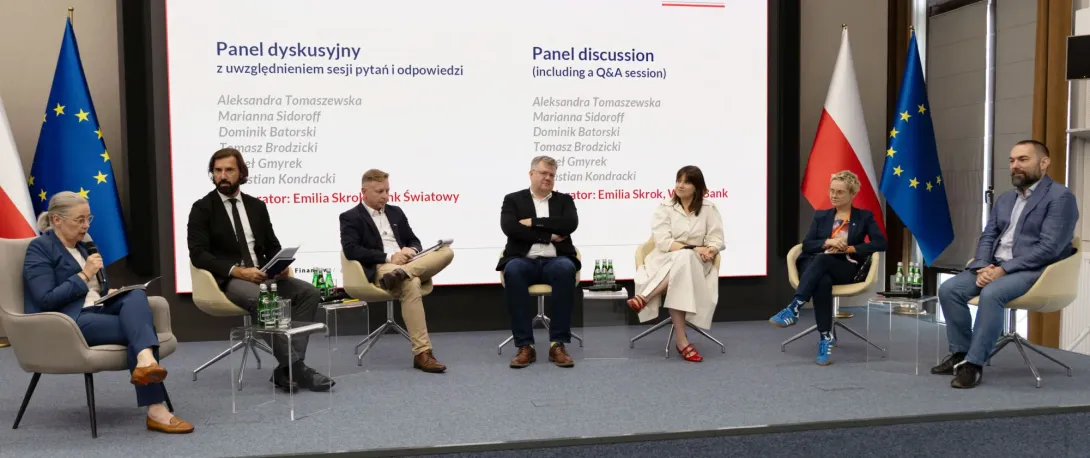
Paweł Gmyrek of the ILO joins a panel discussion at the launch of the report Navigating the Age of AI: Implications for Poland’s Economy in Warsaw. © Ministry of Finance of Poland
Poland becomes the first country application of a new World Bank Group–ILO technical collaboration designed to assess the potential macroeconomic impacts of Artificial Intelligence.
Poland has become the first country where the World Bank Group has applied its new macroeconomic framework, using the International Labour Organization (ILO)’s AI Exposure Index, to model the potential impact of AI on the economy and labour markets. The new findings were published on 22 June in a report titled Navigating the Age of AI : Implications for Poland’s Economy - What AI Means for Growth, Firms and Jobs, which analyses the broader economic impacts of AI adoption.
The launch event in Warsaw, where I represented the ILO as a contributor to the report, was hosted by the Polish Ministry of Finance. It brought together representatives of government, academia, business, workers, research institutions and international organizations to discuss the implications of the findings. The discussion highlighted that the real challenge is no longer measuring AI exposure but deciding how societies respond to it.
Over the past year and a half, I worked closely with the World Bank Group's regional economic and global macroeconomic modelling teams on adapting the Bank's Computable General Equilibrium (CGE) framework to account for AI. A key part of this work involved integrating occupational AI exposure measures developed by the ILO into the model. The methodology behind the framework is currently being documented in a joint working paper, to be published in the coming months. Our goal is not only to present the Polish case, but also to make the framework transparent, replicable and adaptable to other countries.

The Poland report is therefore much more than a country study. It represents one of the first attempts to connect task-level evidence on AI exposure with economy-wide simulations of productivity, employment, wages, public finances and economic growth. In practice, this means moving beyond the question: "Which occupations are exposed to AI?" and asking instead: "What happens to an economy when those occupational changes interact with productivity, investment, labour mobility, wages and structural change?"
This shift matters. Much of the public debate around AI remains focused on individual occupations and the possibility of job losses. Policymakers, however, need answers to broader questions, including how much productivity growth AI could generate, how AI adoption might affect employment across sectors, its impact on wages and public finances, and how gains are distributed between labour and capital.
The report suggests that AI could become a significant source of productivity growth in Poland. Alongside significant opportunities, the report highlights the possibility of worker displacement and job restructuring, the redistribution of employment across occupations and sectors, the unequal exposure of different groups of workers, and the challenge of ensuring that productivity gains translate into broadly shared improvements in living standards. Yet perhaps the most important conclusion is that technology alone does not determine outcomes.
These findings align closely with a central theme of the ILO’s work on the future of work: technological change does not occur in a vacuum. Its effects are mediated by labour market institutions, social protection systems, skills policies and social dialogue.
Social dialogue becomes especially important because, while models can identify likely scenarios, they cannot determine how the benefits and costs of technological change should be shared. Those decisions require a political process involving governments, employers, and workers. The findings provide a starting point for broader discussions on practical policy solutions that support both economic performance and a just transition for workers.
The World Bank’s MANAGE model is used in more than 50 countries worldwide. By incorporating occupational AI exposure into this framework, the collaboration creates a pathway for analysing the labour market and macroeconomic implications of AI across a much wider range of national contexts.
Ultimately, the value of this analytical work lies not only in improving our understanding of AI’s potential economic effects, but also in helping societies make informed choices about how they wish to manage and share the benefits of the transformation ahead.