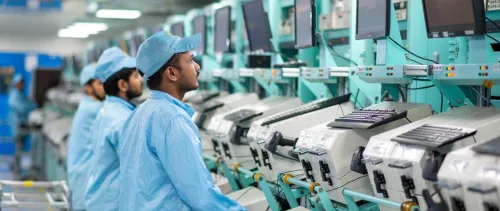

© Shutterstock/ultramansk | Engineers use artificial intelligence and robotics to optimize production.
Artificial intelligence has the potential to reshape human development. The question is whether it will do so in ways that reflect the priorities of the many, rather than the interests of the few.
The global artificial intelligence (AI) market is projected to hit $4.8 trillion by 2033 – roughly the size of Germany's economy – a 25-fold increase in just ten years.
This rapid expansion is already affecting everyday life.
AI-powered mobile apps help rural health workers interpret symptoms where doctors are scarce.
Adaptive learning platforms personalize lessons for students in under-resourced schools.
In climate-vulnerable regions, AI models forecast floods, droughts and crop failures days or weeks in advance, giving communities time to prepare.
But these gains aren’t automatic. They depend on choices about who builds the technology, whose data train it, and who gets a say in how it is governed.
Stakes are high for human development
The benefits of AI are far from evenly distributed.
A small group of economies and around 100 firms control the bulk of AI research, patents, and computing power.
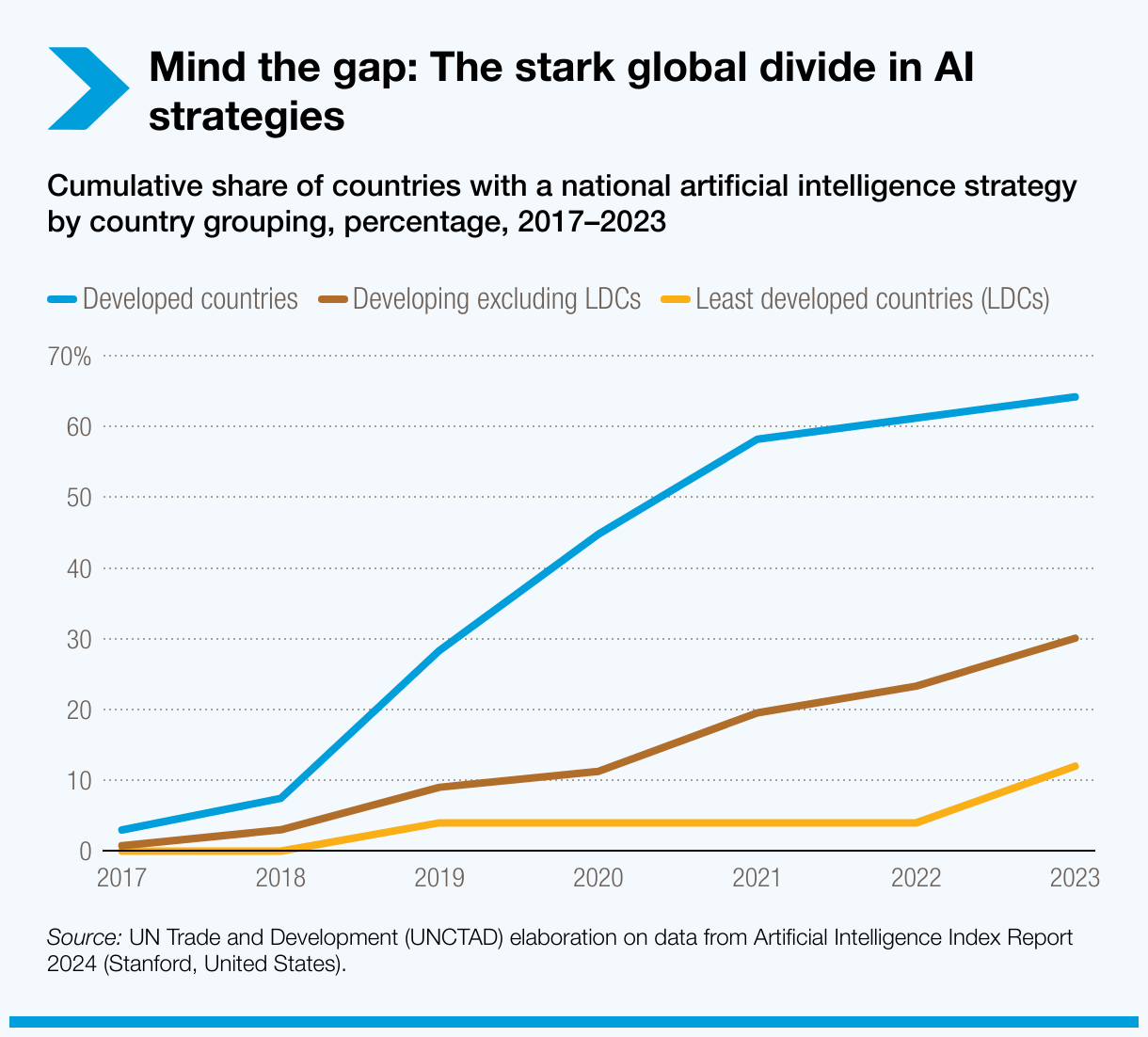
Fewer than one third of developing countries have a national AI strategy. Among least developed countries, the figure is just 12%.
About 65% of people in least developed countries remain offline, putting AI out of reach from the start.
Up to 40% of jobs worldwide could be affected by AI-driven automation. That threatens to erode the low-cost labour advantage many developing economies rely on for growth and poverty reduction.
Meanwhile, 118 countries – mostly in the global South – are absent from major AI governance forums. This means norms on safety, transparency and accountability are being written without them.
These are not just technical gaps. They’re human development gaps affecting livelihoods, public services and countries’ capacities to meet their citizens’ needs.
Leverage points: Infrastructure, data and skills
AI can deliver the greatest human development impact where needs are most acute: agriculture, primary healthcare, disaster management and public administration.
Success depends on three interdependent factors: infrastructure such as electricity, broadband and computing; locally relevant data; and workforce skills.
For most developing countries, the realistic entry point is adapting existing or open-source models to local conditions rather than building proprietary systems.
Aligning these efforts with national development plans — and treating data governance as central to readiness — separates countries that capture AI's gains from those where the technology remains confined to urban centres.
Policy pathways for inclusive AI
Inclusive AI is not a slower path but one that ensures technology leaves no one behind. For developing countries, the window to act is open but narrowing.
UN Trade and Development (UNCTAD) advocates for global cooperation to steer AI towards shared goals and values. Key priorities include:
- Industry commitment: A public disclosure mechanism for AI, similar to the environmental, social, and governance (ESG) framework, can improve accountability and turn global commitments into impactful outcomes.
- Shared infrastructure.: A global shared facility can provide equitable access to AI infrastructure, lowering entry barriers for countries that can’t build such infrastructure alone.
- Open innovation: Open data and open-source models can broaden access to knowledge and resources, supporting inclusive AI innovation. Coordinating fragmented open-source AI resources can make them more accessible and promote global collaboration.
- Capacity building: Sharing AI knowledge and resources – especially through South–South cooperation – can strengthen the capacity of developing countries to seize AI benefits and address common challenges.
RELATED NEWS