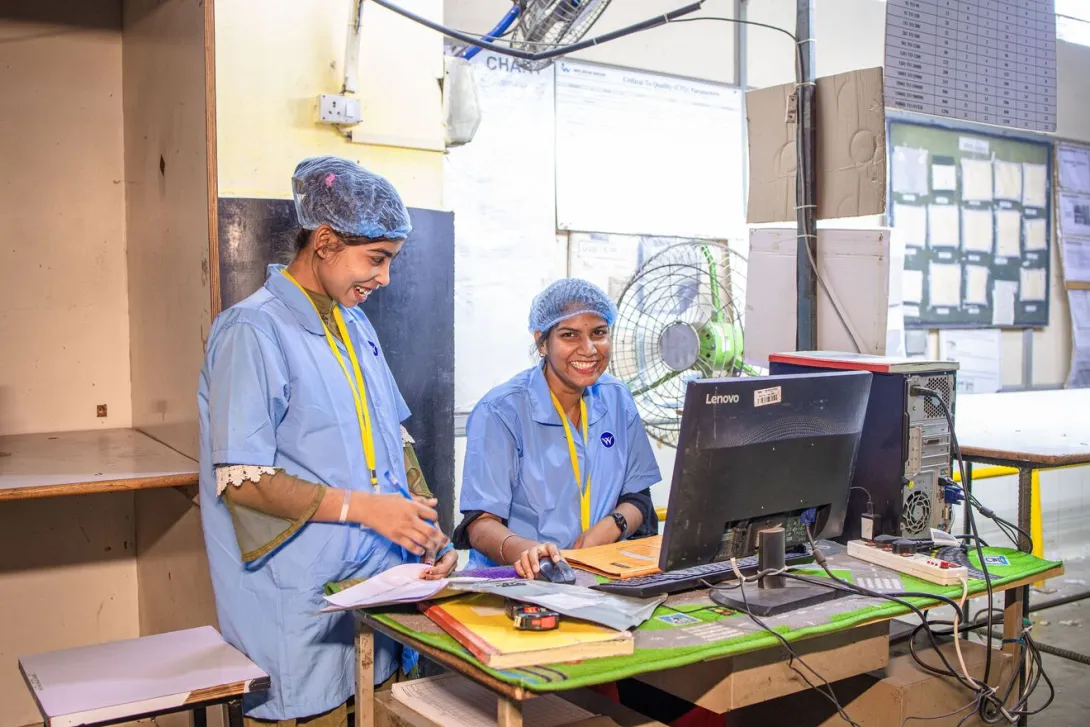
Textile workers using digital tools in a factory setting. As new technologies reshape workplaces, foundational, digital and socio-emotional skills are becoming increasingly important for accessing quality jobs. © Pexels/ EqualStock IN
AI has major implications for the skills workers need to access quality jobs. This article argues that foundational skills, more so than AI expertise, will be central for workforces to navigate this transformation.
The rapid adoption of AI is transforming labour markets. Given the current state of the technology, 24 per cent of workers worldwide are potentially exposed to AI. Some job losses are expected and will require a solid policy response to support the workers concerned. Yet, most jobs are likely to be transformed rather than made redundant (Berg 2024; Gmyrek et al. 2025).
Changing skills requirements are an important element of this transformation. This raises the question of which skills workers need to navigate AI and, ultimately, access quality jobs. It is straightforward to assume that “AI skills” will be required. In this blog, we unpack this notion.
We argue that the main challenge lies less in investing in AI expertise than in ensuring that the broader workforce can work effectively alongside AI. “Old skills” – especially foundational cognitive and socio-emotional skills – will play a key role as workforces adapt. Paired with domain-specific expertise, these foundational skills form the basis of rounded skills profiles that help workers access quality jobs in the AI era.
Which skills are in demand?
In its new flagship report on “Lifelong learning and skills for the future”, the ILO considers millions of online job vacancies from Brazil, Egypt, Jordan, Morocco, South Africa, the United Arab Emirates and Uruguay (ILO 2026). Because these countries are from regions the skills literature focusses less on, the analysis sheds new light on how employers' skills demand is evolving in different labour markets.
Across the online labour markets studied, socio-emotional and cognitive skills are among the most consistently requested competencies. In addition, employers seek workers with rounded skills profiles that combine, for example, communication and teamwork with analytical thinking and technical expertise. Jobs requiring such rounded skills profiles offer higher wages and better working conditions, including opportunities for career development and collaborative work environments (ILO 2026).
Perhaps surprisingly, the demand for specialised AI expertise remains low. In Brazil, Egypt, Jordan and the United Arab Emirates, AI and machine learning skills account for only around 1 per cent of all skills requested in online vacancies. This share is even smaller in Morocco, South Africa and Uruguay (ILO 2026; these figures refer to 2025 for Morocco, 2024 for Egypt, Jordan and the United Arab Emirates, 2023 for Brazil and Uruguay, and 2021 for South Africa).
Evidence from several OECD countries points in the same direction. In these countries, the demand for AI-related skills has grown rapidly following the emergence of generative AI, but largely among software developers, data scientists and workers in similar occupations (Feimi et al. 2026, Borgonovi et al. 2023). As a result, despite this rapid growth, AI skills remain a requirement in only a small share of job vacancies overall. A recent IMF study shows that in 2024 AI skills were mentioned in only around 4 per cent of job vacancies in the United States and Denmark, around 3 per cent in Great Britain, and around 2 per cent in Germany (Jaumotte et al. 2026).
AI changes how people work but not the importance of foundational skills
Even though the demand for AI and machine learning skills is expected to continue growing and may be more visible as more years of data become available, from a conceptual perspective, it makes sense that it will remain limited. And it does not mean that AI is unimportant. Quite the opposite. But most workers are users of AI, not creators. They increasingly rely on “ready-to-use” AI tools for writing, coding, designing, information retrieval and decision-making. They do not design and train AI models themselves.
This new way of working requires foundational skills rather than AI expert knowledge. Digital literacy provides the basis for navigating AI tools and formulating prompts. Critical thinking enables workers to evaluate and adapt AI-generated outputs by detecting and correcting mistakes and adjusting content to specific work contexts. The ability to think critically while using AI tools is reinforced by expertise in a worker’s respective domain, but such expertise does not need to be AI-specific.
Even in jobs that require AI expertise, employers rarely seek these technical skills in isolation, with rounded skill profiles rewarded once again. In the United Arab Emirates, for example, vacancies requiring AI and machine learning skills are associated with a substantial wage premium of 17.6 per cent. The same vacancies require core cognitive skills in 84 per cent of the cases. Socio-emotional skills also have a crucial complementary function in such roles, with social skills demanded in 88 per cent of the cases and customer service skills in 67 per cent (ILO 2026; El Hage Sleiman et al. 2025).
The role of socio-emotional skills
An intriguing question is how the demand for socio-emotional skills will evolve. AI has begun to be part of human communication, whether in customer service, conflict mediation or as a source of advice. To the extent that this trend continues, its effects will be felt in the labour market and beyond. In the words of the philosopher Emmanuel Levinas, human interaction is about “the face speak[ing] to me and thereby invit[ing] me to a relation” (Levinas, 1979, p. 198). This raises fundamental questions that will need to be answered to determine how much, and in which ways, machines should be involved in human interaction. After all, direct communication, possible disagreement, and subsequent alignment around decisions constitute a basis for interpersonal relations, including in workplaces.
Yet another scenario is also possible. AI can assist with strenuous activities, allowing workers to specialise more in socio-emotional tasks that technology cannot easily perform. Some Japanese nursing homes, for example, have introduced AI robots to lift patients and monitor information (see Lee et al. 2025). Human work remains a major component in these processes – who else would place the patient in the right position for the robot to lift them? – but there is also the potential for workers to spend more time interacting directly with patients. Such dynamics would echo earlier waves of workplace computerisation, when labour markets increasingly rewarded teamwork and worker-client interactions (Deming 2017).
Implications for policy
From a policy perspective, the centrality of rounded skills profiles and solid foundational skills in the AI era reinforces the importance of quality learning throughout working life. A vivid discussion currently highlights the needs of entry-level workers (for example, Brynjolfsson et al. 2025; Lambert and Schindler 2026). Inclusive skills development will be similarly important for experienced workers, particularly as many labour forces across the world continue to age.
The debate around the importance of socio-emotional skills also sheds light on how societies value different types of work, especially in sectors that generate social value. Socio-emotional skills carry a substantial wage premium in business services, but this is not the case for care workers, who paradoxically rely on these skills the most (Liepmann and Hegewisch, 2025).
The policy solution is therefore not just about investing in more skills. Societies and economies also need to better recognise, value and reward the skills that workers already possess (ILO 2026; ILO 2023). Investments in employment creation in growing sectors – including the care economy – help ensure that workers’ skills are matched with quality jobs, as do policies promoting decent working conditions.