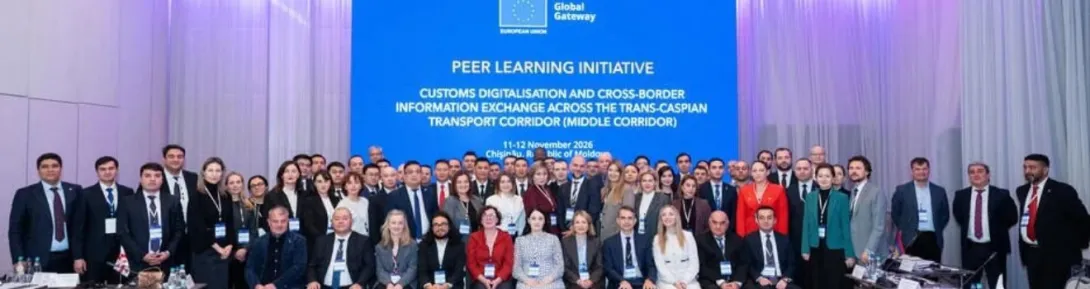
(Chisinau, Republic of Moldova) – Customs officials and digitalization experts from Central Asia, the South Caucasus, Türkiye, Moldova, Romania, Ukraine and the European Commission gathered in Chisinau on 11–12 November to explore concrete opportunities for strengthening cross-border information exchange along the Trans-Caspian Transport Corridor (Middle Corridor).
As countries along the Corridor invest in modernizing their customs systems, it is becoming increasingly important to ensure that information flows seamlessly across borders. More efficient data exchange can reduce administrative burdens, improve the predictability of border procedures, and make the Corridor a more competitive trade route for businesses.
Supported by the European Union, the two-day Peer Learning Initiative on Customs Digitalisation and Cross-Border Information Exchange was organized by the International Trade Centre (ITC), in cooperation with the Customs Service of the Republic of Moldova, under two EU-funded projects implemented by ITC: Ready4Trade Central Asia: Fostering Prosperity through the Trans-Caspian Transport Corridor and EU4Business: Empowering Trade and Competitiveness in Eastern Partnership countries.
"A corridor is only as fast as the information that travels with the goods. Strengthening the transport corridor requires not only investments in physical infrastructure, but also closer cooperation between Customs administrations and digital systems that can communicate across borders. The European Union is committed to supporting this connectivity by bringing countries together, fostering trust and enabling practical solutions that make trade routes more efficient, reliable and predictable," the European Commission stated.
Through interactive exercises, participants compared national digitalization capabilities and explored opportunities for linking existing systems. In the closing Corridor Opportunity Laboratory, they worked together to identify potential information flows, gaps and concrete opportunities for bilateral and regional cooperation, including possible quick wins and future pilot initiatives.
"For a landlocked country like Tajikistan, efficient trade depends not only on our own Customs systems, but also on how effectively we connect with our neighbours and transit partners. Digitalization cannot stop at national borders. The real value comes when our systems can exchange information reliably, allowing goods to move more efficiently across the entire trade route. Bringing Customs administrations together to address these challenges is essential to building more predictable, transparent and competitive trade corridors," said a representative of the Customs Service under the Government of the Republic of Tajikistan.
Over two days, participants:
Mapped national Customs IT systems through eleven standardised digitalisation profiles, presented and discussed during an interactive peer-learning exercise;
Reviewed bilateral Customs-to-Customs exchange in practice, including the Bilateral Seamless Transit Initiative and experience from Kazakhstan, the Kyrgyz Republic and Tajikistan;
Assessed national capabilities to send and receive Customs information electronically across nine key information areas;
Examined regional and multilateral frameworks for exchanging Customs data across several countries, including the electronic transit system used by the EU and its partners under the Common Transit Convention (NCTS), the digital system for international road transport under the TIR Convention (eTIR), and others;
Explored the exchange of certificates and other regulatory data, including the EU Single Window Environment for Customs and national Single Window experience from Armenia and Turkmenistan.
"No single country can make an entire corridor efficient on its own. But by working together, countries can ensure that progress achieved nationally translates into benefits across the whole route. ITC is pleased to support this process, drawing on our Peer Learning methodology, technical expertise and experience across the regions. We are looking forward to supporting the translation of these exchanges into concrete reform opportunities,” the International Trade Centre stated.
The outcomes will inform follow-up technical cooperation and potential activities for implementation, aimed at making customs processes along the Corridor more connected, efficient and predictable.
RELATED NEWS