
The message at the 10th Global Review of Aid for Trade in Geneva was loud and clear: The past 20 years have shown that Aid for Trade has worked and can continue to do so.
But a changing world that sees increasing conflicts, climate crises, an artificial intelligence revolution and tightened governmental spending among many other shifting factors, means that Aid for Trade needs to change with it.
The general sentiment throughout the event was that the complex challenges the world is facing can also bring many opportunities for aiding trade – and that better development cooperation can be achieved through “partnerships for trade and development”, as reflected in a declaration adopted by WTO members on 30 October.
Since its launch at the WTO Hong Kong Ministerial Conference in December 2005, Aid for Trade built around a common idea: developing countries need investments in the roads, ports, skills and rules that let them benefit from global trade. Since then, almost $800 billion has flowed towards that goal, much of it to least developed countries, and the development community has met regularly at the World Trade Organization (WTO) to review progress.
The latest session on 29 and 30 October 2026 saw participants highlighting some of the initiative’s biggest success stories. But Global Review participants also said that the biggest challenge is how aid for trade can better mobilize investments for trade in this moment of transition for the development community.
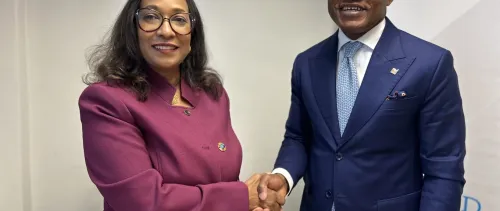
The International Trade Centre (ITC) joined the review, with a delegation led by Deputy Executive Director Dorothy Tembo. From forging partnerships for small and vulnerable economies and AI for inclusive trade to sustainable battery value chain development, Tembo highlighted in several sessions how crucial it is to integrate the perspectives of small businesses in policy discussions and close the finance gap for needed investments in innovation and sustainable trade.
And these efforts are particularly successful with the right public-private partnerships, an integrated support for an enabling business environment and innovative trade solutions.
Here a few highlights.
Three problems small businesses can’t solve alone
On a WTO-hosted panel on trade development partnerships, alongside Barbados, the European Union, ICC, New Zealand, UNIDO and the World Bank Group, ITC set out three obstacles that only joint action can remove.
Finance: Small businesses struggle to borrow for the equipment, certification and stock that exporting requires. ITC pointed to the new SME Trade Finance Facility for small and medium-sized enterprises, a joint initiative by the UN Capital Development Fund, the European Commission and OACPS, as one way to start closing that gap.
Digital access: Online markets and e-commerce mean little without reliable connectivity, infrastructure and the skills to use them.
Green transition: Small firms need affordable and realistic pathways, with clear regulation and access to the funding that already exists.
Critical Raw Minerals and responsibilities
A session on battery value chains in Africa highlighted shortfalls in investment, even for high-demand products. Despite surging demand for electric vehicles, investment in critical minerals has fallen for the first time this decade, and investment in battery production fell even further. Tembo called on participants to ‘turn that investment trend around, responsibly’.
The discussion focused on the Democratic Republic of the Congo, where governments, lenders and companies are looking at how to process more minerals locally instead of exporting them raw, while avoiding environmental and social harm. ‘We need to improve the transparency of the battery value chain. We are working with the Global Battery Alliance in this regard,’ Tembo said.
Unlocking Africa’s Intraregional and international trade
For African firms more broadly, open borders are only a start. The African Continental Free Trade Area (AfCFTA) has lowered barriers on paper, but Tembo warned that 'only removing tariffs and trade barriers does not guarantee market access'.
The €200 million Africa Trade Competitiveness and Market Access (ATCMA) programme, funded by the European Union and run by ITC and the UN Industrial Development Organization (UNIDO), aims to bridge that gap by helping small businesses, especially those led by women and young people, and by creating stronger regional value chains that contribute to competitive continental value chains.
The session highlighted the importance of structural transformation and industrialization of its regional value chains by taking advantage of the African Continental Free Trade Area (AfCFTA), along with value added manufacturing, the green and digital transition, among many other factors that will help Africa's small businesses build competitiveness.
AI toolkit for women entrepreneurs and good data
To make sure that AI narrows trade gaps for small businesses instead of widening them, ITC in partnership with Columbia University developed an AI toolkit for women entrepreneurs.
The toolkit was launched at a high-level panel, for which the ITC SheTrades Initiative worked with Columbia University to survey over 150 women business owners across Africa, Asia, Latin America and the Middle East, most of whom already use AI every day. What they wanted was guidance on applying it to the core of their business and checking what it produces. Their biggest worries were data privacy, cost and online fraud.
The toolkit offers step-by-step guidance for AI use in everyday business functions. Made possible by the support of the Swiss State Secretariat for Economic Affairs (SECO), Iceland and UPS, the toolkit has been piloted in Viet Nam and its results will also inform ITC’s work with ministers following the call to action endorsed at the first Global SME Ministerial Meeting. That event in Johannesburg in 2025 named digital transformation, including the responsible adoption of AI, as a shared challenge.
Good decisions also depend on good data. Over the past decade, ITC’s market intelligence tools, including Trade Map, have supported more than $2.5 billion in business deals. Eswatini presented the nationwide training programme it has run to help firms and officials use them.
The innovation and resilience surrounding sargassum
When the ‘oceans turn the colour of chocolate-brown’, something is not right. Fuelled by warmer ocean temperatures and synthetic fertilizers, mats of sargassum seaweed have formed the Great Atlantic Sargassum Belt, stretching from the Gulf of Mexico to Brazil and West Africa.
A session hosted by Grenada with ITC showed how some businesses as part of the blue economy are turning the seaweed into new products, ranging from biostimulants for use in agriculture to cosmetics. The goal is to help develop a commercially viable sargassum value chain, helping small businesses develop pipelines of projects and connecting them with investors, who are better sensitized to their needs.
Speakers including the BLUEGEA Group from the Dominican Republic, said the lack of regulations for seaweed-derived products makes it hard to raise money. The UN Conference on Trade and Development (UNCTAD) noted that global ocean-related trade is worth $2.55 trillion this year and growing at 6% a year, giving trade policy a real role in helping the sector grow.
Small economies, quick reforms
The case for partnership was also made in a discussion led by Barbados and Guatemala, with WTO’s small and vulnerable economies. Panellists said their small size can be an advantage, because it makes them quicker to introduce reforms and mobilize resources, but they still depend on regional integration and outside investment to grow.
Several cited the SAMOA Agreement, a 20-year legal and political partnership framework between the EU and its African, Caribbean and Pacific partners, as proof of what shared commitments can achieve.
See all photos of the event on Flickr.