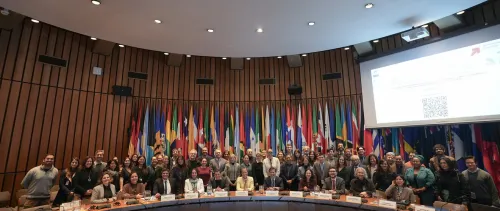
More than 30 senior public officials from 14 Caribbean countries gathered in Jamaica to strengthen the institutional capacities needed to translate digital strategies into implementation, as ECLAC advances regional cooperation under the Digital Agenda for Latin America and the Caribbean (eLAC).
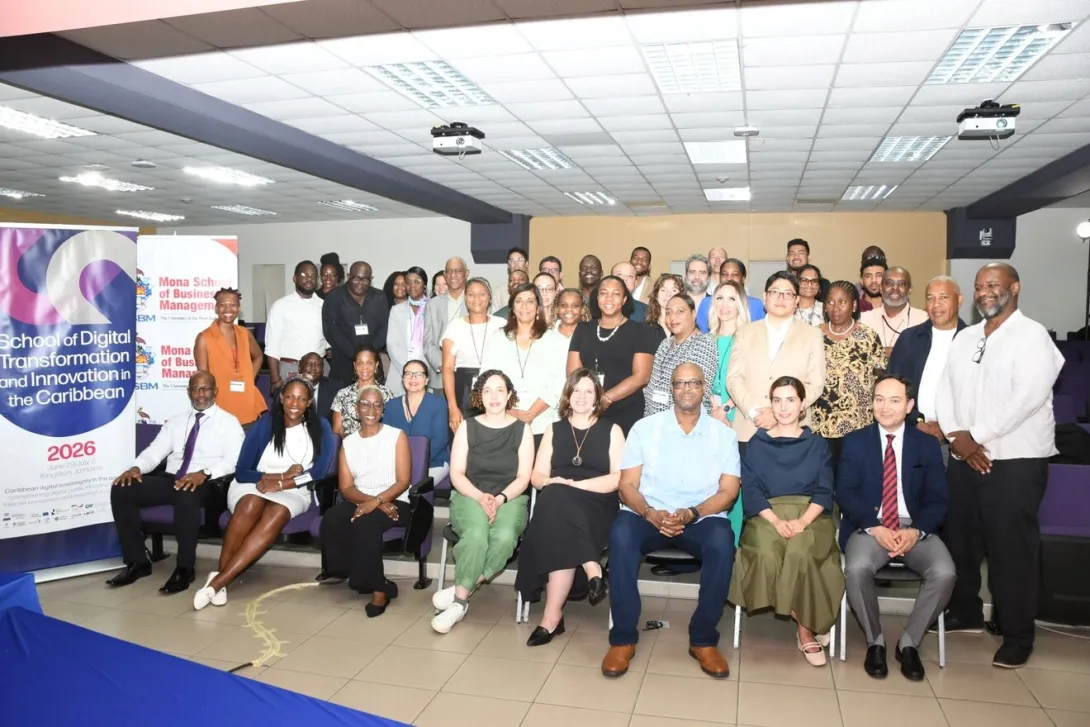
More than 30 government officials from 14 Caribbean countries met in Kingston from 29 June to 2 July for the third edition of the School on Digital Transformation and Innovation in the Caribbean (SODTIC 2026), a flagship capacity-building initiative led by the Economic Commission for Latin America and the Caribbean (ECLAC) to help governments accelerate digital transformation through stronger institutions, better governance and regional cooperation.
Hosted by the Mona School of Business and Management at The University of the West Indies, the four-day programme brought together policymakers, technical experts, academia, international organisations and private-sector representatives to address one of the region's most pressing challenges: turning digital policy ambitions into concrete public action.
Organised by ECLAC within the framework of the Digital Agenda for Latin America and the Caribbean (eLAC), SODTIC 2026 was developed in partnership with CAF – Development Bank of Latin America and the Caribbean, the European Union, Cetic.br/NIC.br, the Caribbean Telecommunications Union (CTU), The University of the West Indies and members of the technical Internet community.
Held under the theme "Caribbean digital sovereignty in the age of AI: strengthening digital public infrastructure, the Internet ecosystem and meaningful connectivity," the School forms part of ECLAC's long-term commitment to strengthening public-sector capacities across the Caribbean. Through regional training, peer learning and technical cooperation, the Commission supports countries in designing and implementing digital policies that respond to their own development priorities while advancing regional integration.
A central conclusion emerging from this year's discussions was that the Caribbean's main challenge is no longer developing digital strategies, but implementing them effectively. Participants identified limited institutional capacity, fragmented digital ecosystems, financing constraints and shortages of specialised technical expertise among the principal barriers preventing digital policies from delivering tangible results.
Discussions highlighted the need for governance models tailored to the realities of Small Island Developing States (SIDS), rather than simply adapting legislative and regulatory frameworks developed for larger economies. Participants agreed that building resilient digital institutions requires approaches that reflect the Caribbean's own social, economic and geographic context.
Artificial intelligence featured prominently throughout the programme, with sessions focusing on practical pathways for governments to move from experimentation to implementation. Topics included the development of national AI agendas, AI maturity assessments, data governance, digital skills and institutional readiness. Participants also stressed the importance of building AI ecosystems that leverage the Caribbean's own strengths and innovation potential.
The School also showcased ECLAC's ongoing regional initiatives supporting digital transformation in the Caribbean, including the Digital Economy Trust Framework for OECS Member States and the Caribbean Data Embassies Initiative, both aimed at strengthening trusted digital governance, data resilience and regional cooperation. Throughout the programme, participants also explored digital public infrastructure, meaningful connectivity, cybersecurity, Internet governance, Internet Exchange Points (IXPs), strategic data leadership and sustainable digital infrastructure.
By bringing together governments, international organisations, academia and the technical community, SODTIC 2026 provided a platform for exchanging experiences, identifying practical solutions and adapting international best practices to Caribbean realities. The programme reflects ECLAC's broader commitment to supporting countries in building the institutional capacities required to harness digital technologies as drivers of more productive, inclusive and resilient development.
For participants, one of the programme's greatest strengths was the opportunity to exchange experiences with peers facing similar policy challenges.
"The school offered far more than technical training. It created an opportunity to learn from other policymakers and practitioners facing similar challenges and to identify practical solutions that can be adapted to our own national contexts," said Desiree Zachariah, Manager of the Business and Data Analytics Unit at the Ministry of ICTs, Utilities and Energy of Antigua and Barbuda.