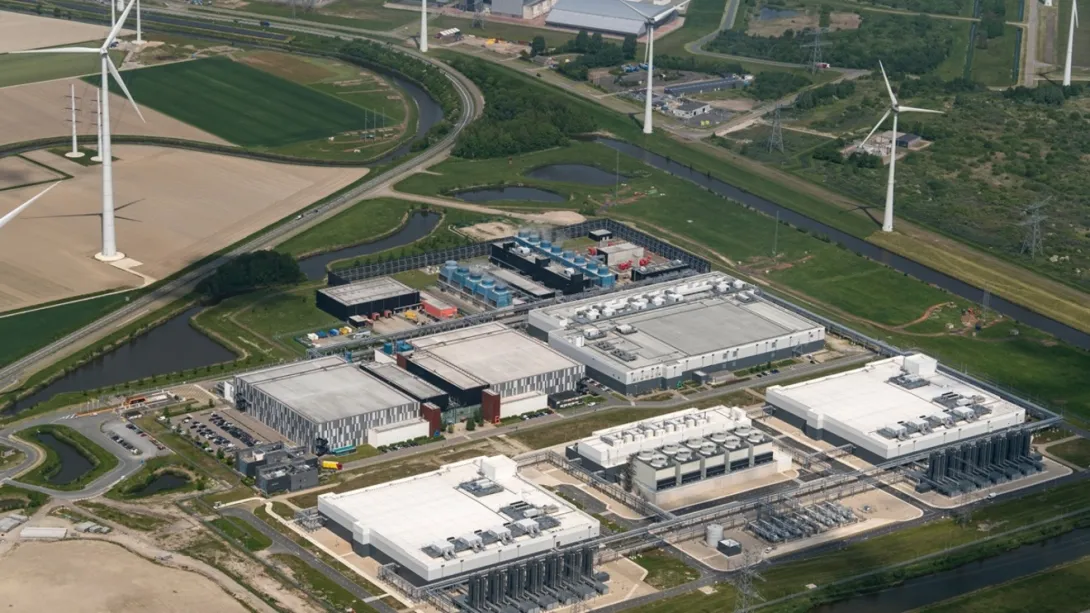
© Shutterstock/Aerovista Luchtfotografie | A data centre in Groningen, the Kingdom of the Netherlands.
Geopolitics and new technologies drive concentration, leaving many developing economies behind.
Artificial intelligence and other strategic technologies are reshaping global investment, concentrating capital in fewer sectors and fewer countries while raising the risk that many developing economies are left behind.
That warning framed the opening of UN Trade and Development’s (UNCTAD) 12th Multi-year Expert Meeting on Investment, Innovation and Entrepreneurship.
Rapid growth in AI and digital infrastructure investment is now intertwined with industrial policy and national security priorities, influencing where companies invest and how global production is organized.
Against this backdrop, global investment is becoming more volatile and harder to predict.
Foreign direct investment (FDI) flows fell by 11% in 2024 before rebounding by 5% in 2025, reflecting the impact of geopolitical tensions and economic uncertainty. But beyond short-term swings, deeper structural shifts are becoming clearer.
“Investment is a bet on the future, but that bet is becoming harder to make – and more uneven in its outcomes,” said Pedro Manuel Moreno, Acting Secretary General of UNCTAD.
Investment concentrates in strategic sectors – and a few countries
Capital is increasingly clustering in a narrow set of industries – notably artificial intelligence, clean energy, semiconductors and critical minerals – where competition, policy incentives and security concerns are strongest.
At the same time, investment is becoming more geographically concentrated. Around 75% of FDI to developing economies now flows to just ten countries (including large economies such as China, Brazil, Mexico, Indonesia and India), leaving most developing countries – and nearly all least developed countries – struggling to attract capital.
For many economies, the implications are immediate. FDI remains a key source of finance, jobs, technology transfer and integration into global value chains. When investment slows, concentrates or shifts elsewhere, development opportunities are lost.
A more fragmented investment landscape
Geopolitical tensions, strategic competition and supply chain restructuring are redrawing the global investment map. Firms are increasingly directing capital toward geopolitically aligned and regionally integrated markets, while governments rely more on industrial policies and screening mechanisms to manage risk.
For countries well integrated into regional networks, these shifts may open new opportunities. For others, the risk is growing that they will be left further behind.
Despite the challenges, some positive signals remain. Sustainable finance continues to expand, South–South investment is rising, and reform efforts are underway across developing economies.
Still, the broader trend is clear: global investment is becoming more selective, more political and more unequal.
Turning AI-driven investment into development gains
Discussions focused on how countries can respond, including how to compete in strategic sectors such as AI with limited fiscal space, strengthen domestic ecosystems and ensure that new investment flows translate into lasting development gains.
UNCTAD’s policy frameworks, entrepreneurship programmes and upcoming World Investment Forum being held in Doha, from 25 to 27 October 2026, aim to support countries in navigating these shifts and shaping a more inclusive global investment landscape.
RELATED NEWS