© Shutterstock/Gorodenkoff
A look inside one advanced AI server reveals who captures the value created in making it.
Before an AI model answers its first question, the components powering it have already travelled a long way.
Copper comes from mines in Chile, Peru or other countries. Chips are made in the Republic of Korea and Taiwan Province of China. Assembly plants in Malaysia and Mexico help turn the components into a working machine.
Many economies help build the AI server, but one company captures most of the profit.
That concentration matters as demand for AI hardware grows. In 2025, technology and AI-enabling goods, including chips and servers, accounted for about one sixth of global goods trade and 42% of its growth in value, according to World Trade Organization data. For economies seeking better-paid jobs, the benefits depend on how much value their firms capture from this expanding industry.
Where the money goes
UN Trade and Development (UNCTAD) examined the NVIDIA GB200 NVL72, an advanced server rack used in data centres – essentially a cabinet of connected computers that work together to run AI.
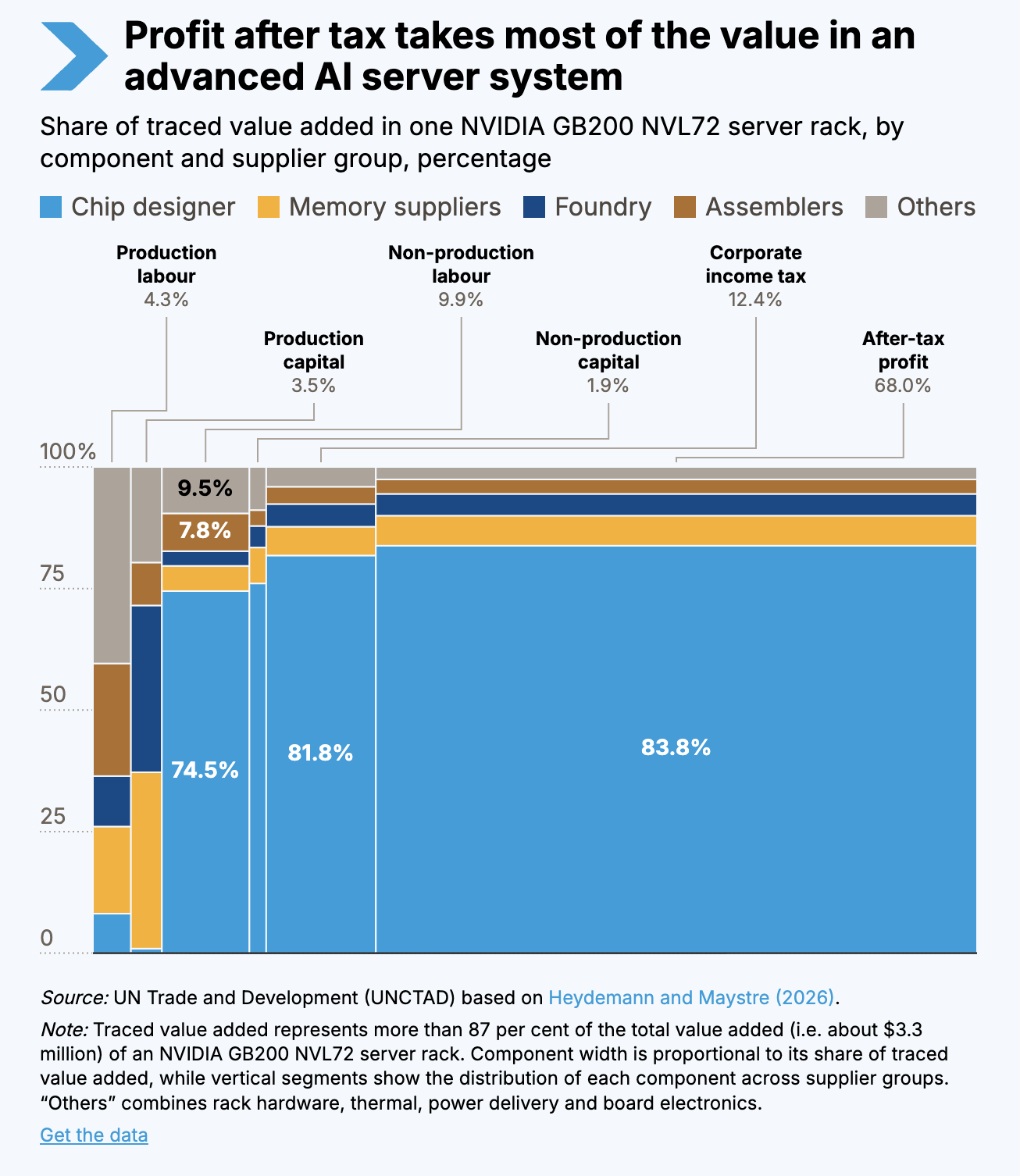
Of the value added in making it that the researchers could trace, 68% was profit left after operating costs and corporate income taxes. Most of that profit goes to NVIDIA, which designs the chips and outsources manufacturing to other firms.
The graph shows where the added value is created from production to profit and how much each group captures.
A role in production, but lower earnings
Building the advanced AI server rack creates work for businesses around the world. Suppliers provide memory, power equipment and cooling systems, while assembly takes place primarily in Taiwan Province of China, Mexico, the United States and Malaysia. But their earnings depend on the role they play.
For developing economies supplying mainly raw materials, the direct gains are small. Further analysis estimates that the silicon, copper and tin in the server rack together account for about 0.2% of its final selling price. Supplying these essential minerals doesn’t bring the same rewards as designing the chips. The AI boom can increase mineral exports without increasing suppliers’ share of the earnings.
Turning trade into better-paid work
Trade can help economies create better jobs and raise incomes. But the route from supplying raw materials to making advanced technology is becoming harder. Access increasingly depends on technology, finance and geopolitical relationships.
The Trade and Development Report 2026 argues that attracting investment should go hand in hand with developing local suppliers and the skills needed to take on more valuable work – although producing advanced AI components and products remains extremely challenging.
Joining the supply chain is a start. What firms do within it helps determine how much they earn.
About the study
The study examines one server rack worth about $3.3 million and allocates 87% of its total value added between six components: production and non-production labour, production and non-production capital, corporate income tax and after-tax profit. The percentages refer to that traced value – about $2.92 million – not the server rack’s selling price.
RELATED NEWS