Photo credit: Gemini/Yann Duval
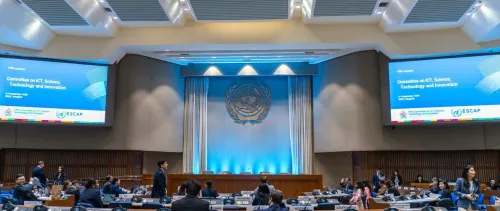
If AI agents begin orchestrating data flows across government agencies automatically, a provocative question emerges: what exactly is the single window for? This was raised during the Paperless Trade Week 2026 in Bangkok recently, where ESCAP and the World Bank also launched a new self-paced course on Single Window interoperability. For more than three decades, the single window has been the gold standard of trade modernization. Traders lodge data once through a single-entry point, a principle enshrined in UN/CEFACT Recommendation No. 33 and the WTO Trade Facilitation Agreement. What if the next stage of trade digitalization makes the single window disappear?
This is no longer theoretical. AI agents could extract data from commercial documents, prepare draft declarations, verify documentary consistency, identify missing certificates, query tariff and regulatory databases, and route submissions across agencies - all with minimal human intervention and without opening a portal. As ESCAP has recently argued, the question is no longer whether to use AI, but how to manage the shift from AI tools that analyse and recommend to AI agents that act and coordinate multi-step trade workflows autonomously - a shift with profound implications for how government systems are designed.
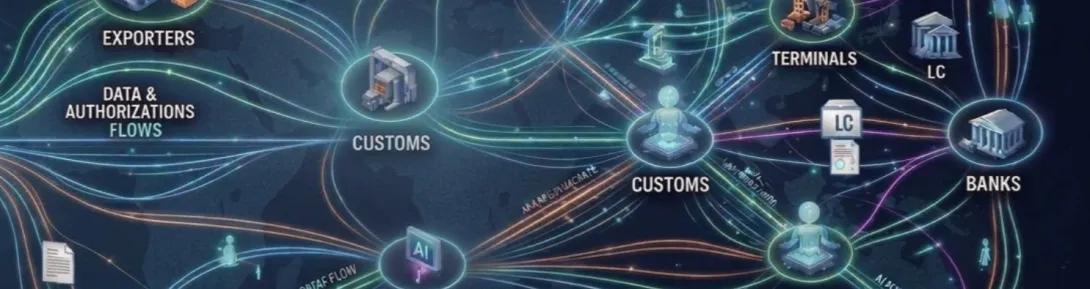
If this trajectory holds, the trader of the future may interact only with a logistics platform, an ERP system or an AI trade assistant that calls government systems directly through secure APIs. The portal may gradually disappear from the user’s experience, while the single window itself evolves into the trusted digital infrastructure that AI agents can interact with directly.
This is a shift from human workflows to agentic ones, and it is more consequential than it first appears. Human operators naturally compensate for weak processes and inconsistent information. AI agents inherit none of that tacit organizational context. To act autonomously and legally on an organization’s behalf, they need reliable inputs, clear semantics, consistent timing and trusted, machine-interpretable sources – not just data they can technically parse.
International organizations are converging on this vision, even if they have not yet said it out loud. The WCO's 2025 Smart Customs report on AI and machine learning addresses governance, interoperability, data protection and cybersecurity as foundational requirements for AI in customs - exactly what an invisible but trusted system backbone demands. The IMF's 2024 technical note on AI in tax and customs administration highlights that modern ICT alone does not guarantee performance: many administrations still struggle with manual procedures and underexploited data - the precise gap AI agents are designed to close. UN/CEFACT's Recommendation No. 37 on Single Submission Portals already envisioned regulatory information sourced directly from logistics systems. The rise of AI agents makes this vision - and the data pipeline concept - more realistic than ever before.
The Asia-Pacific Trade Facilitation Report 2026 confirms that AI adoption in trade facilitation remains below 15% across surveyed economies. Skills gaps, fragmented data systems and regulatory uncertainty remain significant barriers, while early movers are already building AI architectures that connect directly to source agency systems rather than relying on portals.
As adoption scales, though, relying on AI to repeatedly clean up avoidable integration friction becomes strategically wasteful. As AI moves from pilot to production, organizations will increasingly optimize AI token consumption and compute capacity. The highest-value use of AI is not making unnecessary translation more efficiently - it is eliminating the need for unnecessary translation altogether. Standards and structured data eliminate unnecessary translation by giving common meaning to events, parties and document fields before AI processes them. They allow intelligence to be spent on transformation rather than interpretation.
So, is the single window dead? No. But the single window as a centralized portal for manual document uploads is living on borrowed time. For mature single windows, the imperative is to pivot from submission portals to trusted, API-enabled orchestration platforms supporting AI agents across government and private sector ecosystems.
For countries still building single windows, the lesson is sharper still: do not digitize paper processes into brittle portals and isolated platforms. Build modular infrastructure for data exchange, identity, consent, risk, and cross-border interoperability from the start. And express rules, tariffs, licensing conditions and documentary requirements as structured, machine-interpretable knowledge, not scanned forms.
AI may ultimately make the single window disappear as a destination for traders. But the real assets were never the web portal. They are the institutional trust, governance, standardized data and regulatory intelligence that make automated decisions legally defensible. In the AI era, it is precisely these assets and the standards that encode them that make digital integration economically sensible and operationally reliable, giving AI agents the disciplined inputs they need to execute correctly. The new AI capabilities reveal what the single window should always have been: not a website, but the digital nervous system of trade facilitation.
RELATED NEWS