
UPU
As governments accelerate digital transformation, ensuring that everyone can benefit from digital services remains one of the defining challenges of the information society. Throughout the World Summit on the Information Society (WSIS) Forum 2026, held in Geneva from 6 to 10 July, the Universal Postal Union demonstrated how postal networks help bridge the digital divide by connecting people, governments and businesses through trusted public infrastructure. Across a series of sessions and high-level dialogues, the UPU emphasized the role of Posts in expanding access to e-government, digital financial services, e-commerce and connectivity, particularly for rural and underserved communities.
A central theme emerged during a UPU/United Nations Department of Economic and Social Affairs session on inclusive e-government, where speakers stressed that governments must look beyond online platforms alone if they are to reach the 2.2 billion people who remain offline, and the many others who are not meaningfully connected. Instead, digital services should be delivered through multiple channels that combine technology with trusted local infrastructure.
Kevin Hernandez, digital inclusion expert at the UPU, described multi-channel service delivery as an emerging best practice for inclusive digital government.
"People's ability to participate in society is increasingly mediated by digital technology, leaving those who are not meaningfully connected at risk of being left behind," he said. "Governments and development actors need to embrace a multi-channel approach to help ensure that nobody is left behind."
With more than 650,000 post offices worldwide, postal operators provide governments with trusted infrastructure, staff and payment systems that can support digitally enabled public services. Hernandez noted that more than half of postal operators across 153 economies already provide e-government services while calling for greater investment, improved connectivity and enabling regulation to unlock the sector's full potential.
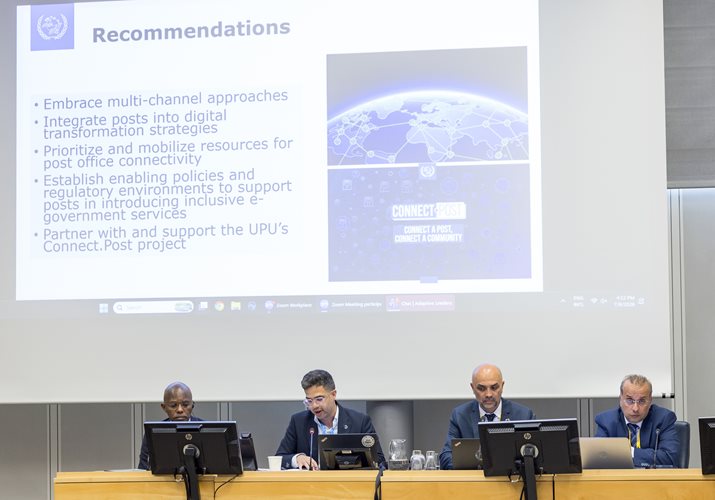
Country experiences presented this approach in practice. Egypt has integrated thousands of post offices into its Digital Egypt platform, while Kenya's Huduma one-stop service centres – half of which are co-located at post offices – allow citizens to access digital government services with support from trained staff.
"Inclusion is not a side effect of digital transformation. It is a design choice," said Dennis Chepkwony, Director at the Universal Service Fund, Communications Authority of Kenya. "Inclusive e-government does not mean forcing every citizen online. It means using digital infrastructure to power diverse, accessible channels that meet citizens where they are."
The importance of trusted public access institutions was reinforced during another UPU co-organized session with UNESCO and the International Federation of Library Associations and Institutions, which examined how post offices and libraries can accelerate digital equity. Drawing on new research, speakers showed that universal service and access funds are already supporting connectivity, digital literacy and public services through these community anchor institutions. The UPU highlighted examples from Zimbabwe, Mauritius and Botswana, while participants called for stronger evidence, sustainable funding and closer cooperation to maximize their impact.
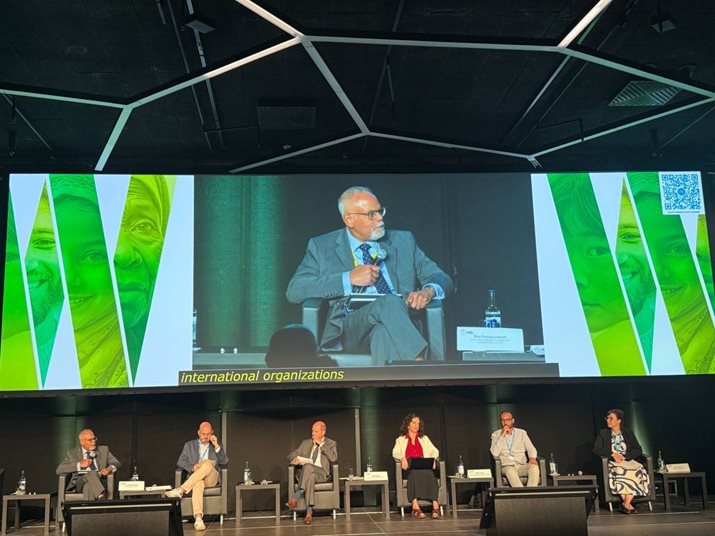
The role of postal networks in supporting inclusive, sustainable development was also featured during the WSIS Smart City Leaders’ Talk High-Level Dialogue, where Siva Somasundram, UPU Director of Policy, Regulation and Markets, demonstrated how existing postal infrastructure can help local governments advance both digital and green transitions. Drawing on examples ranging from support for small businesses and expanded e-government services to environmental monitoring using postal vehicles, Somasundram illustrated how postal networks are translating global policy into practical local action.
"The global standards and all the work that we do as international organizations need to be, above all, useful to local people and bring them real benefits," he said.
The UPU's message also resonated during the WSIS UN High-Level Leaders’ Dialogue on Leadership for inclusive, trusted, sustainable digital transformation, where the UPU Director General Masahiko Metoki joined international leaders to discuss the future of digital cooperation. Emphasizing that stronger connectivity across the global postal network can provide a gateway for communities everywhere to benefit from e-commerce, e-government and digital financial services, he welcomed the recognition of Posts as anchor institutions that promote digital inclusion in the WSIS+20 outcome document. “The UPU will continue to work with partners to connect post offices, expand digital services, and help ensure that no one is left behind,” Metoki said.
Together, the discussions reinforced the message that achieving inclusive digital transformation is not only about developing new technologies but also about making better use of trusted institutions that already serve communities. Across the forum, the UPU demonstrated how postal networks are becoming strategic partners for governments by expanding access to public services, strengthening digital inclusion, and helping ensure that no community is left behind.