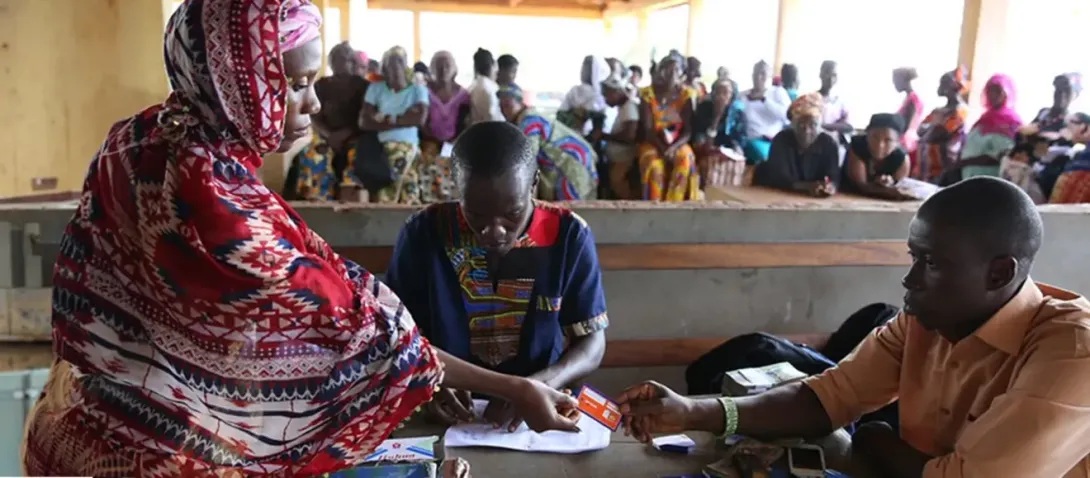
Woman presenting her ID and receiving cash transfer payments. Credit: Dominic Chavez/World Bank.
“Sir, yu get yu ID kad?” (Sir, do you have your ID card?) is a question more Sierra Leoneans hear when opening a bank account, reflecting a growing effort to bring more people into the digital ID system over the last decade. With digital transformation high on the national agenda, 6.4 million people now have a national ID number, with an aim for universal ID coverage of all 8.8 million citizens.
However, ID card uptake remains low, with less than half a million cards issued as of 2024. For most Sierra Leoneans living on less than $2.15 a day, the $6–$7 fee keeps ID cards out of reach. About 8 in 10 people now have an ID number, but with low literacy and without a card, its use remains limited.
The lack of data protection framework and siloed systems undermine safe ID use, blocking access to key services such as digital payments, education, health, and social protection—critical pathways to jobs and opportunity.
Building blocks and what has been achieved so far
Digital ID is a vital building block of digital transformation, but on its own it can’t unlock its full potential. Its value lies in a broader Digital Public Infrastructure—the systems that make digital services work together: digital ID, digital payments, and data sharing. Sierra Leone is still in the early stages, focusing on digital ID and interoperable payment systems.
Progress is underway: legal frameworks are strengthening, civil registration integrating with the national ID, and an open-source biometric platform piloted. Earlier this year, World Bank teams, government, and private sector partners came together to discuss how digital ID and interoperable payments can power everyday services.
Robust, widely used, and connected ID systems deliver services more effectively and multiply benefits. From real-time payments to access in education, health, finance, and social protection, digital rails deliver the greatest impact when directly linked to services.
Results are encouraging. Slowly but surely, the country’s flagship social assistance program is shifting transfers to digital payments. During a recent emergency cash transfer, 35,000 households received payments through mobile phone—a nation’s first and major milestone. These programs help bring more families into the financial system—expanding account access, helping them build transaction histories, and connecting them to Sierra Leone’s growing digital economy.
Agriculture may see the biggest gains. In a country where most people farm, linking IDs is connecting farmers to subsidies, credit, markets, and mobile money—strengthening livelihoods and incomes. As an example, development of a digital farmer registry is being planned to deliver targeted support through integration with the national ID system.
Momentum is growing in the private sector alike, led by telecom and banking. Mobile operators and banks are now connecting their systems to the national ID expanding access and improving services. The new instant payments switch is accelerating financial inclusion enabling interoperable digital payments between mobile money providers and banks—helping people access loans, start businesses, and find jobs. The World Bank and IFC are supporting this progress through modern credit and collateral registries.
Key lessons and gaps to overcome
Digital ID shows promise for public services, but gaps remain. Systems handling sensitive data—such as child protection and gender-based violence—are not yet linked to the national ID and still rely on paper-based processes. Valuable government data also goes underused without connected systems.
Key lessons from Sierra Leone’s ID journey show what other countries can learn:
- Interoperability matters—systems must connect to deliver value.
- Trust needs protection—data protection and security are essential.
- Barriers must fall—cost, distance, and poor connectivity can be eased through social protection programs.
- Impact drives adoption—people turn to digital ID when it makes life easier.
Looking ahead
Sierra Leone’s ambition to scale digital ID under the Big 5 Game Changers is bold yet achievable. Moving forward, key priorities include:
- Strengthen governance to enhance institutional coordination and build a secure, trusted ID system.
- Invest in universal access through mass registration drives, mobile outreach, and affordable ID pricing models.
- Build robust civil registration and ID systems with the capacity to scale.
- Expand a whole-of-government approach with shared standards, digital verification use cases, and tiered authentication.
- Scale private sector ID use cases, such as digital payments through the instant payments switch
Public awareness is critical, especially for reaching marginalized groups. The government is well positioned to lead by aligning priorities, fostering collaboration across sectors and building trust.
As Sierra Leone strengthens its digital public infrastructure, continued investment in energy and digital connectivity will be crucial. Building on the Bank’s support for solar home systems in 500 schools and 200 health facilities, expanding access to electricity and the internet can unlock digital services for more people and communities.
*****
RELATED:
- FEATURE STORY: Sierra Leone Taps Fast Payment Systems to Promote Fast Progress with Financial Inclusion
- PRESS RELEASE: More than 270,000 Sierra Leoneans to Get Better Access to Electricity
- PRESS RELEASE: World Bank Adds Funding to the Regional Off-Grid Electricity Access Project to Promote Solar Products in Western and Central Africa