
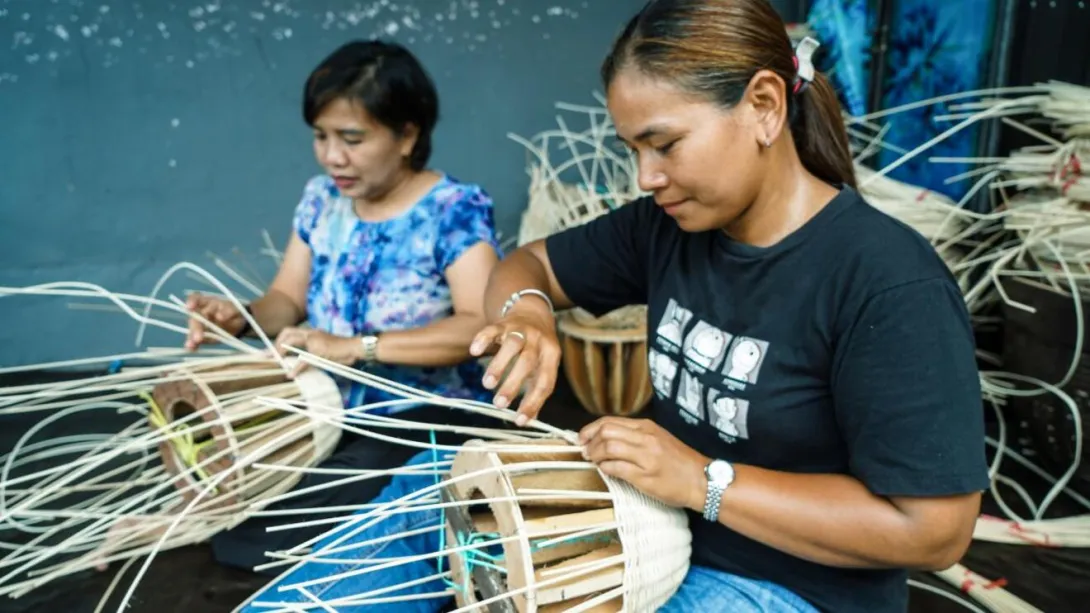
Caption: Women artisans from a rattan MSME in Central Kalimantan, Indonesia, weave handcrafted rattan products destined for international markets.
Photo: © UNIC/Dedy Maryanto
Indonesia’s digital economy is expanding rapidly, but stronger coordination across government agencies, greater digital adoption by micro, small, and medium-sized enterprises (MSMEs), and simpler business registration processes are needed to turn that growth into sustainable global competitiveness, according to a new assessment by UN Trade and Development (UNCTAD).
The Indonesia eTrade Readiness Assessment, launched last month in Jakarta, is the first conducted by UNCTAD in a G20 country. It provides a comprehensive review of Indonesia’s e-commerce and digital trade ecosystem at a critical moment for the country’s growth trajectory, while formulating recommendations for the government.
“Indonesia’s digital economy is growing at a remarkable pace. This creates many opportunities, but it also brings responsibilities. Digital trade must support sustainable growth, strengthen social inclusion, and protect the environment,” said UNCTAD Deputy Secretary-General, Pedro Manuel Moreno.
Big gains, gap remains
Many of the country’s achievements have been driven by multiple factors: broadband access and mobile connectivity have expanded; digital payments have surged, driven by the rapid rollout of a QR code-based national payment system, which now supports more than 30 million merchants. In 2020, by contrast, only 7 million MSMEs were engaged in the digital economy.
At the same time, progress has not been even.
The report finds persistent gaps between central Indonesia and outer islands, where reliable and affordable internet access remains a challenge. Institutional mandates across government ministries sometimes overlap, making policymaking complex. And although financial inclusion among small businesses has climbed to nearly 89 per cent, many users do not actively use their accounts.
MSMEs: Opportunities and challenges
“The impact has been enormous for MSMEs,” said Devi Ariyani, Executive Director of the Indonesia Services Dialogue Council, describing the influence of marketplaces, social media, and digital payments. “From the perspective of market expansion, they are able to grow their customer base and reach customers beyond their geographical boundaries.”
Digital platforms have also changed how businesses operate internally. “With the presence of marketplaces, they learn how to record their transactions digitally. Previously, they recorded transactions manually. Now, through digital platforms, they are able to keep digital records,” she explained.
But significant barriers remain.
Limited digital skills and know-how are among the key challenges MSMEs face, according to UNCTAD National Consultant, Dandy Rafitrandi. “Many MSMEs still lack basic and intermediate capabilities,” he said.
He also pointed to fragmented training and support, noting that existing programmes are often not sufficiently tailored to women entrepreneurs and rural businesses.
For micro enterprises, the gaps are even more fundamental. “Their business, financial, and digital literacy is still low,” Ariyani said. “These businesses require intensive coaching and mentoring to operate effectively and compete in digital markets.”
Medium-sized firms face different challenges. According to Ariyani, they need two things to grow. First is access to markets outside Indonesia and second is access to financing schemes. Exporting requires meeting compliance standards and navigating new regulations, which often call for additional guidance and financial support.
Priorities for action
The assessment sets out a broad set of policy recommendations. Martine Julsaint Kidane, Economic Affairs Officer at UNCTAD, points to several priorities:
“Streamline and clearly communicate institutional mandates. Reducing overlaps between ministries and creating a coherent regulatory framework will make digital policies more efficient and predictable.”
She also called for accelerating the digital transformation of traditional MSMEs. “Support adoption of tools like cloud software, Enterprise Resource Planning (ERP) systems, and Internet of Things (IoT) through outreach and voucher programmes,” adding that this is particularly key for MSMEs in manufacturing, agriculture, and retail.
Furthermore, Indonesia should “encourage the formalization of online businesses by simplifying registration and tax processes and offering incentives for newly formalized MSMEs.”
These measures would help create “the enabling environment Indonesia needs for sustainable digital trade,” she added.
Indonesia’s commitment to inclusive growth
The Indonesian government committed to use the assessment as a strategic tool for the next phase of digital transformation.
“The findings of this assessment will help guide Indonesia’s efforts to strengthen its e-commerce and digital trade ecosystem and foster greater alignment, so that Indonesia’s digital economy grows not only faster, but also fairer, safer, and more resilient,” said Ditya Agung Nurdianto, Director of International Trade at the Ministry of Foreign Affairs of the Republic of Indonesia.
“Through close collaboration and coordinated action with UNCTAD and national stakeholders, Indonesia is committed to advancing a digital economy that is inclusive, sustainable, and resilient,” he added.
The assessment was developed through extensive consultations across Indonesia, involving government institutions, the private sector, civil society, and development partners.
“I encourage all partners to use the findings of this assessment as a call for coordinated action,” said Moreno. “UNCTAD stands ready to support Indonesia through follow-up activities, policy dialogue, capacity-building, and partnerships.”