

The Tajik proverb “A candle does not lose its light by lighting another” reflects a deeper economic truth: growth is not a zero-sum game. When access to skills, information, and employment is broadened, new capacity is created in the labor market benefiting both workers and firms. In Tajikistan, this logic applies most clearly to women, whose participation in the labor market remains limited even as demand for skilled workers continues to grow.
At least formally, only about 32% of women in Tajikistan, who face both mobility and structural gender-based challenges, participate in the labor force. At the same time, domestic businesses are struggling to find the right workers for high growth IT-enabled sectors such as e-commerce.
Assessments made during the World Bank Group led Elevate Global Access Through E-Commerce (E-GATE) program launched in 2023 also found that Central Asia’s digital economy cannot grow without active women’s labor participation. Providing Access and Resources for Women’s Online Networking & Advancement (PARWONA, a butterfly in Farsi) was established in 2025 with funding from the Umbrella Facility for Gender Equality (UFGE) to help bridge the gap between women’s untapped economic potential and market demands.
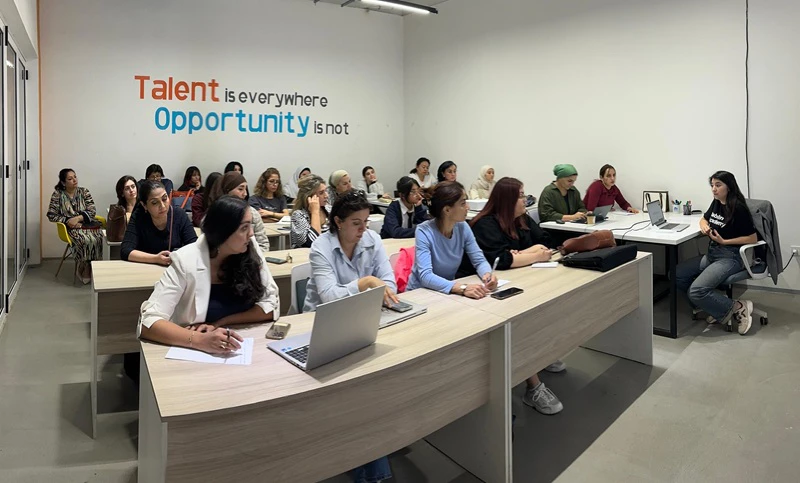
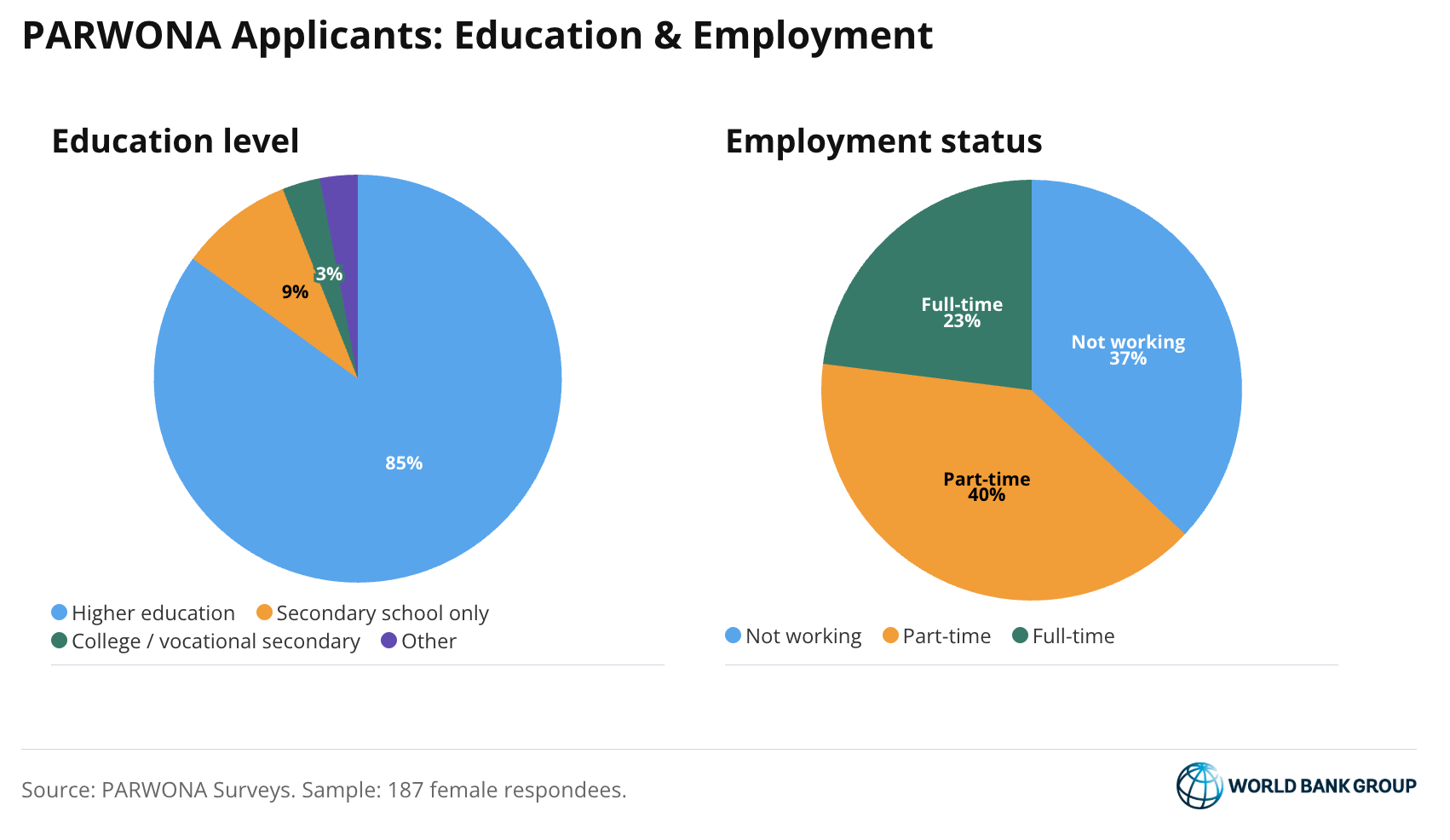
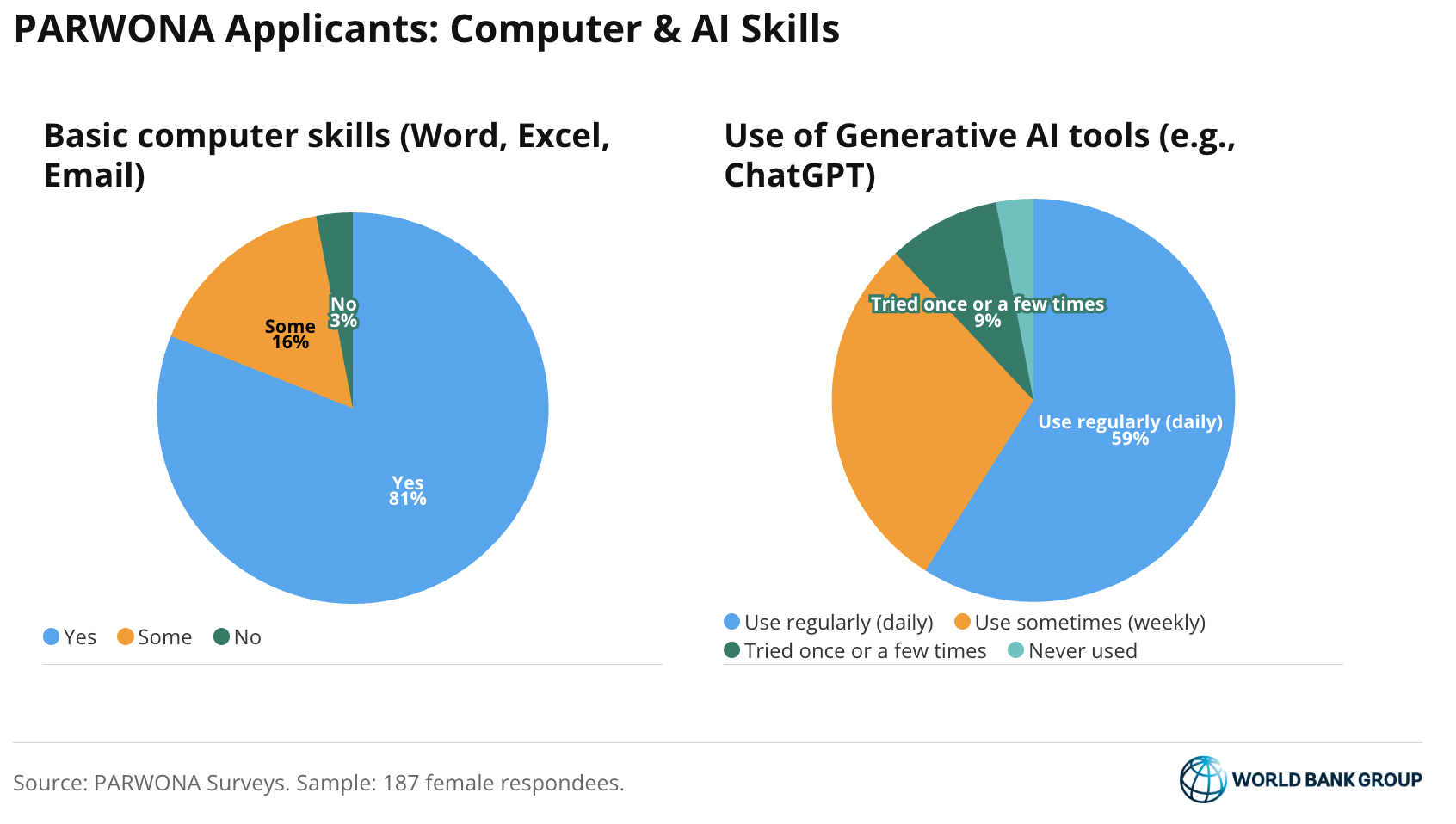
PARWONA aims to train women for e-commerce manager roles at Tajik firms selling goods online both domestically and globally. When the program launched an open call, it was unclear how many women would apply. In just two weeks, nearly 200 applications came in, with many that already showed strong potential. 9 out of 10 applicants reported at least basic computer skills and nearly everyone already used social media for chatting and even sales. But only 1 in 4 were formally employed with, most working part-time, informally, or unemployed. Notably, 90% of the women who were eventually chosen used AI tools daily.
After a tough selection process, where demand and anticipation were high from both applicants and firms, an initial cohort of 50 women and 50 enterprises were selected from across the country, including from the cities of Bokhtar and Khorog. After each participant was matched with a firm, from day one, they helped create and manage actual accounts on local and international marketplaces such as LakLak, Alif Shop, Avval, and Alibaba.com as e-commerce managers. The role allowed participants to learn and practice in-demand skills such as digital marketing, customer communication, marketplace operations, data analytics, AI usage, social-media, and logistics and payment systems coordination.
Just as important as technical skills are soft skills training which can be often overlooked in work training programs. Many participants expressed uncertainty about how to speak with employers, how to present themselves professionally, and how to negotiate expectations and timelines.
PARWONA integrates soft-skills training into the core curriculum and participants are empowered to take ownership of their work by making them active participants in the program while helping them navigate the workplace. They learn how to communicate with clients, write professional messages, manage time and expectations, and handle difficult conversations. For many Tajik women, while digital skills may help open the door to new opportunities, the soft skills allow them to walk through it.
Moving forward, the pilot tracks key outcomes, including additional online revenue generated by participating firms, the number of women who transition into paid roles with the businesses they support, retention in e-commerce after the pilot concludes, and the number of new jobs created. Early results include: over 30 practical training, over 15 new online shops opened on Tajik marketplaces, 90% of women formalized work with local firms, first online sales and first project expansion.
Achieving this at scale requires continued coordinated action, led by the World Bank Group, particularly with IBRD and IFC working closely with Tajik regulators, business associations, private-sector employers, and development partners, including UNDP, UN Women, Women in Tech Global, and local and international e-commerce marketplaces, to translate training into jobs.
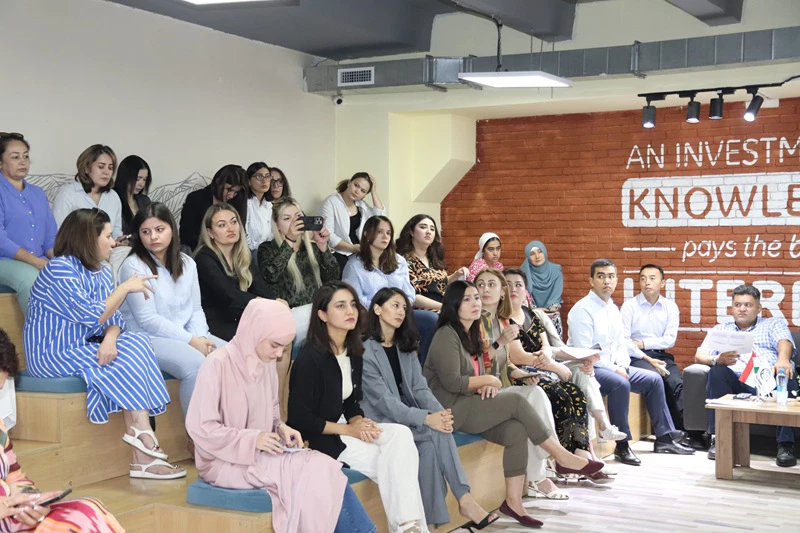
Although still early, PARWONA has emerged as a practical catalyst for jobs and economic empowerment. What began as a small UFGE-funded pilot is already attracting interest from firms and partners, demonstrating a scalable and flexible model that can work in both remote rural areas as well as urban center contexts. The early lessons learned from this project now underpin the basis for scalability through the anchor World Bank Digital Foundations Tajikistan project, which continues to integrate women’s digital skills with e-commerce and IT sector demands into the country’s wider job creation agenda to give employment opportunities to much more Tajik women.
PARWONA shows that investing in women’s digital skills help build new jobs, stronger firms, and more inclusive economic growth in Tajikistan.
Previous e-commerce blogs by the team:
Ending poverty through E-Commerce in Kyrgyzstan, Tajikistan and Uzbekistan?