The challenge ahead is to ensure that women not only receive payments but also make payments and save to build financial resilience. | © Shutterstock.com
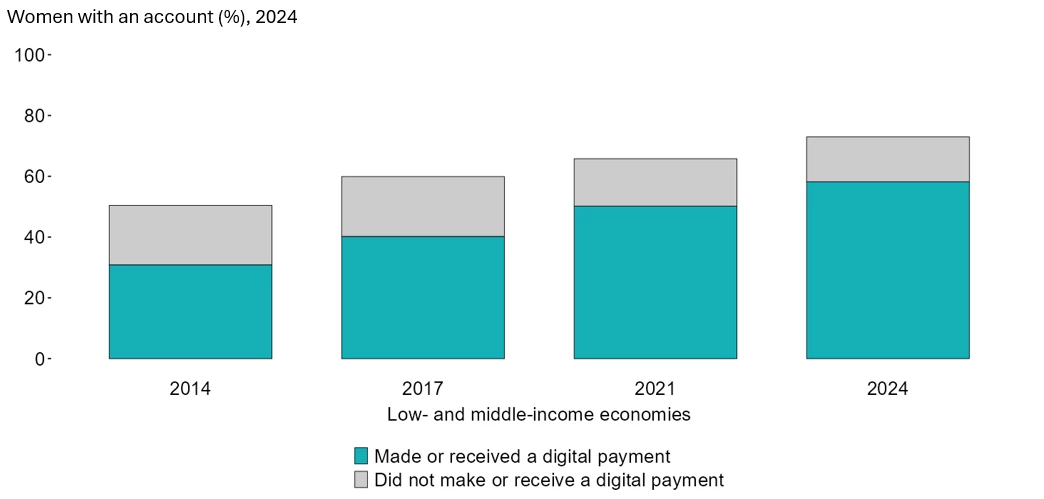
The Global Findex 2025 shows the remarkable financial inclusion strides women have made over the past ten years. Across low- and middle-income countries (LMICs), 73% now have accounts, and the gap between women’s and men’s account ownership is just 5 percentage points—less than half what it was a decade ago. Yet millions of women still lack access to safe, affordable accounts—the essential starting point for building financial wellbeing.
This International Women’s Day, we explored the role digital payments have played in motivating women to open accounts, and what further opportunities exist to accelerate that momentum.
Payments as a Catalyst for Account Ownership
In 2024, 58% of all women (80% of account owners), made or received a digital payment, nearly twice the share from just ten years earlier. Payments are the most widely used financial service, and they are often what prompts women to open accounts in the first place: half of all women account holders opened their first account to receive a wage or a government payment.
Figure: 43% of all women and 59% of account holders opened their first account to receive a payment
Digital government-to-person (G2P) payments are particularly powerful drivers of account ownership. As of 2024, three quarters of the women in LMICs who receive G2P payments were paid into an account. But the impact depends heavily on how digitalization is implemented. Uzbekistan and Iraq offer two distinct examples.
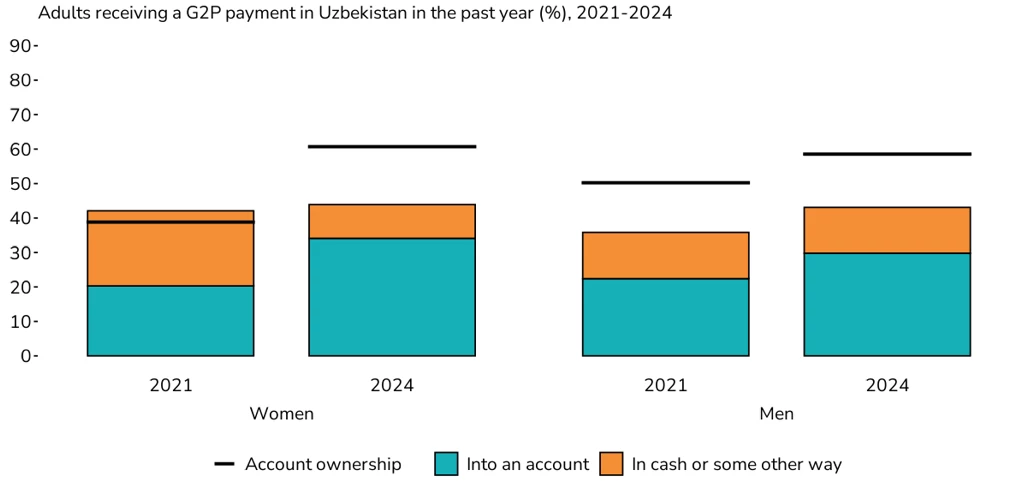
In Uzbekistan, the share of women receiving G2P payments into an account increased by 14 percentage points between 2021 and 2024, from 20% to 34%. Over the same period, women’s account ownership increased by 22 percentage points, from 39% to 61%. Men also saw gains, but smaller ones, meaning that women closed the gap. Targeted efforts using G2P payments likely played a role, given that women were also 10 percentage points more likely than men to say they opened their first account to receive a payment.
Figure: Account ownership for women in Uzbekistan increased in parallel to increases in G2P payment digitalization
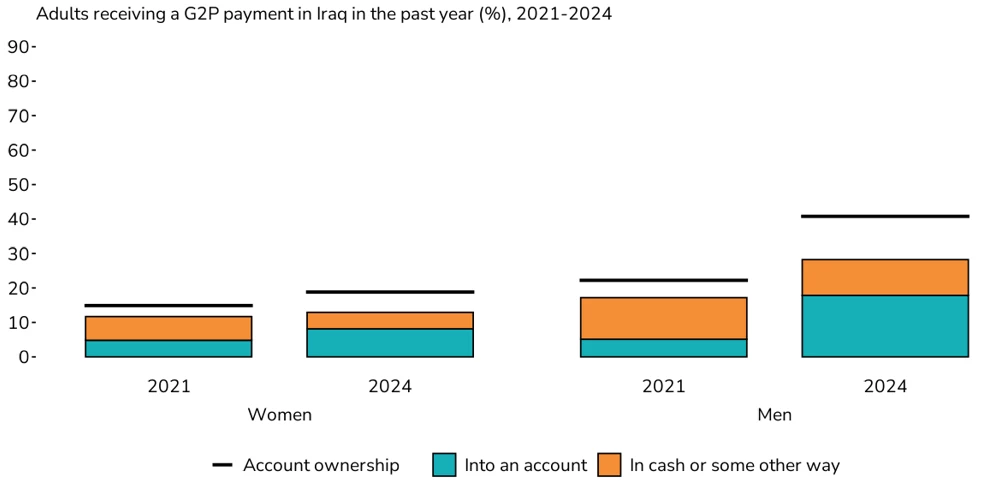
Data from Iraq tells a similar story, but in reverse. Between 2021 and 2024, overall account ownership grew by 12 percentage points, from 19% to 30% of all adults, and digital G2P payments also increased over that time by 8 percentage points - driven almost entirely by increases in pension payments. Yet women were largely left out of this growth. Their account ownership increased by just 4 percentage points, while men's grew by 19 points, from 22% to 41%. This divergence highlights how the benefits of payment digitalization can accrue unevenly when gender barriers are not explicitly addressed.
Figure: Account ownership for men in Iraq has grown, helped by G2P payment digitalization
Using payments to encourage broader use of accounts
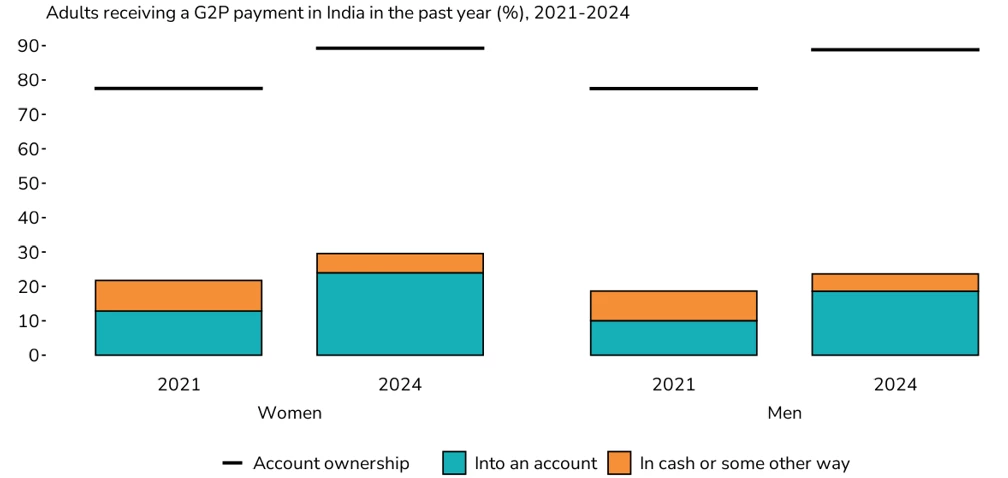
Beyond motivating account ownership, digital payments can encourage more active account use. In India in 2021, a third of all women had inactive accounts. By 2024, only 18% did. That shift coincided with a rise in women receiving digital G2P payments, from 13% to 24%, with four out of five G2P recipients receiving funds directly into an account.
India’s efforts to digitalize G2P payments built on previous government-led efforts to expand financial access, particularly through the Pradhan Mantri Jan Dhan Yojana (PMJDY), which enabled millions of women to open accounts with no minimum balance or maintenance charges. As G2P payments have increasingly been routed into these accounts, women have gained more experience using them—a case of government policy helping transition access into active usage.
Figure: In India, the share of women and men with only inactive accounts decreased between 2021 and 2024
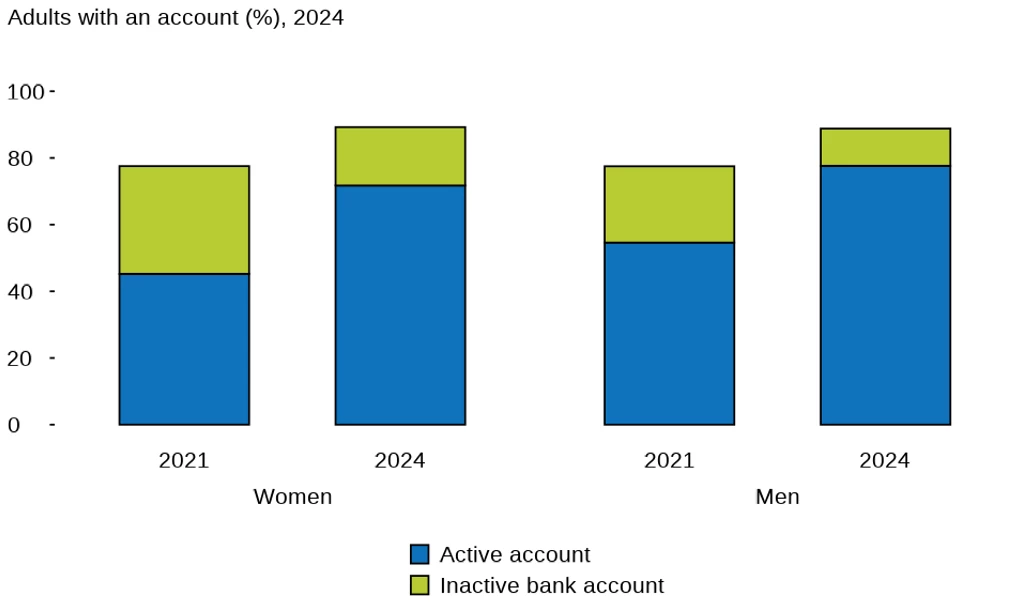
Figure: The share of women and men receiving digital G2P Payments has increased in India
Expanding payment digitalization
Receiving a digital payment is just a first step. To multiply the benefits of having an account, women need opportunities to also make digital payments, formally save, and even access credit.
Across LMICs, women who receive digital G2P or wage payments are 7 percentage points more likely than men to withdraw their full balance upon receipt. There may be multiple reasons why they do that, but one may be a preference for cash in the broader ecosystem where people live and spend money. Global Findex 2025 data finds that the most common reason why people with accounts do not make digital merchant payments is a habit. That suggests that women need incentives and encouragement to keep money in their accounts, where it is safer from loss or theft, and easier to earmark for savings.
The central insight from this data is straightforward: digital payments work best as an entry point, not a destination. The challenge ahead is to build on this progress and ensure that women not only receive payments but also make payments and save to build financial resilience. Such change requires gender-intentional approaches to KYC requirements, account design, and digital literacy. Governments and private-sector employers should prioritize digitalizing payments, as financial institutions make digital channels simple and intuitive to navigate.
Digital payments are not an end in themselves, but when designed intentionally, they can help women participate fully and equally in the financial system.