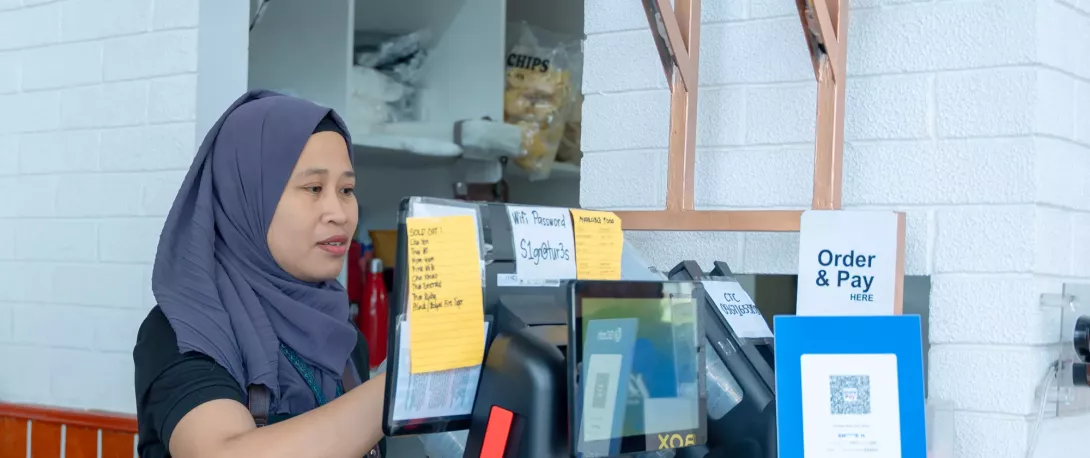
In the Philippines, the ILO and its partners are advancing the rollout of a new mobile phone-based financial education model for micro, small and medium-sized enterprises (MSMEs), particularly first-time borrowers using digital financial services.
MANILA (ILO News) — The International Labour Organization (ILO) through the United Nations Joint Programme on Inclusive, Competitive and Responsible Digital Philippines (Digital PINAS) convened government agencies, financial institutions, business groups and development partners to validate a new mobile phone-based financial education model for micro, small and medium-sized enterprises (MSMEs) with focus on the first-time borrowers. A new mobile learning model delivers short, guided financial lessons to entrepreneurs’ phones - at the moment borrowing and payment decisions are actually being made.
The hybrid stakeholder review on 24 March 2026 brought together representatives from the Bangko Sentral ng Pilipinas (BSP), the Department of Trade and Industry (DTI), the Department of Information and Communications Technology (DICT), the National Wages and Productivity Commission (NWPC) and the Bureau of Workers with Special Concerns (BWSC) of the Department of Labor and Employment (DOLE), the Employers Confederation of the Philippines (ECOP), local government units, financial institutions, farmers’ federations, and development partners.
Why a new approach to financial education
The initiative responds to the rapid expansion of digital financial services in the Philippines alongside persistent gaps in financial literacy and increasing exposure to online fraud and over-indebtedness.
Digital financial services in the Philippines have surged ahead of financial literacy. Cashless retail transactions reached 57.4 per cent in 2024, while digital lending application users have grown to nearly 68 million nationwide. The Philippines now records the second-highest digital fraud rate globally based on industry data.
What is being built
During the session, the ILO presented a mobile-first financial education model that delivers short learning modules via Facebook Messenger and Viber. The platform pairs ILO’s Global Financial Education content, already localized for the Philippines[1] into short and practical mobile phone-based learning sessions for MSMEs, including informal entrepreneurs and first-time borrowers.
Delivered through the popular chat apps such as Facebook Messenger or Viber, the mobile phone-based micro-learning system is operated by BOOST Technologies, which has previously deployed a similar model for digital financial training in Cambodia.
“The goal is not to add more seminars,” explained Hideki Kagohashi, Enterprise Development Specialist of the ILO Country Office for the Philippines. “It is to deliver short, practical guidance to the borrower’s own phone, at the moment financial decisions are actually being made. For example, at the point of loan disbursement.”
Modules form the core curriculum:
- Financial objectives: goal setting, prioritization, and savings planning translated into micro-decisions.
- Budget: simplified ranges and daily tracking habits, replacing full worksheet exercises.
- Fraud and cybercrime (New): spotting scams, the “PAUSE–BREATHE–ASK” response, and protecting devices.
- Credit: comparing lenders, understanding APR and repayment capacity, and preventing over-indebtedness.
- Means of payment: choosing the right payment method and using digital payments safely.
- Digital wage payments (New): responsible adoption of digital wages by employers and workers.
The two new modules respond to fast-changing financial education challenges in the Philippines. Module C promotes safer online behaviour and scam awareness, while Module F introduces responsible digital wage payments and their potential benefits for payroll efficiency, worker protection, compliance and access to formal financial services.
“Digital financial services are expanding faster than financial literacy,” Kagohashi added. “This initiative aims to make financial education more accessible, practical and responsive to the daily realities faced by entrepreneurs and their workers.”
Gustavo Prepelitchi, ILO Master Trainer on Financial Education, presented the technical approach behind the programme, moving from group discussion to guided decision-making, from abstract concepts to concrete micro-choices, and from one-off seminars to spaced, just-in-time reinforcement.
Angelique Ofrasio, National Project Officer of the ILO Global Centre on Digital Wages for Decent Work Project, introduced the new Digital Wage Payments module, while Rhyan Lagunday and Erica Suerte of BOOST Technologies demonstrated the live session on the chat interface.
During the roundtable discussion moderated by Katherine Brimon, ILO Programme Officer for Digital PINAS, stakeholders recommended expanding the modules beyond first-time borrowers, developing Bisaya/Cebuano versions alongside Taglish, strengthening insurance-related information for agriculture loans, and improving offline access through DICT-supported Tech4ED centres and free Wi-Fi sites.
Stakeholders also discussed engagement and retention, data privacy, and the changing role of trainers in digital learning. The ILO clarified that the chat platform-based micro-learning system is designed to support and not to replace face-to-face sessions.
Inputs from the consultation will help refine the modules ahead of a pilot rollout planned for the second half of 2026, in coordination with the BSP and selected financial institution partners.
[1] The localized financial education content was developed and delivered under the Bringing Back Jobs Safely project with support from the Government of Japan.