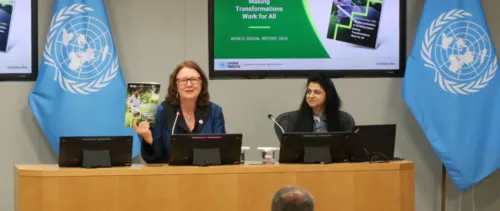
2 November 2026 - Today, we live in a world of extraordinary innovation, technological progress, and wealth. Yet millions of people remain excluded from decent work, quality education, healthcare, digital connectivity, and meaningful participation in society. Meanwhile, the wealthiest one per cent of the global population owns nearly half of the world’s wealth.
As countries navigate profound economic, digital and energy transformations, the challenge before us is clear: how do we turn those commitments into tangible outcomes for people everywhere? This is one of the defining challenges of our age, which is at the heart of UN DESA’s World Social Report 2026.
The report introduces a new Socially Inclusive Transformation (SIT) Dashboard, which measures progress in economic, digital, and energy transformations alongside social and economic equity across 168 countries over the past 25 years. Its findings show that countries with similar income levels and rates of transformation can achieve very different outcomes in terms of inclusion. This highlights the need to shift development priorities from a narrow focus on structural transformation to a broader vision of socially inclusive transformation.
The Report reminds us that transformation is inevitable, but exclusion is not. With the right policies and institutions, change can benefit everyone – and, crucially, enhance the quality and robustness of the transformations themselves. Placing social inclusion at the centre of transformation-related policies enables more people to learn, work, innovate, and contribute, while making economies stronger and more resilient. Social inclusion is not a welfare measure or a by-product of growth: it is an investment and a prerequisite for successful transformation.
In practice, this means expanding digital connectivity and energy access, strengthening education and skills development, ensuring social protection, and promoting institutions that ensure a fair distribution of growth. Focused international cooperation is also needed to ensure that the means to advance socially inclusive transformations are available across the world.