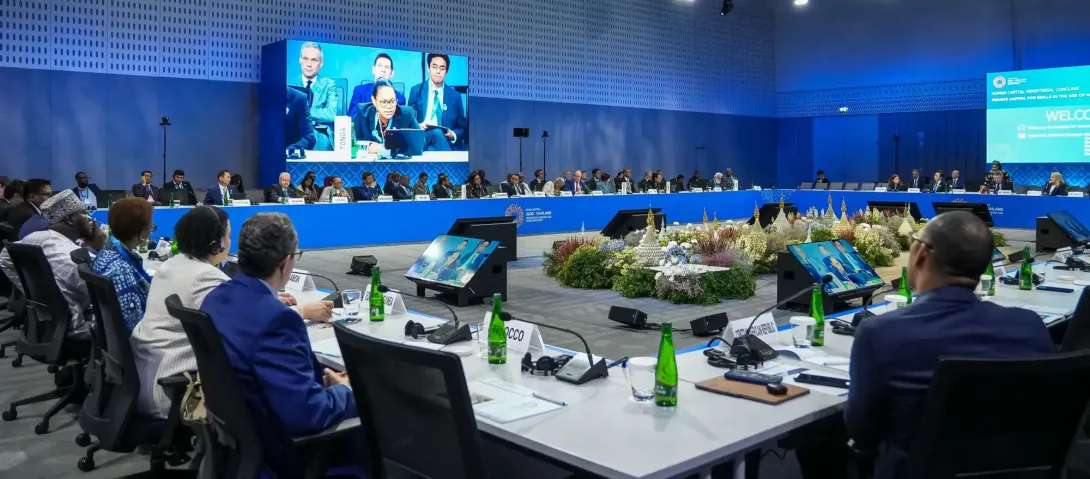
100+ economies share approaches to skills, jobs, and working with the private sector to advance human capital
Over the next decade, 1.2 billion young people in emerging economies will enter the workforce, many into jobs that AI is already reshaping. Yet nearly 7 in 10 children in low- and middle-income countries cannot read a simple text by age 10, leaving too many without the foundation needed to thrive.
The stakes are high. Whether people benefit from new technologies will depend on whether countries invest now in the health, education, and skills people need to use them.
That challenge shaped the 2026 Human Capital Ministerial Conclave, held during the World Bank Group and IMF Annual Meetings in Bangkok. Representatives from 42 Human Capital Project member countries joined development partners and private-sector experts to explore how AI can widen opportunities and how private investment and expertise can help equip people for jobs.
The case for acting is simple. Health, education, and skills are among the highest-return investments a government can make. Between one-third and two-thirds of the difference in income per person across countries comes down to human capital.
Human capital not only has an important role to play in realizing the potential of people, but it can make a vital contribution to economic development and to jobs.
Paschal Donohoe. World Bank Managing Director and Chief Knowledge Officer.

Foundational learning is critical
Speakers stressed that AI cannot replace the basics. A child who cannot read with understanding will struggle to make sense of what AI tells them. “AI is the technology. Learning is the outcome,” said Catherine Russell, Executive Director, UNICEF. AI can help teachers spot struggling students and reach children with disabilities. It cannot replace teachers.
Sandeep Aneja, Founder and Managing Partner, Kaizenvest, said young people also need to build what AI cannot replace: creativity, perseverance, and judgment.
What private capital can bring
“Governments and policymakers create markets. Private capital shapes the markets,” Sandeep Aneja said. Investors bring risk-taking and innovations that scale quickly, but they need clear frameworks from governments.
One commitment, different approaches
Sixteen government representatives described a shared commitment to investing in people, pursued through different combinations of public funding, private investment, incentives, and technology.
Approaches included wage subsidies that cover part of the cost of hiring young people, with many placements leading to longer-term contracts; national plans that set aside significant funding for education and skills and expect the private sector to finance a large share; and tax incentives that draw private investment into education.
Other countries are using AI and digital platforms to overcome distance and limited scale. Examples include using AI to bring quality teaching to every island in an archipelago, shared regional digital training platforms for small island states, national programs to train young people and civil servants in AI, and AI tutors and coaches being tested in secondary schools with World Bank Group support.
Countries also emphasized the enabling conditions for responsible AI adoption. Ministers shared that AI only helps if connectivity and digital infrastructure come first and if AI governance frameworks protect people without stifling innovation. People must be equipped to advance with advances in technology.
A growing network
The Conclave also marked a milestone: Botswana, Gabon, Kosovo, Mauritius, Thailand, and Zimbabwe joined the Human Capital Project this year. The network has grown from 28 member economies in 2018 to 102 today. Through data, dialogue, and country diagnostics, it helps ministries learn from approaches that work elsewhere and adapt them to local contexts.
The new members join the Human Capital Project with ambitions to advance human capital at home. Some are creating national bodies that bring government, industry, and education leaders together to align learning with labor-market needs. Others see a young population as an advantage only if young people finish school with the skills their economies need, stay healthy, and find good jobs at home.
The private sector as a partner in a changing world of work
Mamta Murthi, World Bank Group Vice President for People, closed the Conclave with a clear takeaway: the private sector is a key partner in financing skills and workforce development and in bringing innovation that improves the outcomes of public spending. She encouraged countries to continue learning from one another and to join the Conclave again in 2027.