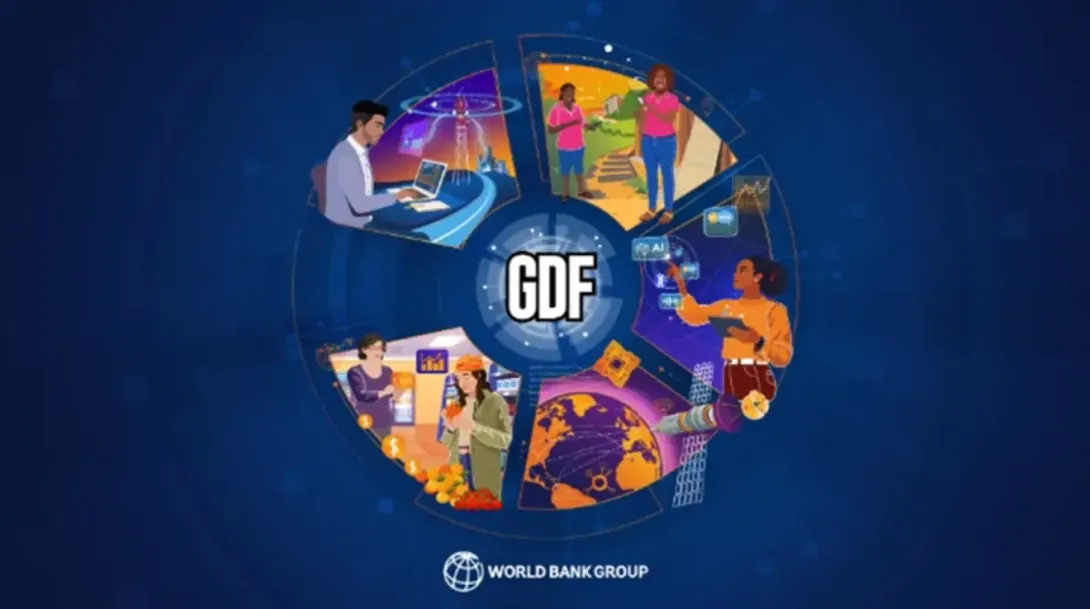
Since the launch of the Global Data Facility (GDF) in 2021, it has steadily grown into a powerful platform for collaboration, bringing together governments, development partners, and technical experts to deliver on a shared goal: ensuring that data works for people and the planet. The result is tangible, measurable progress. The GDF demonstrates that strategic investments in data can drive better policies, smarter decisions, and more inclusive development outcomes worldwide.
These results are borne out in detail in the recently published 2025 Annual Report of the Global Data Facility Trust Fund.
From vision to measurable impact
Throughout last year, the GDF advanced a wide range of initiatives across its global, country, and hybrid pillars. These efforts addressed some of the most persistent data challenges faced by countries, from fragmented statistical systems to gaps in emerging data sources, to unmet international standards for data and statistics. Through targeted support and innovation, the GDF helped modernize national data ecosystems and improve the availability, quality, and usability of data for decision-making. For example, thanks to the support of development partners’ contributions through the GDF:
- In Kazakhstan, mobile phone data revealed that domestic tourism was being dramatically undercounted - with one resort area showing 2.4 times more visitors than official figures - prompting a parliamentary decree requiring all mobile network operators to share data with the national statistics bureau starting in 2026.
- In Guinea-Bissau, a targeted World Bank/UNCTAD training mission helped the country’s debt management office reconcile years of external debt records, uncovering an additional $160 million in previously unreported public debt and reducing discrepancies with official records to less than 1 percent.
- In Pakistan, a GDF-funded diagnostic of the national data ecosystem catalyzed roughly $140 million in new World Bank federal and provincial investment operations focused on statistical modernization, while establishing a Data Evidence Lab to embed evidence generation into public policy.
- In the Pacific Islands, after more than a decade away, nearly 20 Pacific Island economies rejoined the International Comparison Program by adopting digital data collection tools, enabling the region to contribute to global purchasing power parity estimates that underpin poverty measurement and development policy worldwide.
Taken together, GDF-supported activities throughout 2025 helped to unlock and inform more than $1 billion in new World Bank investments, substantially amplifying the impact of every dollar contributed to the GDF. By strengthening data foundations, the GDF enabled countries and development partners to design better projects, prioritize investments more effectively, and scale solutions that respond to real-world needs.
Strengthening national data systems
At the heart of the GDF’s work is a commitment to strengthening national statistical systems. In 2025, this included modernizing household surveys, updating methodologies, and supporting countries in adopting new data collection tools. These efforts helped ensure that core social and economic indicators remain relevant, timely, and fit for purpose in a rapidly changing world, for example:
- In Tanzania, GDF-supported hands-on technical support for the 2024–2025 Integrated Household Budget Survey (including enumerator training, digital data collection tools, and real-time quality assurance) substantially strengthened the quality and timeliness of results, enabling the production of quarterly socioeconomic indicators for poverty measurement and national planning.
- In the Democratic Republic of Congo, GDF support enabled the National Institute of Statistics to complete a national statistical capacity assessment and begin extending the review to selected provinces, directly informing the design of a new IDA investment of up to $100 million anticipated for the 2027 lending pipeline.
- In Nigeria, a GDF-funded study tour to Germany for the National Bureau of Statistics and 12 state bureaus generated concrete action plans on GDP, consumer price index, and small area estimation, while broad consultations across government and academia built consensus around a national statistical modernization roadmap and initiated formal dialogue on future World Bank investment.
The GDF also supported countries in integrating non-traditional data sources, such as mobile phone data, into policy frameworks. By complementing traditional surveys with high-frequency, granular data, governments gained new insights into mobility patterns, service access, and economic activity, particularly in contexts where conventional data collection is costly or slow. This integration represents a critical step toward more responsive and adaptive policymaking. For example:
- In Rwanda, GDF support helped lay the institutional groundwork for integrating mobile phone data into Imibereho, Rwanda's Dynamic Social Registry, with a government ministry formally requesting access to mobile data for the first time - a landmark step toward building a shock-responsive social protection system capable of detecting rapid changes in household welfare in near real-time.
- In Ecuador, Mobile phone data is being used to track granular mobility patterns across Quito and produce dynamic, micro-level poverty maps, which are now complementing traditional surveys with high-frequency insights that are directly informing both a $150 million World Bank emergency resilience project and the planning of a new metro line extension in the country.
- In Mongolia, recognizing that sparse populations, nomadic traditions, and high rural-to-urban migration make traditional census methods unreliable, GDF support enabled the national statistics office to partner with the country's largest mobile network operator under a new tripartite memorandum of understanding to use mobile phone data to produce more accurate, timely population and migration statistics that official surveys alone cannot capture.
Advancing global public goods and standards
Beyond country-level support, the GDF continued to invest in global public goods that benefit the entire development community. In 2025, this included producing global purchasing power parities in over 190 countries, enhancing debt transparency, helping over 120 countries and partners better understand fiscal risks and improve accountability, and finalizing the update of the System of National Accounts 2008 (SNA 2008) statistical standards which opened up the way for the SNA2025 adoption and endorsement at the UNSC meeting in March 2025. These efforts contribute to a more coherent global data architecture - one that supports comparability, trust, and evidence-based dialogue across borders.
Another forward-looking area of investment is the development of AI-ready language data libraries. As artificial intelligence becomes increasingly embedded in development practice, ensuring that language data is inclusive, representative, and accessible is essential. By pioneering work in this space, the GDF is helping lay the groundwork for AI applications that serve diverse populations and reduce, rather than reinforce, existing inequalities.
The GDF is also expanding effective and trustworthy AI access to World Bank development data through the adoption and implementation of the Model Context Protocol as a standard interface for AI-ready data and statistics dissemination. This represents a major advance in data accessibility, enabling AI to help users engage with trusted development data regardless of language or data literacy, transforming it into a truly global public good.
Partnerships as a foundation for scale
None of this progress would be possible without strong partnerships. The achievements highlighted in the GDF’s 2025 Annual Report reflect the commitment and expertise of development partners and technical collaborators around the world. These partnerships enabled the GDF to scale proven solutions, respond to country demand, and remain flexible in the face of evolving challenges.
By working collaboratively across institutions and disciplines, the GDF has been able to bridge gaps between data producers and data users, ensuring that investments translate into practical tools and actionable insights for policymakers, practitioners, and communities alike.
Spotlight on innovation: making the invisible visible
Two further initiatives exemplify the momentum achieved in 2025.
The New Approaches to Identifying and Measuring Informal Enterprises project addresses a long-standing blind spot in official statistics. Informal, women-led, and home-based enterprises play a critical role in job creation, income generation, and poverty reduction, yet they are often undercounted or entirely absent from traditional data systems. Through innovative measurement approaches, the GDF is helping ensure these enterprises are visible, providing policymakers with a more accurate picture of economic activity and livelihoods.
Similarly, the expansion of the Geospatial Employment Environment Tool has enabled more granular, spatially disaggregated insights into jobs and economic opportunity. By mapping barriers to employment and economic activity, this tool helps governments identify where interventions are most needed, whether related to infrastructure, access to services, or local labor market dynamics. The result is a clearer, place-based understanding of how and where people work.
Building resilient data ecosystems for the Digital Age
Together, these innovations reflect a broader shift in how data systems are designed and used. By modernizing statistical systems and harnessing emerging technologies - including mobile data and AI - the GDF is helping countries build resilient data ecosystems that can adapt to new challenges and opportunities. These ecosystems are essential for evidence-based decision-making and for advancing inclusive, sustainable growth in an increasingly digital world.
Crucially, this work is not just about technology. It is about people and ensuring that data reflects lived realities, informs better policies, and ultimately improves outcomes for communities. When data is inclusive and actionable, it becomes a powerful tool for accountability, innovation, and progress.
Looking ahead
As the GDF looks to the future, its priorities are clear: expand reach, deepen impact, and continue strengthening global public goods. By mobilizing financing, accelerating innovation, and supporting countries at every stage of the data value chain, the GDF aims to ensure that no country is left behind in the data revolution.
The progress achieved in 2025 demonstrates what is possible when data is treated not as a byproduct, but as a strategic investment. With continued partnership and commitment, the GDF will remain at the forefront of turning data into impact for every person, everywhere.
Click here to download the full 2025 GDF Annual Report.
Learn more about the Global Data Facility by visiting worldbank.org/global-data-facility