
Digital platforms offer new employment opportunities for workers, but they also pose challenges for policymakers under pressure to improve working conditions. Copyright: Jason Florio/World Bank
Digital platforms have opened a world of new employment opportunities—especially in developing countries. Recent estimates suggest that hundreds of millions of people globally are participating in online platform work—a number that excludes location-based services like ride-hailing or food delivery.
Behind these numbers are diverse life stories. In South Africa, a woman who spent four years searching for work found income by writing blog posts for clients on digital platforms. Her words reached readers in the United States, India, and the United Kingdom, and she pieced together a livelihood through creativity and diligence. In Vietnam, a 30-year-old software developer leveraged his computer science degree to freelance globally across multiple platforms, accumulating annual earnings around $40,000, well above the wages in the local labor market. Meanwhile, in Mexico, Uber drivers reported earning about three to four times the official minimum wage ($162 back in 2018), net of vehicle rental costs, a significant amount that nonetheless required 11-hour days and provided no labor protections.
These narratives highlight the opportunities and challenges that platform work can present. From microtasks to app development, from copywriting to ride-hailing, platforms are connecting people to local and global demand. In low- and middle-income countries, platforms can also help organize occupations that would typically be carried out informally. Moreover, in developing countries platforms help medium and small firms access specialized talent as needed, which helps them become more productive.
The rationale for regulation
What these stories don’t easily show are the risks and precariousness that platform-based jobs can imply, and the challenge for policymakers under pressure to improve working conditions in digital labor markets.
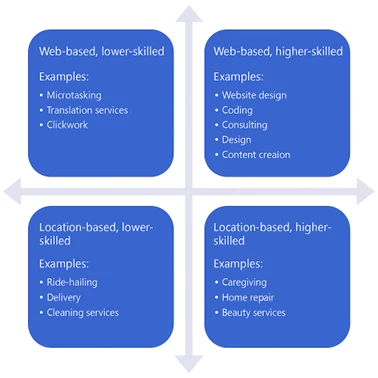
Algorithmic management and concentrated market power can leave workers vulnerable to discrimination, arbitrary disconnection, and untransparent compensation. Workers face unclear job status, unstable pay, long hours, and often operate in a legal gray area that does not ensure access to benefits like health insurance or paid leave. As more formal businesses shift to platforms to source workers and services, there’s a concern that unregulated platforms may replace better-regulated, visible, and taxable employment relationships. At the same time, the wide range of jobs available on platforms (see figure 1), with varying levels of skill and exposure to risks, requires careful regulatory planning.
Figure 1: The different types of digital platform work
There are various ways to regulate platform work
Designing effective worker-focused regulations is challenging in developing countries, where informality is high and enforcement capacity is limited. So how can platform workers benefit from, and be integrated into, essential labor market protections?
One approach to regulation taken in some jurisdictions is to classify platform workers as self-employed, a status that is lightly or entirely unregulated—rarely ideal for vulnerable workers. At the other hand of the spectrum, some platform workers have been reclassified as full-time dependent employees. Such workers become entitled, de jure, to the full set of associated rights. Such an approach normally raises significantly the unit cost on labor, in ways that may or not fit with the product markets that the platforms try to serve. In general, regulating in a generous form can be beneficial to workers but possibly prevent jobs from being created, so this approach is more beneficial where accessible alternatives of formal employment exist outside the platform economy, which is often not the case in developing countries.
A third avenue adopted by some countries is to design tailored regulation for platform workers. A recent stocktaking by colleagues Hatayama and Maj-Swiztak highlights common legislative efforts such as algorithmic transparency, data protection rights, payment transparency, and protections against arbitrary disconnection. Taken together, these options underscore the need to balance protection and practicality, ensuring platform workers are covered by core rights while avoiding mismatches with country conditions and enforcement realities.
Getting regulation right from the start
In a recent discussion paper, we propose a set of guiding principles to establish bottom-up platform work regulations that are grounded in the economic realities of low- and middle-income countries.
Governments, particularly in developing countries, have a rare opportunity for a clean slate to build smart, context-specific, and data-driven regulation from the ground up. Unlike informal businesses, platforms are inherently traceable. They operate through digital infrastructure, use formal payment systems, and generate rich data on transactions, hours worked, and worker performance. Governments can—and should—use these features to support effective regulation and enforcement. However, the price of getting regulations wrong is that jobs disappear from these jurisdictions altogether. Pursuing an incremental and flexible approach is therefore key.
This approach should also be based on rigorous evidence. Although more research is needed to understand how different regulations affect platform workers, there are some emerging insights. For example, minimum wages have had mixed effects in digital platforms, and haven’t necessarily increased workers’ earnings, as our recent review of the evidence finds.
Besides regulating labor directly, regulators should also consider how product markets regulation can affect workers’ welfare—as we argued in a previous blog in this series. Evidence shows that some individual platforms exercise strong market power on particular segments of the labor market, with substantial control over prices, working conditions, and access. In such markets, platforms could align to new regulations without cutting jobs, and product-market regulation—targeting entry rules, market concentration, or pricing structures—can be a powerful complement to labor regulation to improve workers’ welfare.
Labor market observatories can play a central role in informing the direction of new regulations over time. By tracking trends in wages, work hours, platform behavior, and worker demographics, observatories help policymakers identify risks early and adjust regulations gradually and pragmatically. In addition, governments should ensure that platform workers are able to comment on new regulatory proposals and ideally to engage in social dialogue, by protecting their right to associate even if they are geographically dispersed.
The decisions countries make now will shape the future of digital employment. Platform work is not just a new labor market trend—it’s a test case for the kind of dynamic, integrated regulation we’ve argued for throughout this series: one that evolves with changing conditions, coordinates across institutional domains, and delivers better outcomes for both workers and firms.
This blog is the third in our series on labor and product market regulation and draws on a recent discussion paper “The Regulating Platform-based Work Low and Middle-income Countries: Towards a Context-appropriate Approach.” The first blog in the series summarized findings from a review of 199 studies on labor and product market regulation. The second blog proposes a new approach to regulation, in line with a recent discussion paper.