
The last 2 years have brought a new priority to global economic diplomacy: critical minerals now feature in most trade and economic agreements. The rush to secure resources needed for the climate and digital transitions has pushed all large consumers to compete for availability and security of supply. The United States is at the heart of the complicated web of bilateral agreements, yet an immense effort to get a share of this pie is being exerted by all the major players—such as China, the European Union, India, and Japan—and some unexpected ones, such as Saudi Arabia and the United Arab Emirates. The International Institute for Sustainable Development's (IISD's) Trade & Climate Tracker provides insight on where to build on existing cooperation to better impact climate and communities.
Need to Know
- Critical minerals are now central to economic diplomacy: 139 of the 211 trade and economic agreements signed since January 2025 and mapped in the IISD's Trade & Climate Tracker are linked to critical raw materials.
- The United States leads by a wide margin, with 41 critical raw material (CRM)-linked agreements largely driven by security and technology concerns. But Canada, China, the European Union (EU), India, Japan, Saudi Arabia, and the United Arab Emirates (UAE) are also signing deals at pace.
- Resource-rich countries are in demand, and they’re using these deals to push for local processing and stronger value chains at home. Some are also cooperating with each other.
- Most CRM deals (68%) are memorandums of understanding (MoUs) and other non-binding instruments. They are fast to agree but weaker on follow-through, and 39% of these texts are not made public.
- Climate is largely missing: only 1 of the 60 CRM-centred agreements includes energy provisions, and none address climate governance.
- To make this moment count, future deals should share value with producing countries, link minerals cooperation to climate goals, and make their texts public.
From Friction to Cooperation
Demand for critical minerals is rising on several fronts. The energy transition requires lithium, cobalt, nickel, and graphite for batteries; rare earths for wind turbines and electric vehicle motors; and copper for power grids. The expansion of artificial intelligence (AI) and data centres is adding pressure on supplies of copper for power and cooling, gallium and germanium for chips, and rare earths for hardware. Defence needs are adding further pressure.
Some producers are using export restrictions to capture more value in domestic manufacturing, aiming to move beyond the role of sole mineral providers. The Democratic Republic of the Congo (DRC), Indonesia, and Zimbabwe have introduced bans or limited exports of raw ores and concentrates, such as nickel, cobalt, and lithium, to push processing at home. In Latin America, many governments have stepped up state control and licensing requirements. China, while controlling some important critical minerals, is also the leading refiner of most CRMs; its control of the value chain, as well as the limits it has applied to exports of rare earths and magnets, have created broad concerns about its dominant role in the overall production process of green and digital industries.
In light of the recent rise in CRM export restrictions, major consumers are de-risking their supply chains and coordinating with one another. The EU is pooling investment and purchasing, coordinating stockpiling, and proposing limits on scrap exports; Australia is building a strategic reserve of critical minerals; India is offering incentives for rare earth magnet manufacturing; and G7 partners have launched a Critical Minerals Production Alliance. For some buyers, the urgency is immediate: a Japanese official told the Financial Times in October 2026 that Japan had “months, not years” of yttrium—a rare earth used in cars and chip manufacturing—left.
Partly in response to these frictions, CRM cooperation has become a key part of trade diplomacy: in just 21 months, 79 countries and blocs signed 139 agreements linked to critical minerals, from dedicated minerals deals to broad trade agreements that include CRM related provisions.
A Global Minerals Race With a Leader–and Some Strong Contenders
The United States leads by a wide margin: 41 of its 48 mapped agreements (85%) are either exclusively centred (24) on CRMs or have strong CRM provisions (see figure below). Many U.S. CRM agreements follow a near-identical playbook for securing supply of outputs from mining and processing, and the emerging model of agreements on reciprocal trade now pursues CRM provisions as part of tariff deals. These agreements open partners’ mining and processing to U.S. investment and coordinate finance, offtake, stockpiles, and pricing, with some supporting local processing. They treat minerals as a national security and technology problem rather than a climate change-related issue, and in this context, efforts to decouple from China are playing a central role. Critical minerals is one of the few topics on which the current U.S. administration is showing a global leadership ambition: in February 2026 the Office of the U.S. Trade Representative launched a public consultation on the possible plurilateral Agreement on Trade in Critical Minerals. The EU and the United States together announced the Action Plan for Critical Minerals Supply Chain Resilience on April 24, 2026, following similar announcements with Mexico and Japan earlier in the year, which together could lay the building blocks for a possible plurilateral agreement.
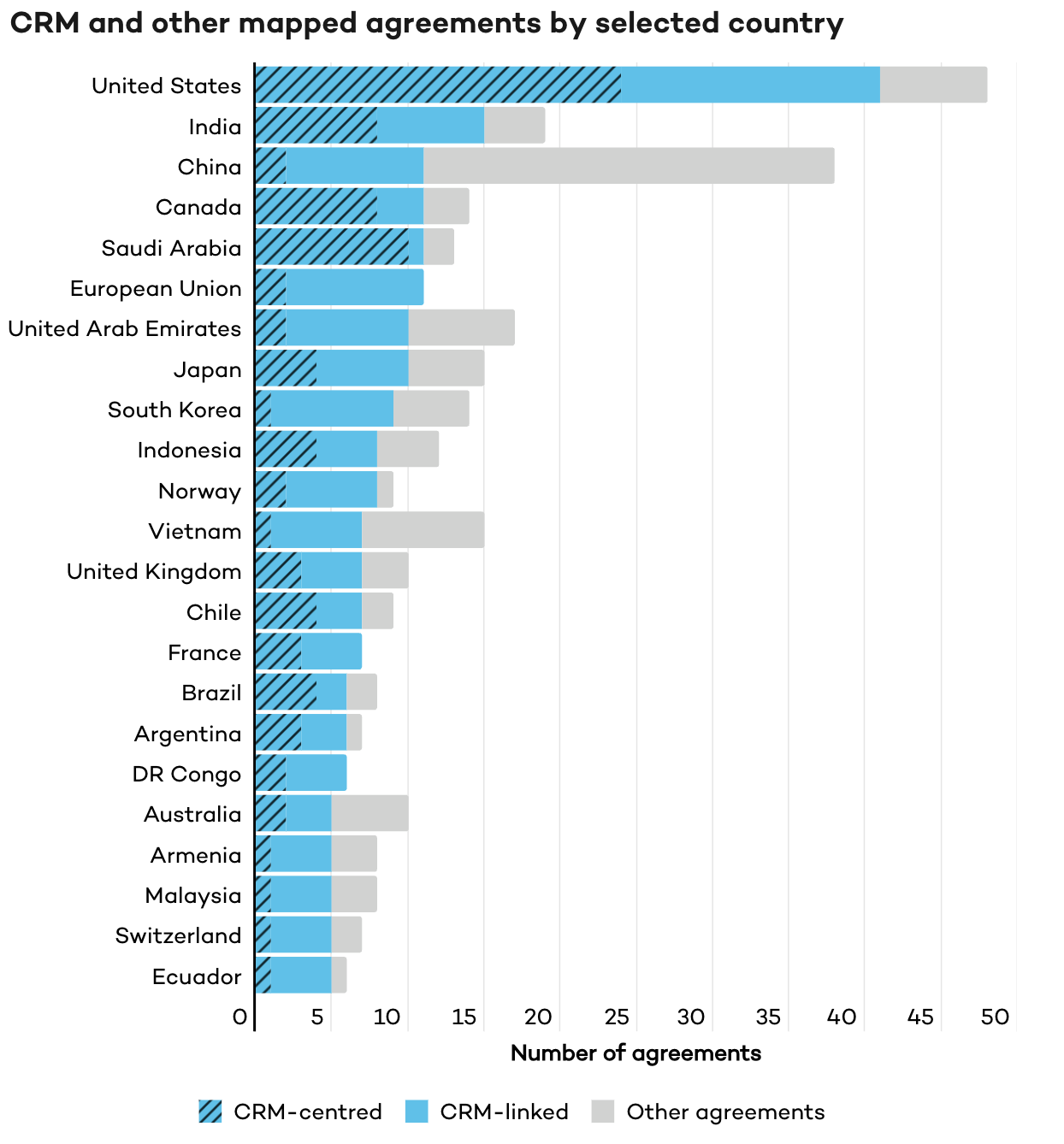
Mineral diplomacy is not a U.S.-only priority. Since 2025, India has signed 15 CRM-related agreements; Canada, China, the European Union, and Saudi Arabia 11 each; and Japan and the United Arab Emirates 10 each. Some jurisdictions, such as the DRC, EU, France, and Saudi Arabia, added critical minerals-related provisions to almost all agreements signed over the reviewed period.
Approaches differ. Canada and Saudi Arabia mostly sign dedicated CRM deals, such as MoUs or joint declarations of intent. The EU, Japan, South Korea, and the UAE more often fold minerals into broader agreements, from free trade agreements (EU) and comprehensive economic partnership agreements (UAE) to cooperation frameworks (Japan, South Korea). China is among the most active economic agreement negotiators; however, only 11 of its 38 mapped agreements are CRM-linked, and these mostly with mineral-resource-rich countries. Its agreements are more often focused on energy cooperation, particularly centring on renewable energy priorities such as solar, wind, and electric vehicles.
Pre-2025 critical minerals cooperation
While the IISD data collection started in January 2025, the mineral diplomacy started earlier. From 2021 to 2024, the EU built strategic partnerships on raw materials with 14 partners, with Canada and Ukraine in 2021; Kazakhstan and Namibia in 2022; Argentina, Chile, Zambia, the DRC, and Greenland in 2023; and Rwanda, Norway, Uzbekistan, Australia, and Serbia in 2024. Canada concluded eight bilateral partnerships before 2025, with producers such as Chile and Indonesia and buyers such as Japan and South Korea. Its cooperation goes back even further: Canada and the United States finalized a Joint Action Plan on Critical Minerals Collaboration in January 2020.
Who Signs With Whom: Producers, consumers, and hubs
Mineral diplomacy has created a complex web of agreements: 79 countries and blocs are building partnerships. The United States casts the widest net, with 32 partners; for 8 of them, from Colombia to the Philippines, the U.S. deal is their only CRM-linked agreement. Other consumer economies, such as India (14 partners), the European Union (11), and South Korea (9), are building their own networks. Many of these agreements (94) include provisions focused on securing the necessary mineral supply. Japan (six partners) has worked mainly through multiple agreements with other importers (the United States, the European Union, and India), pointing to supply coordination among buyers.
Resource-rich countries are hubs in their own right. Indonesia had 12 CRM-linked partners, Argentina 10, Brazil 9, and Chile 7, though some of these partners come from bloc agreements. Many of the agreements (84) signed by such governments contained provisions are aimed at building up stronger manufacturing downstream in producer countries, from scaling up exploration to local processing and skill building. Gulf states act as investors and conveners: Saudi Arabia signed most of its minerals deals at its Future Minerals Forum, with producers such as Brazil, Chile, and Zambia and buyers such as Canada, France, and the United Kingdom, while the UAE builds minerals into economic partnership agreements with resource-rich countries.
There are also important producer-to-producer ties: Argentina, Bolivia, Chile, and Peru signed a joint declaration on strategic minerals in August 2026, and the DRC has deals with Rwanda and Tanzania, pointing to scope for regional value chains. Producing countries are also using these deals to advance their own industrial goals, with provisions on building value chains at home now almost as common as those on buyers’ supply security.
The MoU Moment: Practical, fast, non-binding
Of the 139 CRM-linked agreements, 95 (68%) are MoUs, cooperation frameworks, joint statements, or other non-binding instruments rather than more traditional legally binding trade agreements, such as free trade agreements (FTAs).
The appeal of this new MoU diplomacy is speed. FTAs can take years to negotiate because their scope spans multiple sectors from agriculture to financial services. An MoU can be agreed upon in months, avoid parliamentary scrutiny and the necessity of ratification, and focus on a few issues that matter most to each side, whether it’s securing supply for importers or helping exporters develop production downstream in the value chain. MoUs also signal intent to investors and can pave the way for deeper agreements later.
MoUs might be weaker on follow-through. They are not legally binding, and their delivery rests on implementation arrangements that may not be immediately clear.
Many also lack transparency: 39% of CRM-related agreements’ texts are not published, so a significant part of CRM cooperation remains veiled, making it challenging to verify if the agreement’s objectives have been delivered upon.
Critical Minerals and the Climate Agenda
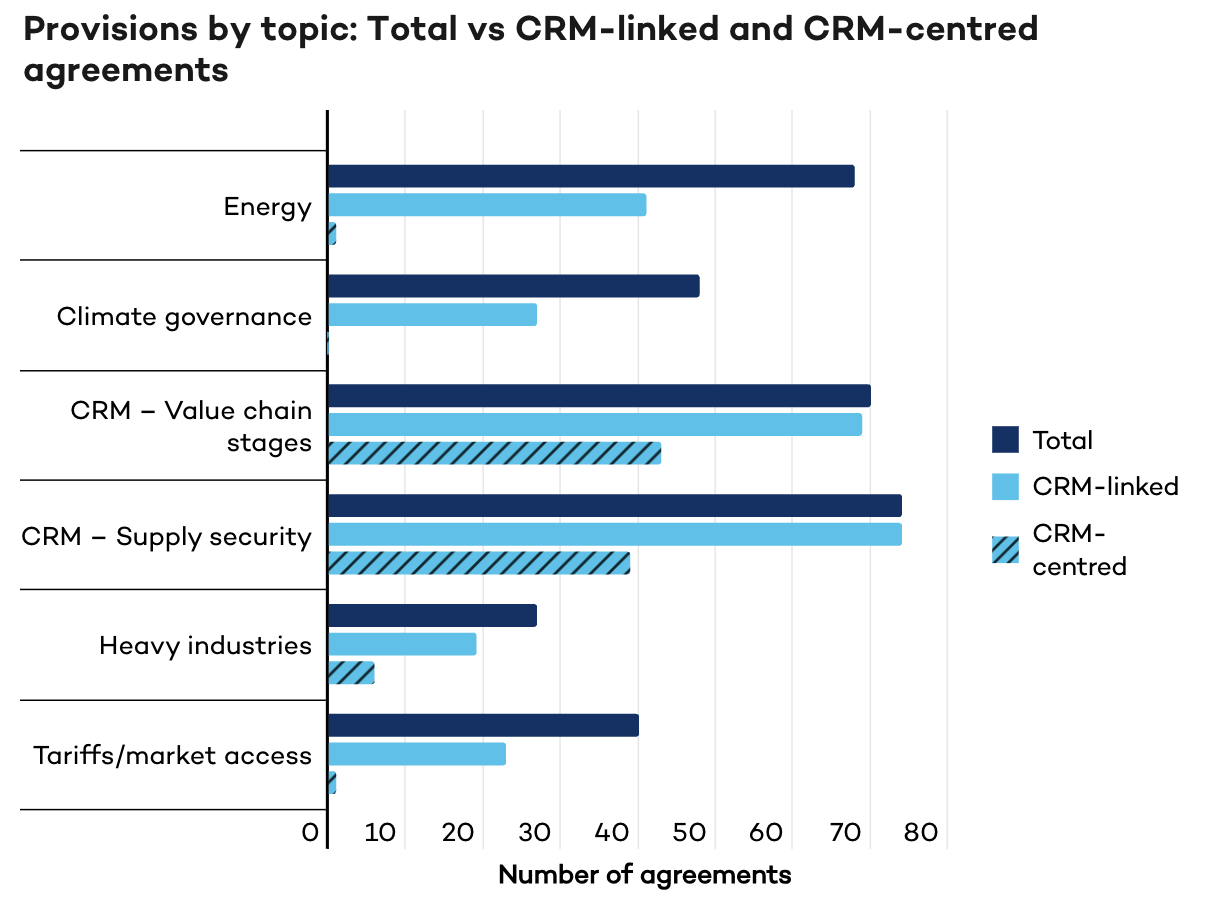
While much critical mineral diplomacy is likely pursued with both climate and digital transition in mind, the climate agenda is rarely explicitly mentioned. Of all the 60 CRM-centred agreements, only one includes additional energy provisions, eight address heavy industry-related cooperation objectives, and none talk about broader climate governance. More climate-linked issues emerge in broader instruments, such as FTAs, which often pair CRM provisions with broader transition goals; this is often the case in the European Union and EFTA-signed agreements.
The IISD tracker demonstrates how agreements with CRM provisions (113) dominate those signed from January 2025, yet outside the CRM-centred agreements, other mapped climate agenda items were also actively included: energy cooperation (109 agreements), climate governance (66), and heavy industry decarbonization and circularity (40).
Making the Moment Count
The pace of these deals shows that governments see cooperation as necessary to secure the minerals crucial for green and digital transitions. Yet approaching this work in a patchwork manner may not be sufficient to ensure sustainability objectives are fully met. A bird's-eye view of this movement enables policy-makers, researchers, and civil society to see formation of the new “critical mineral friends” clubs and to see what might be driving the impact (or the lack thereof) of such collaborations on the CRM-producing economies and their objectives, as well as on the global objectives of climate change mitigation. For this moment to deliver for supply security, producer country transition, and the climate objectives, policy-makers should use this global view to
- share value with producing countries. Provisions on building value chains through local processing, skills, and infrastructure already appear in 84 agreements, and future deals should improve and build on them.
- link minerals deals to climate goals and governance. Only 1 of 60 CRM-centred deals include energy provisions, and none include climate provisions such as emissions reduction, climate finance, or a just transition. Future deals can tie minerals cooperation explicitly to the energy transition, with commitments to cut emissions from mining and processing and efforts to support producing regions through transition finance that builds a skill-base for value-adding activities and ensures processing is done with as little environmental impact as possible.
- enhance transparency supporting the follow-up analysis. While the rush of CRM diplomacy is driving a lot of innovation in economic diplomacy, much of it is happening both quickly and outside civil society oversight, making it difficult to assess whether the ambition of those deals actually created on-the-ground change—be it the changes in the CRM trade flows or the creation of downstream industries in producer countries. Nearly half of all agreements mapped by IISD, and 58% of CRM-centred deals, have no publicly available texts. Publishing the texts would allow for important scrutiny by investors, communities, and other governments, as well as a deeper understanding of changes in global CRM governance.
Understanding the Trade & Climate Tracker
IISD's Trade & Climate Tracker maps trade and economic agreements signed by national governments since January 2025 and tracks provisions relevant to climate and the green transition. The current version covers 211 agreements signed up to September 15, 2026, across instruments such as FTAs, MoUs, cooperation frameworks, and joint statements. The tracker codes provisions on energy, climate, critical raw materials, and heavy industry, plus tariff measures. Each topic is split into subtopics; for CRM, provisions are split into value chain stages and supply security. The tracker records what agreements provide for, not whether they are implemented. The tracker and its methodology note are available online.
RELATED NEWS