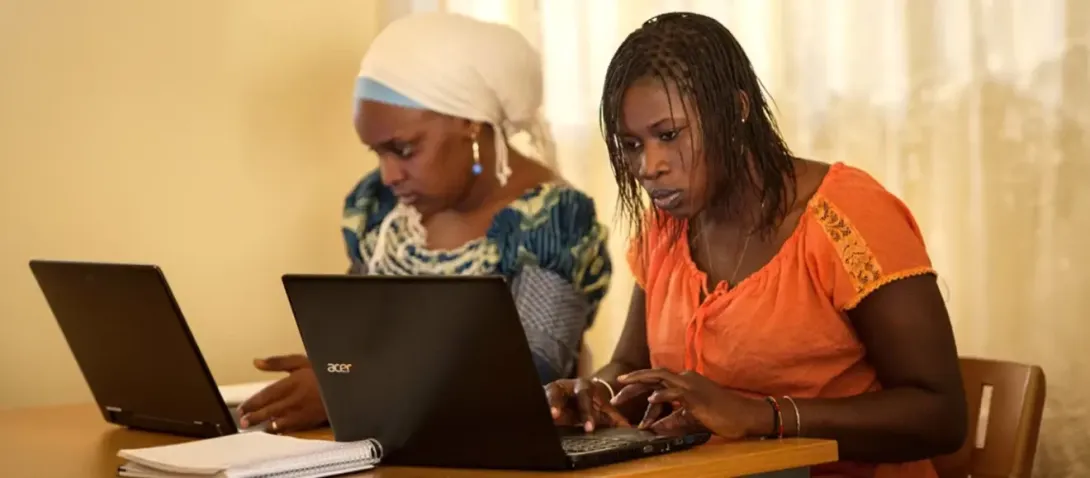
Graduate students in a computer science class at Gaston Berger University in Saint-Louis, Senegal, part of an IDA-supported Africa Center of Excellence. Credit: Sarah Farhat / World Bank Group.
“If they don’t give you a seat at the table, bring a folding chair.”
Shirley Chisholm (1924–2005)
As I reflect on this powerful statement about agency — about refusing exclusion and claiming space even when systems were not designed for you — I cannot help but wonder: what happens when bringing your folding chair comes at a cost?
In my work as the founder and Executive Director of ASVIOL Support Initiative, I have seen how exclusion limits opportunity and shapes economic outcomes for young women. As an IDA Youth Champion, I have also seen how expanding access to education, finance, and digital tools can begin to change those outcomes.
In today’s unequal world, access to opportunity often comes through sponsorship or scholarship — someone opens a door, or a system recognizes your merit. But when culture, religion, or social norms are used to justify excluding women from decision-making spaces, public platforms, and economic opportunities, their chances of securing either diminish. And then we ask why women make up a disproportionate share of the world’s poor.
Globally, women are more likely than men to live in poverty. According to World Bank data, nearly one in ten women lives in extreme poverty, and gender gaps in earnings, asset ownership, and access to finance persist across regions.
At the same time, a major labor market challenge is emerging. Over the next decade, 1.2 billion young people across emerging economies will reach working age, yet only about 420 million jobs are expected to be created. Closing this gap requires unlocking the economic potential of entire populations, including women.
Yet women remain less likely than men to participate in the labor force. Globally, just over 50% of women are in the workforce compared with around 80% of men. In many countries, young women face additional barriers to employment, entrepreneurship, and leadership — from limited access to finance and networks to safety concerns in both physical and digital spaces.
Jobs remain one of the most reliable pathways out of poverty. Beyond income, they provide dignity, stability, and opportunity. When women are able to work and build businesses, families become more secure, communities strengthen, and economies grow more resilient.
This is why the World Bank Group is prioritizing job creation as a central development objective.
Through programs financed by the World Bank Group’s International Development Association (IDA), girls and young women are gaining access to education, finance, and entrepreneurship skills. Initiatives such as the Sahel Women’s Empowerment and Demographic Dividend (SWEDD) program in West Africa and the Recovery and Advancement of Informal Sector Employment (RAISE) initiative in Bangladesh are helping dismantle structural barriers and open pathways to economic participation and job creation.
IDA is also supporting young women to build digital literacy and entrepreneurship skills so they can participate in a rapidly evolving economy. But as women gain access to digital platforms, spaces increasingly essential for networking, entrepreneurship, and employment, new barriers are emerging.
Online gender-based violence is becoming an increasingly serious threat. Harassment and abuse do not remain confined to the screen; they spill into real life, shaping career choices, silencing public participation, and forcing many women into self-censorship. Many limit what they share, how they show up, or whether they participate at all.
And invisibility has economic consequences.
When women withdraw from digital spaces, they lose networking opportunities, professional visibility, market access, and platforms that increasingly shape income and employment. In developing economies where digital participation is becoming essential for entrepreneurship and job creation, online violence directly constrains women’s economic agency.
The consequences extend beyond individuals. Women who retreat from visibility are less likely to build businesses, access capital, or lead enterprises that create jobs for others. Over time, this reinforces inequality and slows progress toward inclusive economic growth. The World Bank Group has consistently shown that investing in women drives economic growth. When women work, control assets, and participate fully in the economy, households become more stable, children’s outcomes improve, and economies grow stronger. But investment cannot stop at education, training, or credit. If women cannot participate safely in public and digital spaces, those investments are undermined.
Through legal reforms, digital safeguards, and initiatives such as the Digital Economy Enhancement Project for Pakistan (DEEP) and the Digital Economy for Africa (DE4A), the World Bank Group is supporting countries to build safer and more inclusive digital environments so women can fully participate in economic, social, and civic life.
The reality is this: if we invest in women’s skills, businesses, and leadership but fail to protect their right to exist safely in public and digital spaces, we weaken the very foundations of inclusive job creation. A woman who must remain anonymous to remain safe is a woman whose potential is constrained. When women live anonymously, what does that mean for representation? For the historical record? What evidence will remain that women helped shape this era?
Visibility is not vanity. It is participation. It is economic agency. It is the ability to build, lead, and create jobs.
When women are both invested in and protected, economies grow, societies stabilize, and communities thrive.