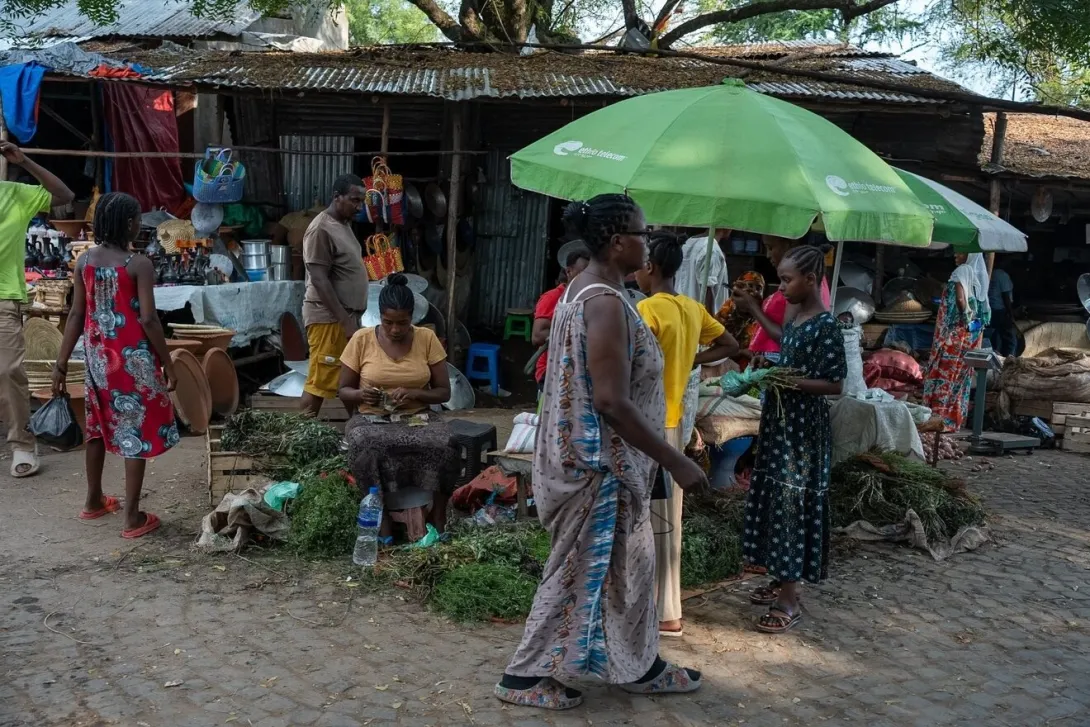
Women in marketplace around Gambella, Ethiopia. Photo: UNCDF

“I never thought digital financial tools were for someone like me.”
When Sara Wolelaw, a diplomat at Ethiopia’s Ministry of Foreign Affairs, first heard about the national Digital Financial Literacy campaign, she assumed it was meant for entrepreneurs or technology professionals rather than public servants like her. Today, after the training she confidently uses digital payments, understands mobile money products and encourages other women in her ministry to do the same.
“Now, I feel empowered not only to use these tools, but to help other women use them too,” she says. Sara is one of 525 participants from 26 public institutions who were reached through the three-day nationwide Digital Financial Literacy campaign led by the Ministry of Innovation and Technology (MInT) and supported by UNCDF. The campaign is part of the UNCDF Digital Literacy for Financial Services and the Future of Work in Ethiopia (DLFSFW) program, implemented under the DFS4Resilience initiative, funded by the European Union and the Organisation of African, Caribbean and Pacific States (OACPS).
While the initiative focuses on building women’s digital financial capability, its broader ambition is systemic, that is to strengthen the participation of women and youth in Ethiopia’s growing digital economy and unlock more inclusive growth and financial participation.
Closing the gender gap in Ethiopia’s digital future
Ethiopia’s digital transformation is advancing significantly, yet women remain disproportionately excluded from formal financial systems. According to the 2024 World Bank Findex data, only 41.6% of women in Ethiopia have an account at a financial institution or mobile money provider, compared to 56.5% of men. Limited access to mobile devices, lower digital and financial literacy levels, and entrenched social norms continue to constrain women’s economic participation. Without the skills, tools and confidence to use digital financial services, many women are excluded from payments, savings, credit, insurance and investment opportunities that drive economic growth.
Recognizing this structural gap, UNCDF together with the Ministry of Innovation and Technology (MInT) and the National Bank of Ethiopia adopted a market development approach that goes beyond training to strengthen the digital financial capability of women working in public institutions, a largely untapped group with the potential to drive institutional change and influence broader digital inclusion. By enhancing their financial capability, women use digital financial services more and become a new group of potential customers for financial service providers, thereby creating a new market with scaling potential.
To operationalize this approach, UNCDF worked with MInT to design the training approach and roll out a digital financial literacy campaign as a market-building intervention. The training was structured around practical use cases and convened financial service providers including telecommunications operators and partner banks to deliver hands-on sessions linked to real products. This ensured that participants moved beyond awareness to actual usage of services such as digital payments, mobile money, savings and credit. The training was also aligned with national digital transformation priorities, positioning the intervention for scale and longer-term ecosystem impact. “There is no digital economy without women’s active participation,” noted Dr. Yishurun Alemayehu, former State Minister at the Ministry of Innovation and Technology.
The campaign strategically targeted public sector women because of their dual role as users and decision-makers. As administrators, policy influencers and institutional actors, they are uniquely positioned to shape digital adoption within government systems and beyond. By equipping them with practical knowledge of digital tools and payments, mobile money, savings and responsible borrowing products, the campaign drives change at two levels. First, by improving usage of digital financial services; and second, by influencing workplace culture so digital finance becomes more accepted, encouraged, and routinely practiced within public institutions. For many participants, it marked their first formal training in digital finance.
“This is not just training, it’s a turning point,” Sara reflects.
“Women’s roles become visible when we continuously upgrade our skills to meet the demands of the digital economy.” said Elsabeth Gebreselassie, CEO of the Women and Social Affairs Unit at MInT.

Building an ecosystem
The campaign also brought together experts from Ethio Telecom, Safaricom, Commercial Bank of Ethiopia, Dashen Bank, and Wegagen Bank, among others ecosystem actors. They delivered training sessions on basic concepts of digital and financial services, advantages, security concerns, fraud and safety measures to protect one’s digital assets. Financial service providers presented their digital products and services and their efforts to expand and realize inclusive financial services. The presenters also highlighted services designed specifically for women, including savings products and access to credit intended to support women’s economic participation.
This joint initiative reinforced a critical lesson that inclusive digital economies cannot be built in silos. They require public-private partnerships that strengthen trust, expand access points and support users throughout their journeys.
“Many of us had never received this type of training,” shared one participant. “It demystified the digital economy and gave us the confidence to be part of it.”
Capability that fuels market growth and national priorities
By strengthening women’s digital financial literacy, new market segments open up for financial service providers, gender-responsive financial ecosystems are reinforced, national digital transformation priorities are advanced, and more women and underserved groups gain access to funding, credit and investment opportunities. This also strengthens the investment case for financial service providers by reducing perceived customer risk and demonstrating a viable, underserved market segment.
As UNCDF National Digital Financial Services and MSME FinanceCountry Coordinator in ConsultanEthiopia, Endashaw TesfayeSeifu Teshome explains, “By empowering women with the knowledge to access technology and finance services, we are paving the way for market development, systemic change, and capital flows that advance the SDGs.” The next step is institutionalization by embedding digital financial capability into public sector training, national curricula, and financial product and service design. This ensures women become active architects of their own professional growth, and consequently of the economy of their country.
A ripple effect beyond the training
For Sara, the impact is already tangible. What began as uncertainty has evolved into advocacy. She now champions the use of digital tools and encourages colleagues to take ownership of their financial future. Her journey demonstrates that inclusive growth does not start with infrastructure alone but with opportunity and capability,
“Small, targeted interventions like this unlock women’s ability to earn, control, and make independent financial decisions,” she emphasizes.
There is no digital transformation without women. And with the right support, they will become active participants and architects of Ethiopia’s inclusive economic future.