
B-READY 2025 data show a large global gap in business location services, with public service delivery and transparency lagging far behind regulatory quality and operational efficiency. / Image: Shutterstock
Where a firm chooses to locate—and how easily it can register property, obtain permits, and navigate environmental requirements—shapes its prospects from day one.
Across 101 economies, the World Bank's Business Ready (B-READY) flagship report assesses three dimensions of business location: the quality of regulations governing property and construction (Pillar 1), the infrastructure that connects rules to practice—digital platforms, transparency mechanisms, and interoperability (Pillar 2)—, and the practical experience of businesses accessing those services, such as the actual time and cost to obtain a permit or register property (Pillar 3). While many governments perform reasonably well on the first and third, the second reveals a persistent gap.
The public services gap
Findings from B-READY’s Business Location topic show that governments are fairly effective at drafting regulations and at processing applications once they’ve been submitted. What falls between the two is public service delivery—whether businesses can access information online, registries and permitting systems talk to each other, fees and timelines are published and predictable.
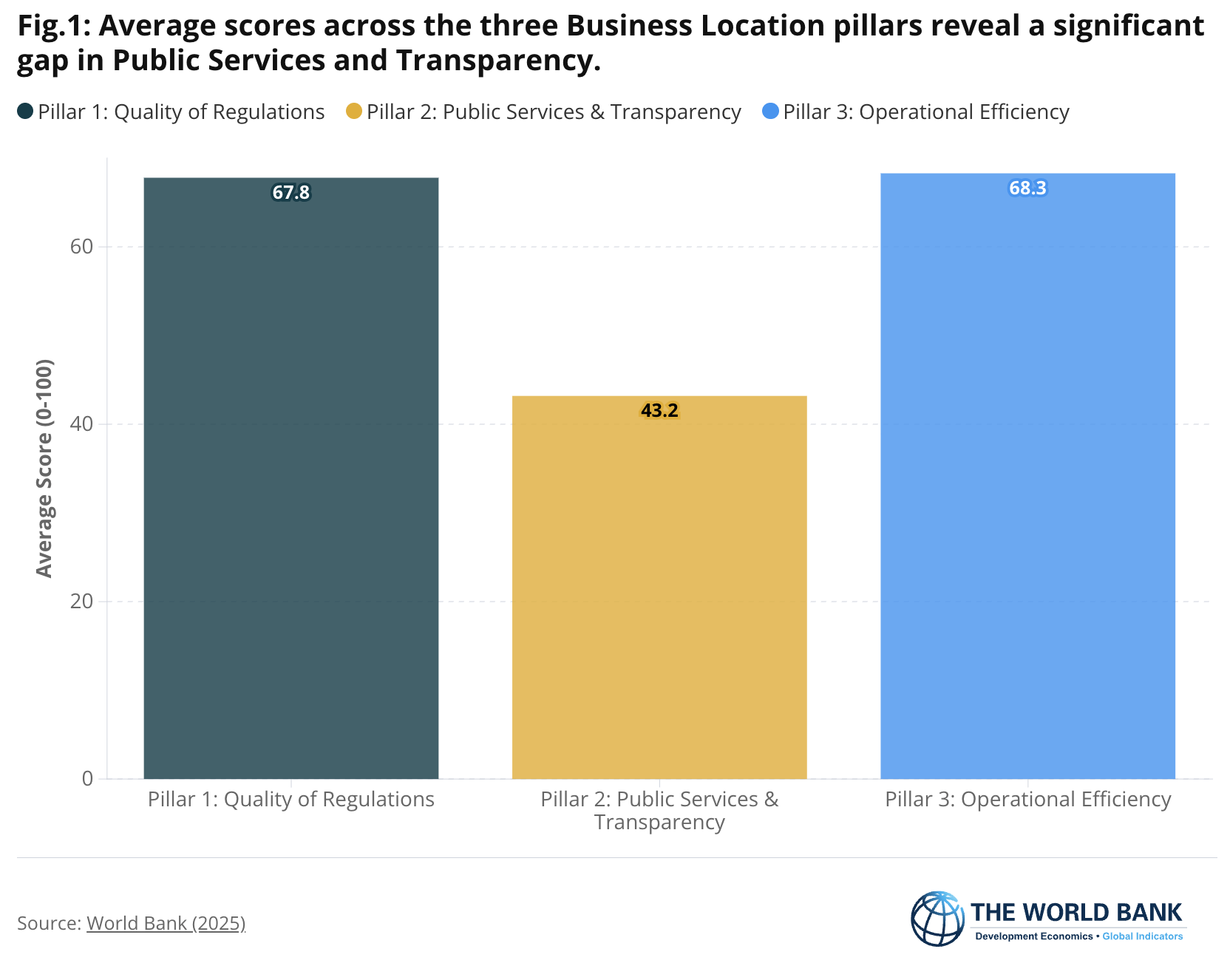
On this middle layer, B-READY finds a gap that dwarfs performance differences on either side of it: economies score an average of 68 out of 100 on regulatory quality and operational efficiency, but just 43 on public services and transparency (Figure 1). That 25-point shortfall is not a marginal finding—it is the dominant pattern across economies at every income level.
A closer look at the data shows where these gaps are most pronounced. Fewer than one in four economies (24.8%) offer a single online platform that covers the full property transfer process—and just 8.9% can handle all due-diligence checks in one place. Interoperability is similarly limited: while 44.6% of economies share property data between registry and cadaster in real time, that figure drops to 27.7% when it comes to other agencies. Perhaps most telling is what governments choose not to publish: only 3.0% report official statistics on average land dispute resolution times, and just 5.9% release sex-disaggregated land ownership data.
The implications are significant. Pillar 2 encompasses digital service availability, systems interoperability, and transparency in government processes—precisely the areas where economies can achieve substantial efficiency gains through modernization.
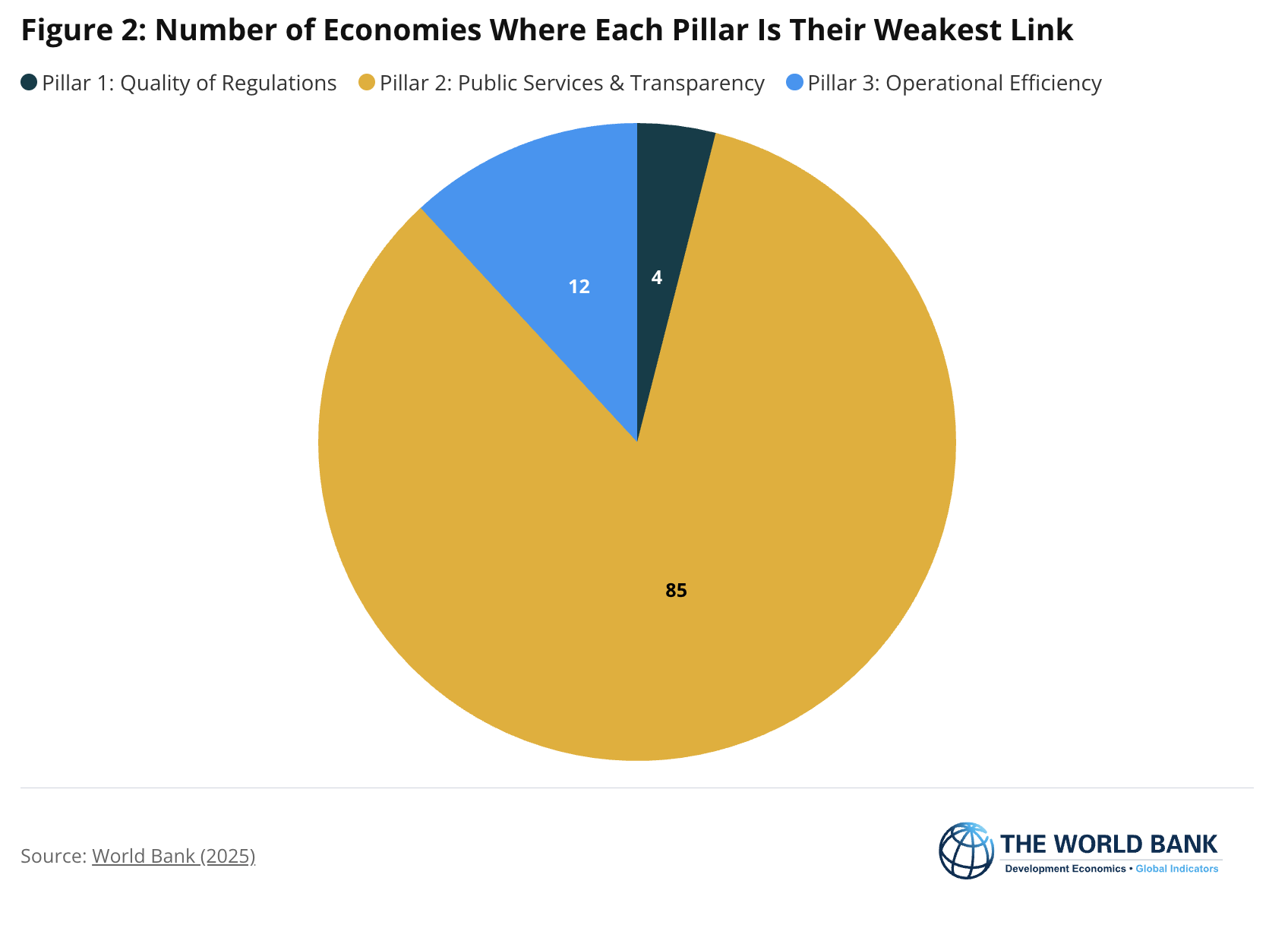
The gap between Pillar 2 and the other pillars is wide enough that even modest improvement could bring meaningful enhancements in delivery of public services. Economies like Rwanda and Estonia—which have invested in digital land registries and online permitting platforms—perform well above the global average across all three pillars, suggesting that digital reform can catalyze broader improvements rather than operating in isolation (Figure 2). The clearest illustration of what this looks like when it works comes from the economies with strongest overall performance.
Good practices and lessons learned
Top-performing economies in B-READY’s Business Location topic include Italy (with a topic score of 83.6 out of 100), Singapore (80.8), the Republic of Korea (79.9), Georgia (79.5), and Latvia (78.6) (Figure 3).
But, what distinguishes these economies? Examining their pillar-level scores reveals a pattern: the highest-performing economies tend to demonstrate strength across all three dimensions rather than exceptional performance in just one area. Italy, for instance, scores above 70 in all three pillars, with particular strength in regulatory quality (93.0) and public services (84.9). Italy’s strong performance may appear unexpected considering its well-documented administrative complexity—but this is precisely what B-READY is designed to reveal. Its strong performance on regulatory quality reflects a genuinely detailed legal framework for property rights and construction; its operational efficiency score, while still above 70, captures the well-known gap between rules as written and processes as experienced.
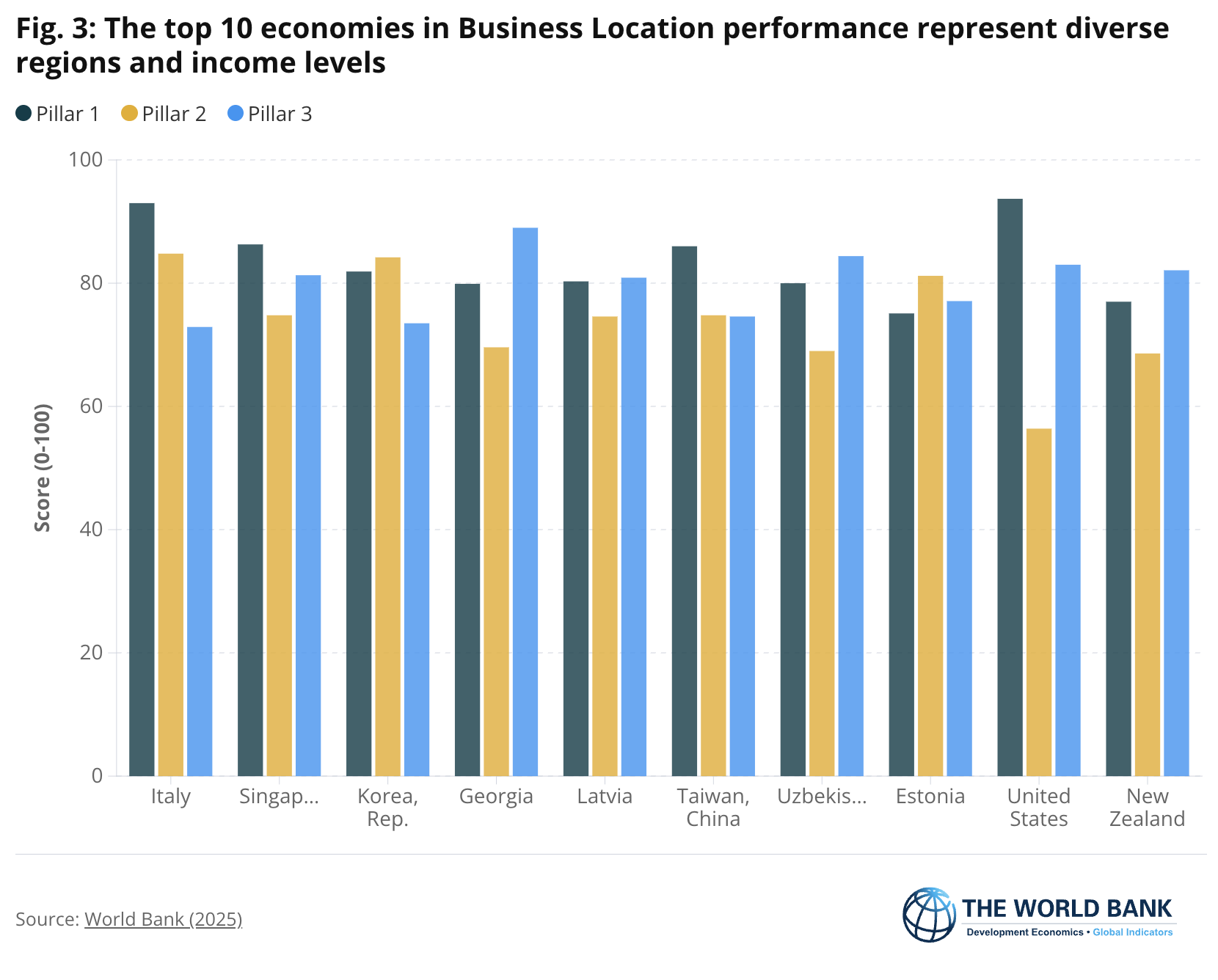
The performance of Georgia (79.5) and Uzbekistan (77.8) are also notable: these upper-middle-income economies outperform many high-income countries, demonstrating that effective business location frameworks are achievable regardless of development level.
The balance effect
The public services gap has a further consequence. Because performance under Pillar 2 is weak across so many economies, any economy showing robust performance on regulations or efficiency will show large imbalance between its best and worst pillars—and that imbalance drags down the overall performance. Pillar 2 is not just the weakest area on average; it is the binding constraint on overall performance. Reforms concentrated on regulations or faster permitting alone are unlikely to move the needle if public service delivery remains underdeveloped (Figure 4).
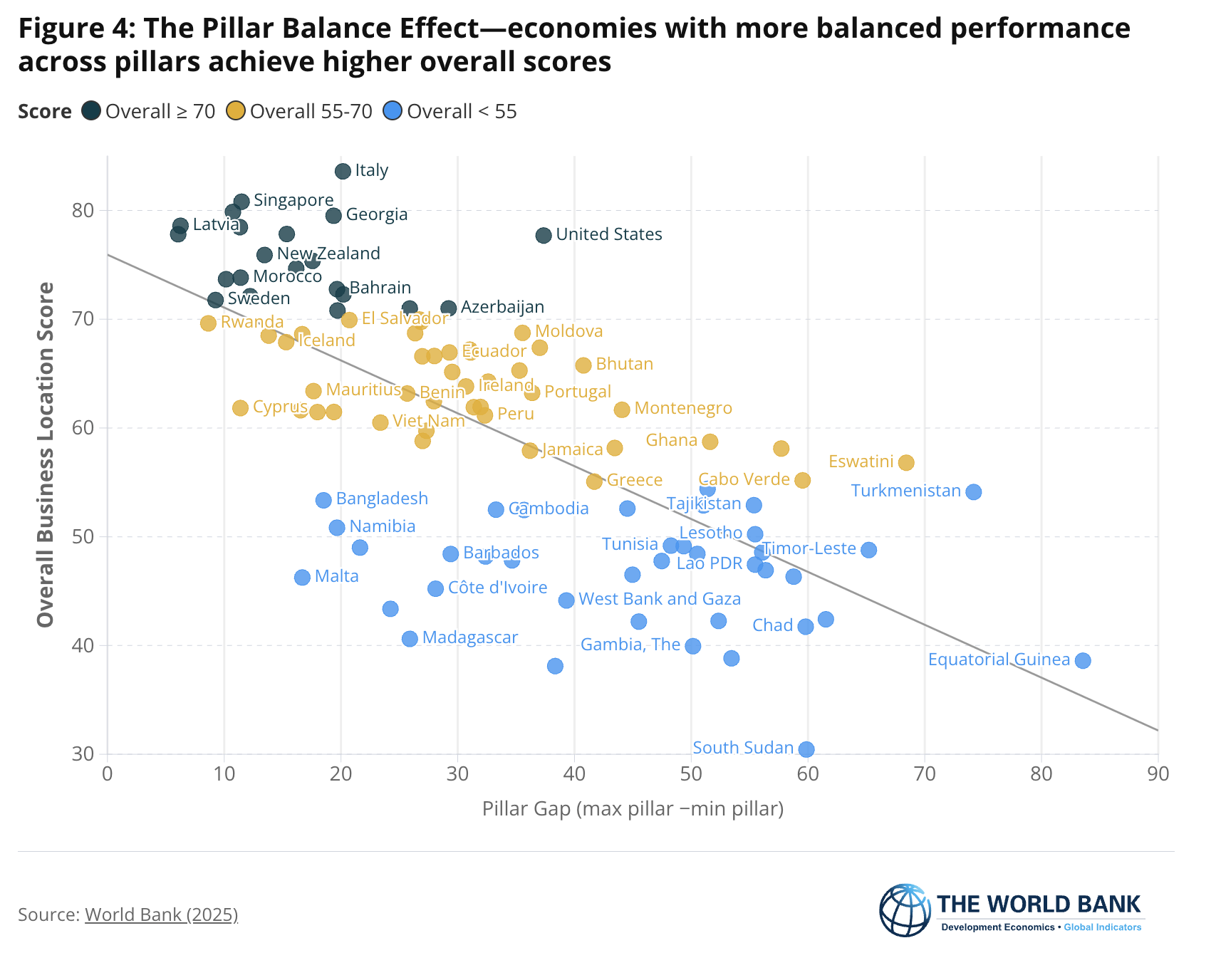
Estonia illustrates the positive case: with a pillar gap of just 6.1 points between its maximum and minimum pillar scores, it achieves balanced strength across all three dimensions and is among the global top performers.
Among the bottom quintile of performers, by contrast, operational efficiency scores often outpace public services scores by 30 points or more. These economies have cut procedural steps and reduced the time and cost to register property or obtain a permit—gains that regulatory simplification and administrative reform can deliver even without digital platforms—but have not yet built the online services and transparency infrastructure that would make those gains universally accessible to businesses. Reforms that chase operational metrics without investing in the quality of service delivery are unlikely to produce durable improvements.
Looking forward
The B-READY 2025 Business Location data offer a clear message for policymakers: investing in public service delivery—through digital platforms, real-time data sharing, and transparency mechanisms—is among the highest-leverage reforms available.
The 24-point gap between Pillar 2 and the other pillars is not just a measurement finding: it is a policy priority. The experiences of strong performers like Italy, Georgia, and the Republic of Korea show that regulatory frameworks and public service delivery are most effective when they are built together, not in isolation.
As the B-READY time series grows in the years ahead, economies will be able to track their own trajectories and identify which reforms are delivering results for businesses on the ground.
Explore the findings of the report here.