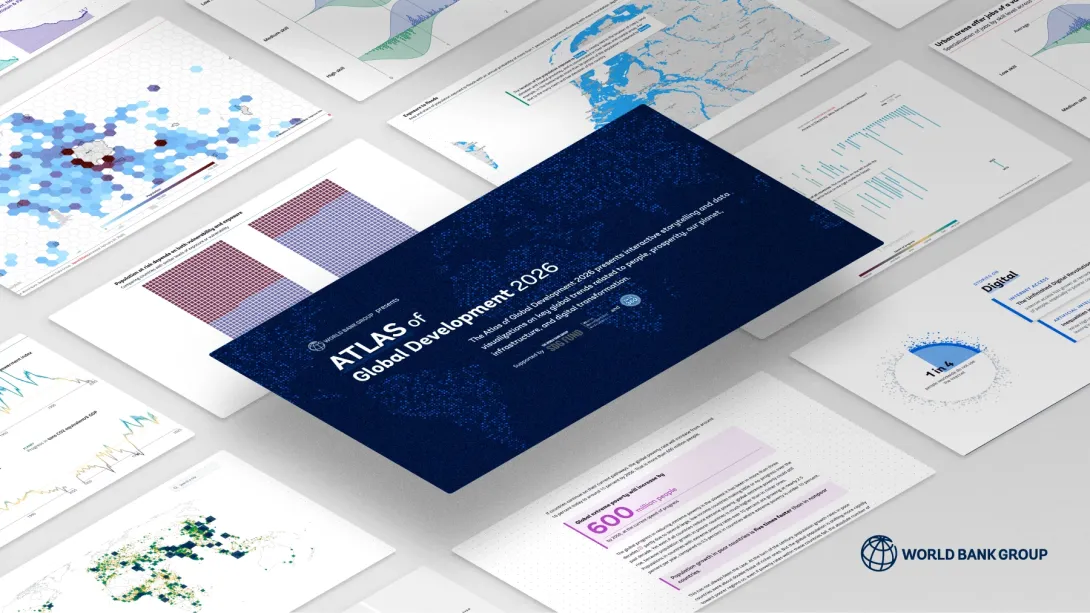
Global progress is slowing — but unevenly: The Atlas of Global Development 2026 tracks how countries are advancing across five key dimensions, revealing widening gaps in the pace of development. / Image: World Bank Group
At the heart of development knowledge lies data — and the new Atlas of Global Development 2026 puts that data front and center. Through immersive data stories and state-of-the-art visualizations, the Atlas transforms data into something far more powerful: the insights and knowledge needed to improve people’s lives.
The latest edition is structured around the World Bank Group’s five knowledge pillars — People, Prosperity, Planet, Infrastructure, and Digital. It covers 12 important development topics, from the role of education for better jobs, to access to safe water, and the unfinished but promising digital revolution.
Through the Atlas, the World Bank’s Development Data Group (DECDG) brings together expertise from across the institution and distills 121,249 data points from 107 data sets to create 95 visualizations and deliver critical insights. The Atlas is now hosted on Data360, the World Bank Group’s new data hub that brings together a range of development data in one place. By integrating the Atlas into Data360, users can move seamlessly from data to insights and discover how data can be turned into compelling evidence for development.
A critical moment for development
This edition of the Atlas asks a fundamental question: which countries are moving the fastest and which are losing ground? To answer it, the 2026 Atlas introduces a new framework that tracks how countries have advanced, each from its own individual starting point, across key dimensions.
The picture that emerges is sobering. After decades of meaningful gains, global progress today has reached its slowest pace in three quarters of a century. But the global average only tells part of the story. Embedded within it are countries that have defied the trend and accelerated far ahead. These success stories are not outliers to be dismissed — they are proof of what is possible. And the 2026 Atlas brings them to light so others can learn and adapt.
Here are five key highlights from this edition that illustrate how progress is unfolding:
Prosperity: Extreme poverty could rise in the coming years
The slow pace of global progress is perhaps most starkly reflected in poverty reduction. If countries continue on their current trajectories, global poverty will not just stall, but will begin to rise steadily. If current trends continue, in 43 countries with high levels of extreme poverty, the situation will remain unchanged or even worsen.
Yet, there is also hope. In 10 countries, mostly in Sub-Saharan Africa, extreme poverty could fall below 10 percent by 2050 if countries continue their current trajectories.
People: Women's economic participation is years away from parity, but can change fast
Women's full participation in the workforce could add trillions of dollars to global gross domestic product (GDP). Still, today, only 55 percent of women work, compared to 80 percent of men. At the current pace, the world is more than 350 years away from reaching parity.
But the Atlas also shows that with the right policies and conditions in place, change can come quickly. In Türkiye, women's labor force participation rose 8 percentage points in a single decade — from 34 percent in 2015 to nearly 42 percent in 2024. Based on historical experiences, this would typically take 36 years to achieve. That means Türkiye progressed four times faster than average. With supportive policies in place, other countries can accelerate progress too.
Infrastructure: Sub-Saharan Africa's persistent gap in electricity infrastructure
The number of people living without electricity has halved globally, falling from 1.3 billion in 2000 to 666 million in 2023. Although a remarkable achievement, this masks a deeply unequal picture.
Nearly 9 in 10 people worldwide who still lack access to electricity live in Sub-Saharan Africa, and just eight countries account for half the global total. While urban and rural access rates have converged in most regions, Sub-Saharan Africa remains a stark outlier: in 2023, only 1 in 3 rural residents had electricity access, compared to more than 4 in 5 urban residents.
Ethiopia offers one of the most compelling stories of rapid progress in the Atlas. Starting from near-zero rural electrification, the country has reached close to 50 percent of rural access today, and near universal access in urban areas. Ethiopia's trajectory shows what determined, sustained effort can accomplish, even when starting from extremely challenging circumstances.
Planet: Water quality, a hard problem to solve
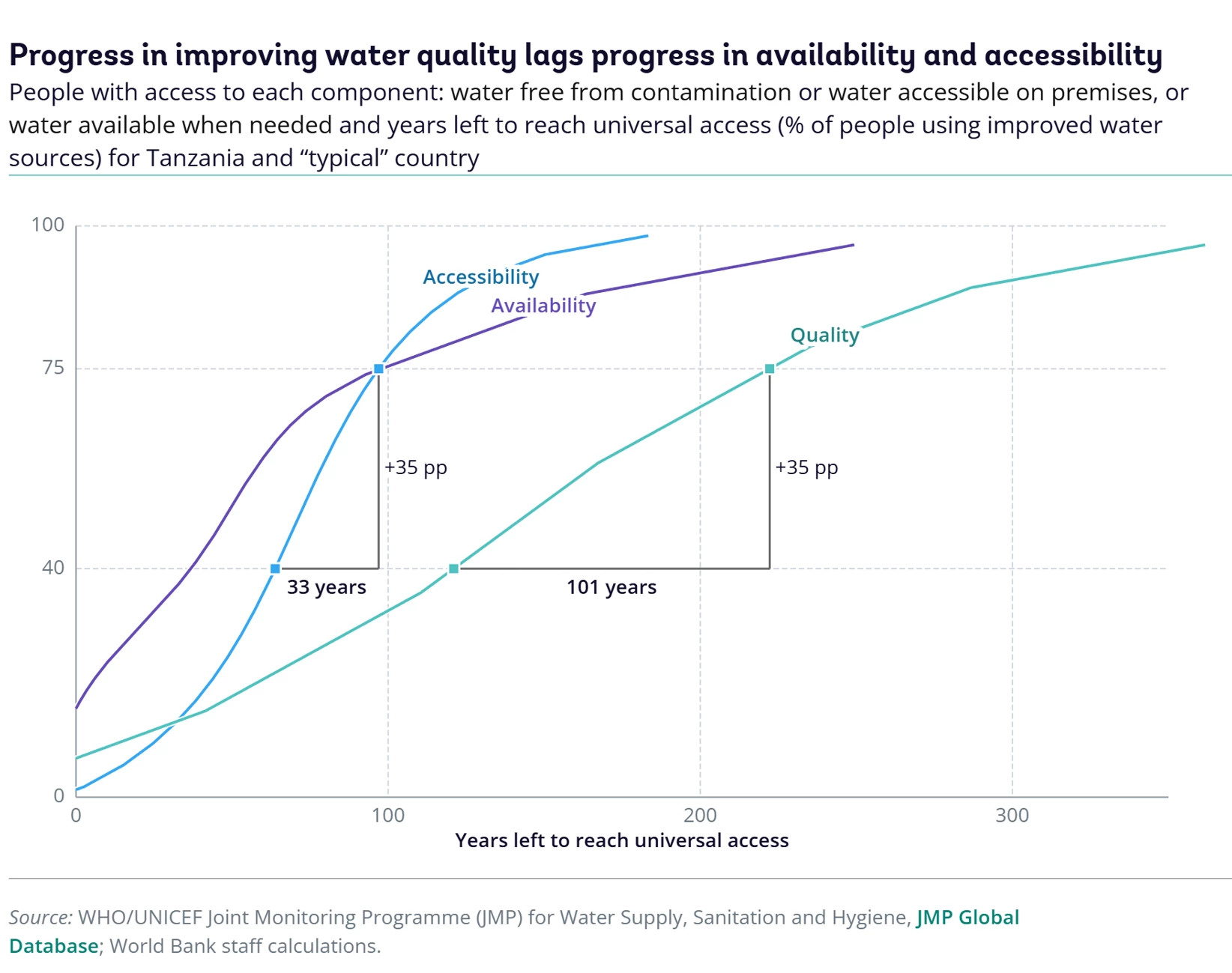
2.1 billion people lacked access to safely managed drinking water in 2024, and among its three components (accessibility, availability, and quality), water quality has lagged furthest behind.
The scale of the challenge is stark when considering the pace of progress required. Based on historical experiences, expanding water accessibility from 40 to 75 % of a country’s population typically takes 33 years. Achieving the same scale of progress in water quality, ensuring water is safe, as well as physically accessible, takes three times as long. Progress is possible, but countries must treat water quality as a distinct and urgent priority, not an afterthought to infrastructure expansion.
Digital: The benefits of the internet are not shared equally
Although Internet access has steadily expanded over the past two decades, 2.2 billion people remain unconnected. And for many who are online, the low quality of their connection limits what the Internet can offer. Internet speed is critical for accessing education, healthcare, and economic opportunities. But while some countries enjoy broadband speeds that support a wide range of activities, others still rely on slow connections, that constrain the benefits people can fully realize online.
Who is the Atlas for?
The Atlas is designed as a public resource for decision-makers, the development community, academics, journalists, and anyone who cares about how the world is changing. Whether you are a decision maker tracking economic trends, a researcher exploring inequality, a journalist looking for the story behind the numbers, or simply a curious reader — the 2026 Atlas has something for you.
Want to know more about which countries are making progress on poverty and inequality? Are we preparing children for the jobs of the future? Is the digital revolution leaving anyone behind? Read the stories, dive into the data, and explore the interactive visuals — visit the Atlas here.