
This story follows the journey of an Aceh-born visionary who, with ILO’s support, has revived the golden age of Aceh’s patchouli oil through innovation and digital transformation.
BANDA ACEH, Indonesia (ILO Story) – Under Aceh’s warm tropical sun, the fragrance of patchouli lingers – earthy, musky and inseparably bound to the province’s identity. Its rich, resinous aroma forms the backbone of countless perfumes and cosmetics worldwide. Nowhere does the plant flourish more than in Aceh, Indonesia’s westernmost province, renowned for producing patchouli of exceptional quality, with alcohol content exceeding 34 percent.
For generations, this fragrant crop has sustained thousands of smallholder farmers, its oil perfuming the world’s luxury brands. Yet despite its global prestige, Aceh’s farmers long faced unstable prices, outdated cultivation methods and limited access to finance. By the mid-2000s, conflict and economic uncertainty had driven production into sharp decline.
If even 20 percent of Aceh’s patchouli were processed locally, the impact would be enormous. We imagine a Patchouli Gallery that honours our history, showcases technology and empowers small producers.
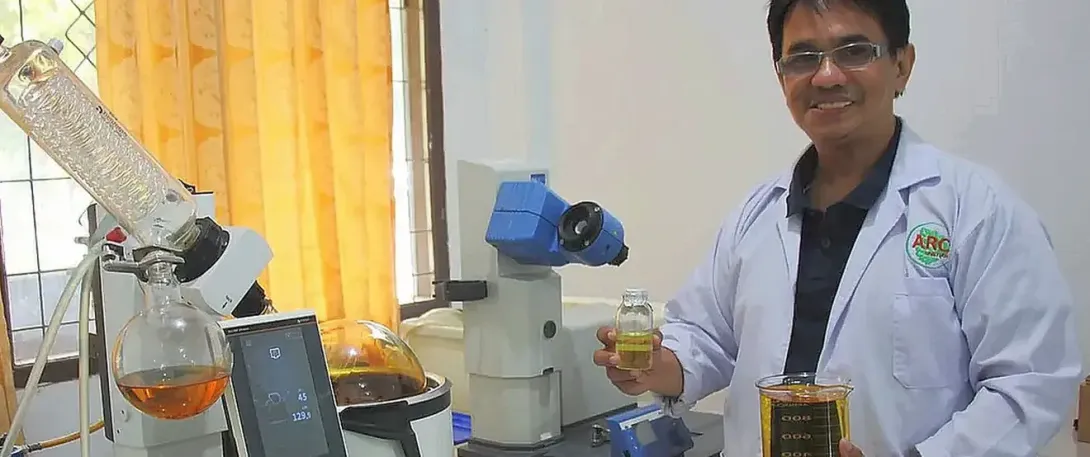
Dr. Syaifullah Muhammad, the founder of the Atsiri Research Center (ARC) at Syiah Kuala University
Today, a quiet transformation is unfolding, driven by research, digital innovation and international collaboration. At its centre stands Dr. Syaifullah Muhammad, an Aceh-born visionary, who in 2016 founded the Atsiri Research Center (ARC) at Syiah Kuala University. Under his leadership, Indonesia’s essential oil industry, responsible for supplying 90 percent of global demand, has been reimagined, with Aceh restored to its rightful place at the heart of this transformation.
“Patchouli oil has been commercialized since the Dutch colonial era. But for too long, farmers struggled with unstable prices and outdated systems. It is time to create a fair and innovative ecosystem for patchouli,” Syaifullah explained. “We began with only four districts cultivating the crop. Today, 17 districts are growing again, and prices have risen from Rp 300,000 (USD 17.9) to over Rp 1.8 million (USD 107.8) per kilogram.”
His vision extends beyond reviving Aceh’s golden era of patchouli. It embraces innovation through digitalization. A major breakthrough has come with support from the International Labour Organization (ILO) under its Promoting SME Enterprises through Improved Entrepreneurs’ Access to Financial Services (Promise II Impact) Project, funded by the Swiss State Secretariat for Economic Affairs (SECO).

The transparency builds trust and trust opens access to credit... Thanks to our collaboration with the ILO, this is something we could never have achieved alone.
Dr. Syaifullah Muhammad
In collaboration, ARC and the ILO developed MyNilam, a digital Enterprise Resource Planning (ERP) system that integrates production records, farmer data and quality tracking across the entire value chain. By digitizing this information, MyNilam enhances traceability, strengthens transparency and broadens access to finance.
With reliable data now available, banks can assess farmers’ performance with far greater accuracy – an essential step toward inclusive financing that strengthens the industry while improving the livelihoods of farming families. Beyond technology, the partnership also advances financial literacy and inclusion, particularly among women farmers.
“The transparency builds trust and trust opens access to credit,” Syaifullah emphasized. “Farmers, including women farmers, now keep records, save regularly, and even invest in new equipment. Thanks to our collaboration with the ILO, this is something we could never have achieved alone.”
Djauhari Sitorus, Project Manager of Promise II Impact, praised the dedication of Syaifullah and ARC in ensuring the sustainability of MyNilam and in strengthening financial support from local development banks. He highlighted that the project’s ultimate goal is to align digital tools, financial access and market systems so they reinforce one another for the benefit of Aceh’s local economic development.
“We greatly value our strong collaboration with ARC in building inclusive value chains,” Djauhari noted. “The MyNilam system is a powerful example of how digital innovation can serve people. Through this partnership, smallholder farmers are connected to finance, markets and technology, ensuring that digital transformation benefits everyone and is sustained as part of promoting decent work for all, including those in the agricultural sector.”

Syaifullah’s tireless commitment to strengthening the entire patchouli value chain has led to the development of more than 32 local products derived from patchouli, alongside innovations that enable the production of high-quality patchouli oil with alcohol content reaching 99.8 percent locally. His achievements earned him the Indonesia Innovator Award from the National Research and Innovation Agency (BRIN) in August 2025, recognizing his success in transforming research into commercial innovations that directly uplift local communities.
Looking ahead, Syaifullah envisions a future where Aceh no longer exports only raw oil but also produces finished goods that embody Indonesian craftsmanship – perfumes, skincare and essential oils capable of competing on the global stage. “If even 20 percent of Aceh’s patchouli were processed locally, the impact would be enormous,” he explained. “We imagine a Patchouli Gallery that honours our history, showcases technology and empowers small producers.”
Through this partnership, smallholder farmers are connected to finance, markets and technology, ensuring that digital transformation benefits everyone and is sustained as part of promoting decent work for all, including those in the agricultural sector.
Djauhari Sitorus, Project Manager of Promise II Impact