
ITU
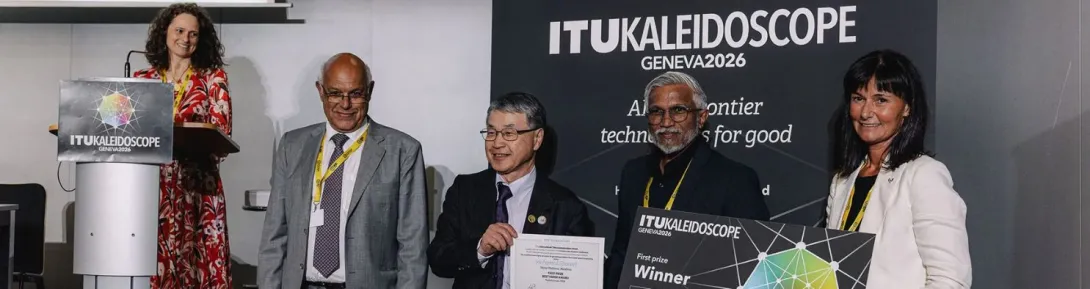
Small island developing states (SIDS) offer structural stress tests for policies and controls over artificial intelligence (AI) globally, argues Mohamed Shareef at Nexia Maldives, who took home the award for best paper at this year’s Kaleidoscope academic conference.
His winning paper, “The amplified sovereignty paradox: AI governance lessons from small island developing states,” suggests that solutions developed for SIDS offer valuable models for the global majority. According to Shareef, this is because the models solve for constraints that exist everywhere, even in the world’s wealthiest countries where they may not be as evident.
Shareef’s findings were recognized at Kaleidoscope 2026: AI and frontier technologies for good, during the AI for Good Global Summit organized by the International Telecommunication Union (ITU) in Geneva, Switzerland, between 7 and 10 July.
“Breakthroughs for a better world start with research,” said Seizo Onoe, Director of ITU’s Telecommunication Standardization Bureau. “We then bring them to life by connecting research, business, technology and policy.”
ITU organizes Kaleidoscope to engage with academic researchers and continuously surface original research.
“This understanding is central to ITU’s work with academia,” Onoe added. “As the United Nations (UN) agency for digital technologies, we want to help your research make an impact far and wide.”
And the runners up are…
Second prize this year goes to “A sequential model selection and optimization framework for security in zero-touch network environments” by Alharith Tawfig Elghasriat the Libyan International Telecom Company and Abdulbaset Mustafa Hamed at the University of Tripoli, Libya.
Their paper proposes a framework integrating online learning with machine-learning principles to support automated, autonomous security operations in 5G and 6G networks. Innovation towards fully automated, self-healing and self-securing networks has challenged the capabilities of traditional static-security mechanisms.
Leonhard Konstantin Cuzmin at Maastricht University in The Netherlands claimed third prize for “Reuniting the fragmented body of EmAI: A global analysis of embodied AI research and development.”
His paper explores research on embodied AI – where AI takes physical shape in humanoid robots, robotic arms or autonomous vehicles – with the aim of identifying synergies and interdependences in which research communities could invest to drive more integrated innovation in this highly interdisciplinary field.
Kaleidoscope creates connections
ITU Kaleidoscope is a peer-reviewed academic conference aimed at highlighting emerging research trends and their connections with international standardization.
ITU also connects researchers with its global community through ITU Academia membership and the ITU Journal on Future and Evolving Technologies.
Take it from Eva Ibarrola, this year’s Kaleidoscope Chair:
“As a professor at the University of the Basque Country, one of the founding members of ITU’s Academia membership programme, I have seen how valuable the collaboration between academia and ITU can be.
My first Kaleidoscope was in 2009, when the conference was only in its second edition and I was a PhD student. At that time, our contributions to ITU were made through the membership of our national administration, rather than under the name of our university.
None of us imagined that Kaleidoscope would become the starting point of such a long collaboration with ITU. Over the years, it led us to join ITU as an Academia member, participate actively in ITU study groups, submit technical contributions and, eventually, become authors of ITU standards.
For me, this is what makes Kaleidoscope so special.
It is much more than a conference. It brings academia and standardization closer together, giving researchers the opportunity to see their work go beyond publications and contribute to international standards.”
Read all the papers
All papers accepted and presented at the conference are published in the Kaleidoscope Proceedings and the IEEE Xplore Digital Library.
Outstanding papers may also be published in international journals, including the ITU Journal on Future and Evolving Technologies.
Authors of the three best papers received special recognition and shared in a prize fund of 6,000 Swiss francs (CHF).
Authors up to 30 years of age who presented accepted papers at the conference received a Young Author Recognition Certificate.
Review all presentations on the Kaleidoscope 2026 programme.