
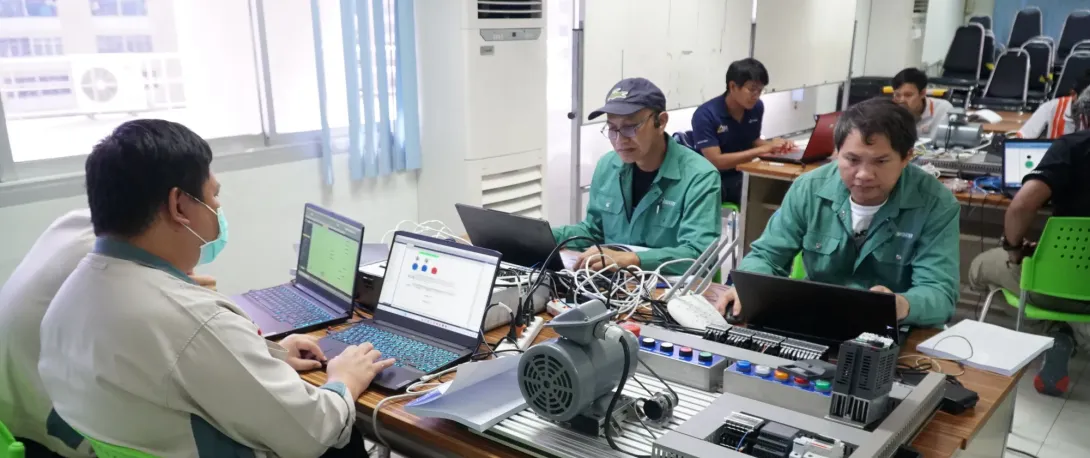
Auto workers in Thailand learn about the application of new technology in the workplace. © ILO
New ILO study highlights the need for targeted policy action to build the preparedness and resilience of workers, enterprises and institutions in an AI-enabled economy.
BANGKOK (ILO News) - A new study by the International Labour Organization (ILO) reveals that generative artificial intelligence (GenAI) is set to touch the working lives of nearly 80 million people across the Association of Southeast Asian Nations (ASEAN). However, only a small proportion work in occupations facing the highest levels of exposure and there is no evidence to date of large-scale job losses.
The report, titled "Generative AI and labour markets in ASEAN: Significant exposure, limited disruption, uneven preparedness," examines implications of GenAI for jobs and labour markets across the 11 countries of ASEAN by considering both occupational exposure and emerging patterns of GenAI adoption.
According to ILO estimates for 2025, 22.9 per cent of total employment in ASEAN (equivalent to nearly 80 million workers) is in occupations with more than a minimal degree of potential exposure to generative AI. However, only 3.3 per cent of the workforce, corresponding to 11.7 million workers, were employed in occupations classified within the “highest exposure category”. At the same time, around 67 per cent of employment remained concentrated in occupations with no identified exposure to GenAI.
Across the nine ASEAN countries with available data, Singapore records the highest share of workers with more than a minimal degree of GenAI exposure, accounting for 42.2 per cent of total employment. It is followed by the Philippines (28.1 per cent) which reflects, in part, the country’s relatively service and IT oriented economy; Indonesia (21.7 per cent); Viet Nam (20.8 per cent); and Thailand (20.6 per cent).
The report notes that employment in highly exposed occupations has continued to expand across ASEAN. “The potential for labour market transformation is significant, but widespread disruption is not yet visible”, the brief notes.
GenAI adoption remains at an early and uneven stage with use concentrated in technology intensive occupations and comparatively limited uptake in office and administrative roles despite their high exposure.
The report highlights that young workers (ages 15-24) and adult workers exhibit broadly similar levels of exposure to GenAI. However, a significant gender gap in AI exposure is identified. Women are more than twice as likely as men to be employed in occupations with high GenAI exposure, reflecting their concentration in clerical, administrative, and professional roles.
The study also identifies an uneven "preparedness gap" across the region with Singapore standing out as a globally competitive AI ecosystem, combining advanced digital infrastructure, strong talent availability and a whole-of-government approach to implementation strategy.
To ensure that AI innovation contributes to productivity growth, creates quality employment and fosters inclusive and equitable benefits across ASEAN, the report outlines regional priorities. They include human-centred governance; inclusive skills development by expanding upskilling and reskilling programmes, with a specific focus on women and youth; support for micro, small and medium enterprises (MSMEs) to overcome barriers to AI adoption; and strengthening knowledge exchange and coordinating human resource development across the Member States.
"Harnessing the benefits of GenAI requires more than access to technology," said ILO Economist and lead author of the report Christian Viegelahn. “Productivity gains depend on investments in human capital and social protection. Ultimately, future labour market outcomes will depend less on exposure alone than on the policy choices to build the preparedness and resilience of workers, enterprises and institutions.”
Note for editors: A webinar to discuss the findings of the report will take place on 15 July 2026 from 2pm-3pm Bangkok time. For more information or to register please see here
For more information, please contact
Steve Needham
Snr Communications Officer, ILO Regional Office for Asia and the Pacific
Email: [email protected]
Tel.: +66 83 6066628