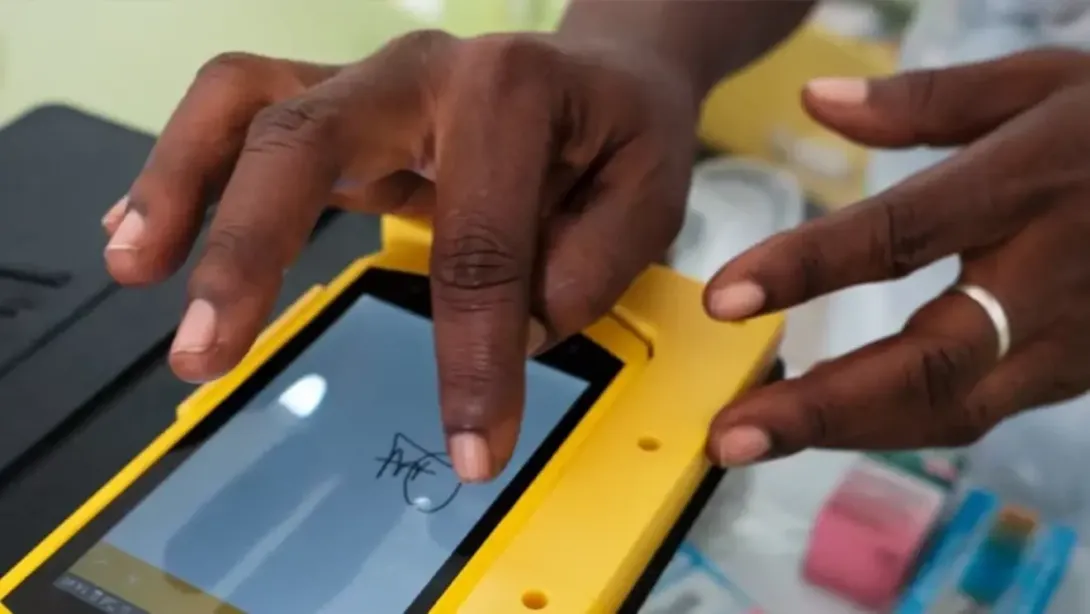
Providing an electronic signature during digital ID verification, expanding access to secure services through Digital Public Infrastructure.
© Nyani Quarmyne / International Finance Corporation
The World Bank Group’s cross-sector Global Digital Public Infrastructure (DPI) Program helps countries build and scale up core digital systems such as digital ID, payments, and secure data sharing. The Program supports over 80 countries to improve access to services and opportunities for millions of people.
Development Challenge
Digital Public Infrastructure (DPI) helps countries build shared digital foundations, like digital ID, payments and secure data exchange for public benefit, but major gaps remain. 2.9 billion people—mostly in Sub-Saharan Africa and South Asia—lack digital IDs for online transactions, and only 8 percent of lower middle-income countries and 16 percent of upper middle-income countries have fast, inclusive payment systems. Progress remains limited by fragmented strategies, low institutional capacity, outdated laws, and lack of secure, interoperable systems at scale.
World Bank Group Approach
The Global DPI Program is implemented through three flagship World Bank initiatives: Identification for Development (ID4D), which helps countries expand access to trusted digital identification; Government-to-Person Payments (G2Px), which improves how governments deliver social transfers and wages through digital payments; and the Frictionless Affordable Safe Timely Transactions project (FASTT), which supports the rollout of fast, interoperable payment systems that enable instant, low-The Global DPI Program contributes to multiple WBG targets: Mission 300, the Gender Strategy, and the Jobs agenda. On Jobs, it drives private sector innovation, competition, and new services that create better employment opportunities. For Mission 300, digital ID, interoperable payments, and geospatial data enable precise targeting and affordable connections at scale. On Gender, the Program promotes women's inclusion through a gender-intentional approach, targeting 300 million more women using broadband by 2030 while closing the gender ID gapcost digital transactions.
It works by bringing together policy advice, financing, analytics, and technical assistance to help countries build safe, inclusive, and reusable digital foundations. Rather than supporting isolated systems, the Program promotes interoperable digital ID, payments, and data-sharing platforms anchored in principles of inclusion, privacy, and user trust. This integrated approach enables governments and markets to scale services faster, reduce duplication, and unlock innovation across sectors such as social protection, finance, health, and climate.
The Program brings together country operations with global public goods—open standards, toolkits, and knowledge products—and pilot innovative approaches to local use cases. It partners with UN agencies and regional bodies, like the African Union and the Association of Southeast Asian Nations (ASEAN), to align norms and accelerate adoption at scale. Joint work with International Finance Corporation (IFC) leverages DPI to crowd in private investment and expand digital finance, marketplaces, and green solutions, while collaboration with Multilateral Investment Guarantee Agency (MIGA) helps with risk mitigation.
Results
Since 2015, the WBG has helped 80 countries introduce safe and inclusive digital identity systems and deliver cash assistance through digital identity, payments, and data sharing. In FY25, 176 million people used new or enhanced digitally enabled services through WBG-wide projects.
- Ethiopia: Over 36.6 million residents are registered under Fayda ID, closing a 15-percent gender gap. G2Px supported 1.3 million households transitioning to digital payments. By late 2025, over 1,600 business licenses and 6,600 work permits had been issued to refugees, enabling formal economic participation.
- Nigeria: Over 100 million National Identity Numbers have been issued, including to women and people with disabilities. The National Social Safety Net Scale Up program supports over 8 million households with cash-out points within 60 minutes of their homes.
- Philippines: 80 million people are enrolled in PhilSys (87 percent of eligible population), with 60 million IDs issued, 8 million new bank accounts opened, benefit processing cut from four days to one, and business permit processing reduced by 80 percent.
Contribution to World Bank Group Targets and Jobs
The Global DPI Program contributes to multiple WBG targets: Mission 300, the Gender Strategy, and the Jobs agenda. On Jobs, it drives private sector innovation, competition, and new services that create better employment opportunities. For Mission 300, digital ID, interoperable payments, and geospatial data enable precise targeting and affordable connections at scale. On Gender, the Program promotes women's inclusion through a gender-intentional approach, targeting 300 million more women using broadband by 2030 while closing the gender ID gap.
In a world where identity is the key to access, Fayda Digital ID for refugees is not just an ID; it is a gateway to dignity, enabling access to essential services, legal recognition, and opportunities to be integrated into host communities. Let's build systems that recognize everyone, ensuring that no one is left behind.
Yodahe Zemichael – Executive Director of the National ID Program of Ethiopia
Lessons Learned
A robust legal and regulatory environment is critical for safe, sustainable DPI implementation. Early-stage technical assistance and policy guidance are vital for effective project design and local adaptation. The Global DPI Program leverages WBG's convening power to unite policymakers, private sector, donors, UN agencies, academia, and civil society, fostering innovation, trust, and long-term sustainability. Countries should adopt international standards to enable cross-border interoperability. Finally, secure system design is a priority, requiring close attention to data misuse, information security, and inclusion to prevent discrimination.
Next Steps
The Global DPI Program will continue to build on ID4D, G2Px, and FASTT to help countries design and scale up trusted, inclusive, and reusable DPI systems. Over the next five years, the Program will focus on strengthening national DPI strategies, deploying core systems—including digital ID, data sharing and fast payments—and applying them to high-impact use cases in social protection, health, and agriculture.
RELATED
Global progress in identification: 3 findings from the latest data
Ten Years of Impact : Putting People at the Center of Digital Transformation - Annual Report 2024-25
How interoperable digital public infrastructure can transform fast payments
Project FASTT (Frictionless Affordable Safe Timely Transactions)