How the World Bank Group is scaling practical AI for development
Artificial intelligence is often described as one of the most significant technological breakthroughs in decades. Yet as the world moves rapidly toward an AI-driven future, a critical question remains: will AI narrow global divides, or widen them? Today, 2.2 billion people remain offline, and many more lack access to affordable devices, data or digital skills. This imbalance is already visible in AI adoption, with less than one percent of ChatGPT usage coming from low-income countries.
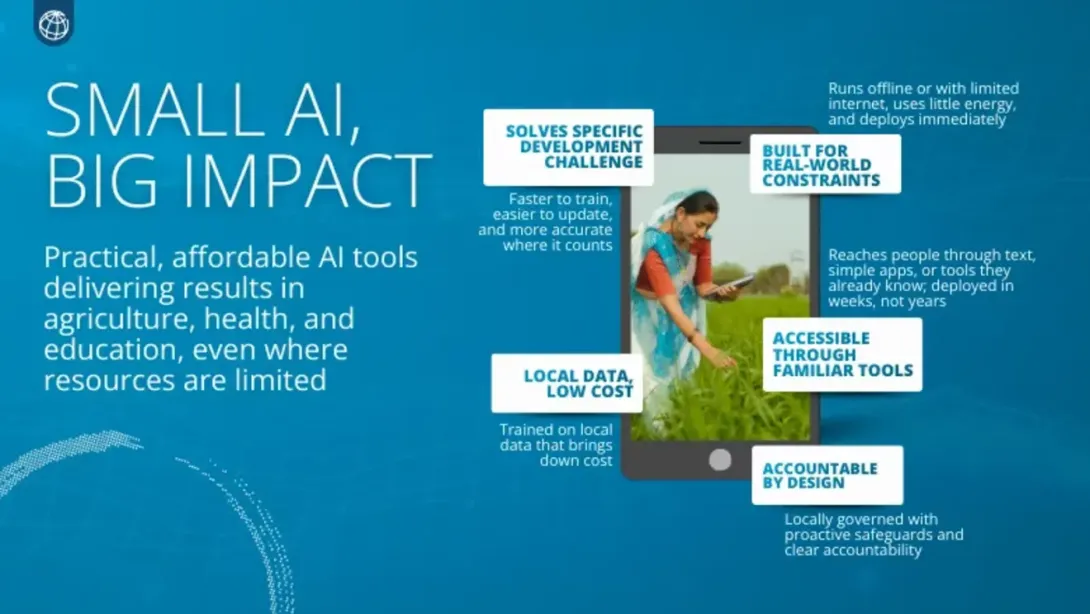
The Word Bank Group is enabling small AI, practical, affordable solutions that run on everyday devices, to solve specific, local development challenges where infrastructure and skills are limited. This includes reducing policy barriers, supporting the private sector to pilot and scale small AI in priority sectors, and strengthening the foundations needed for responsible AI adoption.

Across sectors, small AI is already delivering results. In agriculture, farmers can diagnose crop pests from photos taken on basic smartphones. In health, handheld devices support tuberculosis screening without requiring constant broadband connectivity. In education, lightweight AI tutors are helping students achieve learning gains comparable to an additional year of schooling. These solutions are designed for the environments where most people live, and where governments must deliver services at scale.
Resources:
- You Ask, We Answer: Making AI Work For All
- World Bank President: How Small AI Can Help Solve a Big Jobs Crisis
- We Need to Think Big About Small AI
- Small AI, big impact: Harnessing artificial intelligence for development
- Annual Meetings conversation with Tufts professor on “What is Small AI?”
- Small AI Is India's Secret Weapon, Ajay Banga Tells NDTV At Davos
- Digital Progress and Trends Report: Strengthening AI Foundations