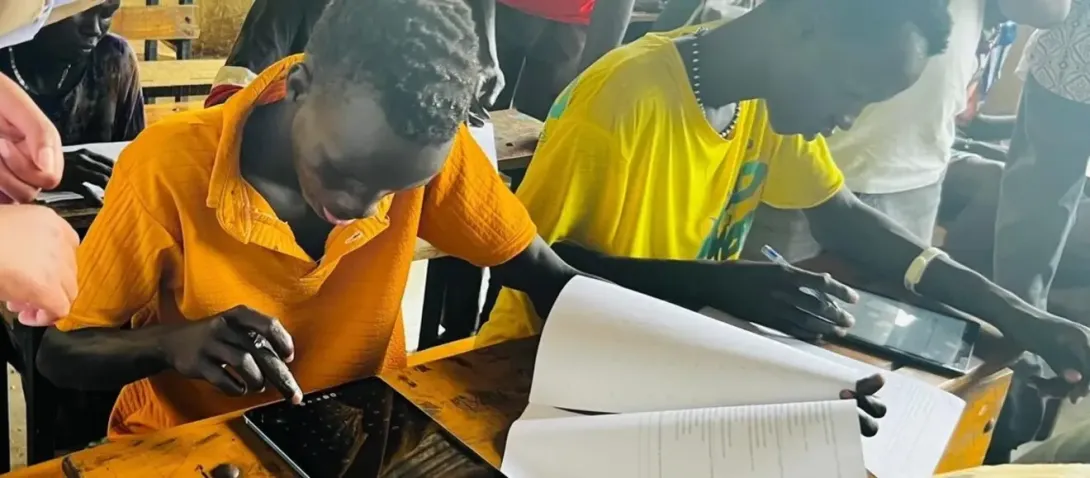
The Inclusive Support for Refugee Education pilot program in Ethiopia aims to build both digital literacy and core academic skills. Copyright: World Bank.
In Ethiopia’s refugee-hosting regions, education is both a lifeline and a daily struggle. Millions of children affected by displacement attend schools where classrooms are overcrowded, textbooks are scarce, electricity is unreliable, and teachers have limited access to training. For refugee and internally displaced students, learning is further complicated by trauma, disrupted schooling, and uncertainty about the future.
But the stakes extend beyond the classroom. In communities facing displacement and economic fragility, education is not only about learning. It is about livelihoods and jobs. Without strong foundational skills, young people risk exclusion from the labor market, perpetuating cycles of poverty and dependency.
Against this backdrop, the Inclusive Support for Refugee Education (INSPIRE) pilot launched in 2025 with a clear question: Can digital learning strengthen foundational skills today while ensuring they are prepared for the jobs of tomorrow?
Early results from refugee hosting Gambella and Somali regional states suggest the answer is yes.
From national commitment to socio-economic inclusion
Ethiopia has demonstrated strong leadership in advancing inclusive education for refugees and host communities, recognizing that long term stability depends on building human capital. The INSPIRE grant is part of this national effort, implemented with the Ministry of Education, regional education bureaus, and the World Bank, and delivered through four Ethiopian EdTech firms.
The pilot centered on an offline-enabled Learning Management System aligned with Ethiopia’s national curriculum and reviewed by Ministry of Education subject experts. It focused on two priority subjects: mathematics for Grade 7–8 in Gambella and integrated science in Somali.
These subjects are not incidental. Strong numeracy and scientific literacy form the backbone of employability in agriculture, construction, services, health, and emerging digital sectors. By reinforcing foundational competencies, the program helps ensure that refugee and host community students are better prepared to transition into secondary education, technical and vocational training, and ultimately the labor market.
At the same time, the grant supported four Ethiopian EdTech firms, stimulating local innovation, strengthening domestic digital capacity, and creating skilled jobs within Ethiopia’s growing education technology sector.
Starting with reality on the ground
Before installing a single device, the World Bank team carried out detailed needs assessments in refugee middle schools. They observed classrooms, interviewed teachers and students, and assessed infrastructure.
Across sites, findings were consistent: limited digital equipment, low teacher familiarity with EdTech, students eager to learn through interactive content, and electricity and connectivity constraints that made offline solutions essential. These realities shaped every design decision.
Lessons developed though the pilot used clear language, strong visuals, and culturally relevant examples. Interactive quizzes, short videos, and accessibility features supported inclusive learning, with gender responsiveness embedded throughout.
By building both digital literacy and core academic skills, the program introduced students to competencies increasingly required in modern workplaces, including problem solving, independent learning, and basic digital navigation.
Bringing digital learning into refugee and host schools
Implementation was carefully sequenced to avoid disrupting school routines.
Two desktop computers preloaded with content were installed in each school, supported by system hubs that allowed teachers and administrators to monitor engagement and progress.
Teachers received structured training in foundational digital skills, digital pedagogy, and student safeguarding, alongside hands-on practice and on-site support. For many students, this marked their first experience with education technology. Strengthening teacher digital competency not only improves classroom instruction. It also enhances teachers’ own professional development and employability in a digitizing education system.
For students, the shift was equally significant. Many experienced digital learning for the first time, gaining early exposure to technology enabled environments that increasingly shape higher education and the world of work.
What changed in the classroom and why it matters for jobs
Within weeks, teachers reported higher engagement, stronger participation, and improved understanding of mathematics and science concepts. Students were more motivated and confident, and teachers gained flexibility in lesson delivery.
Across Gambella and Somali regions, the pilot INSPIRE grant directly reached more than 14,000 refugee students and 438 teachers in middle schools. Regional education bureaus also gained something critical: evidence that digital learning can strengthen engagement and contribute to improved performance, including in national mathematics examinations.
Improved foundational learning outcomes increase the likelihood that students complete secondary education, pursue technical and vocational pathways, and secure better paying employment. In refugee hosting regions where economic opportunity is limited, even modest gains in learning can have long term implications for income generation, self reliance, and local economic growth.
Overcoming constraints with smart solutions
The project was designed around the challenges of refugee education. Simple interfaces support teachers and students with limited digital experience. Groups of students rotated during lessons to maximize limited devices in crowded classrooms. Offline functionality ensured continuity despite connectivity gaps. And standardized training materials mitigated the effects of teacher turnover, particularly in refugee schools.
In practice, constraints became catalysts for innovation, particularly in remote refugee schools with limited infrastructure.
The program demonstrates that even in fragile and resource constrained settings, digital tools can strengthen foundational skills, build digital competencies, and lay the groundwork for future jobs.
A path forward
This INSPIRE grant shows that displacement does not have to mean disrupted learning. With the right combination of technology, teacher support, inclusive design, and government leadership, education systems can equip refugee and host community students not only to catch up academically, but to build skills and contribute to the economy of the community.
In Ethiopia’s refugee hosting regions, digital learning is doing more than improving math and science scores. It is building the skills, confidence, and digital exposure that young people need to access further education, technical training, entrepreneurship, and jobs.
This program is supported by the World Bank’s Foundational Learning Compact multi-donor trust fund. Find out more: https://www.worldbank.org/en/programs/foundational-learning-compact