
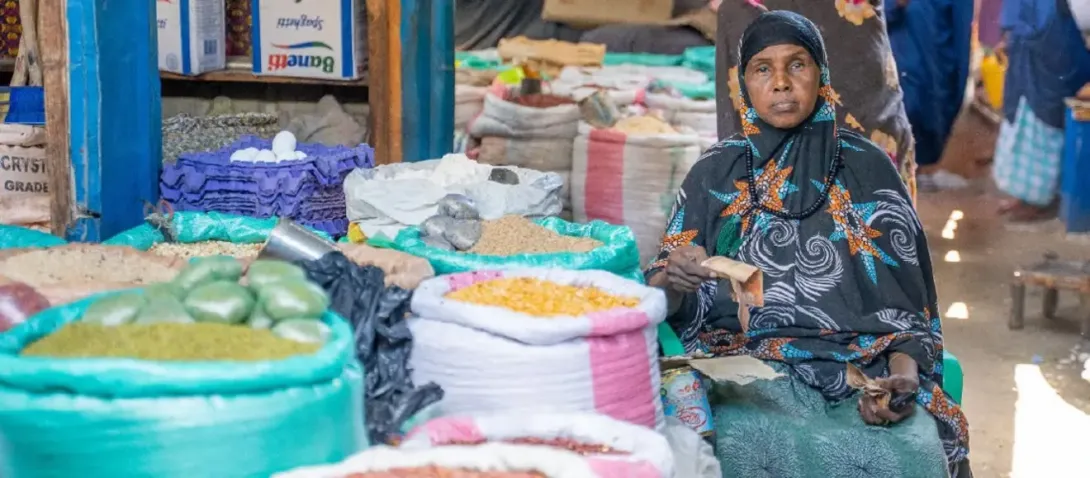
A woman entrepreneur in Somalia. Photo: World Bank Group
When we speak with business owners across Somalia, we often hear a familiar mix of determination and frustration. Entrepreneurs are adapting, finding customers, and keeping their businesses afloat but they feel stuck. They are working hard, but struggling to grow, invest, and create new jobs.
Over the past two years, we have listened carefully to these experiences, not only to conversations with firms, but also to the data. Two rounds of the Somalia Integrated Business Surveys, conducted in 2023 and 2024, each covered 700 formally registered firms across five cities: Mogadishu, Baidoa, Beledweyne, Bosaso, and Kismayo. Together they offer detailed and timely views of how Somali businesses are performing, what is holding them back, and how they see the future-something that is very valuable as we work to design projects and assistance targeted to help them succeed.
This analytical work, supported by the Somalia Multi Partner Fund (MPF), complements the World Bank Group’s Somalia Country Private Sector Diagnostic (CPSD, 2025), and the World Bank Enterprise Survey (WBES, 2025), which highlight the central role of the private sector in driving growth and jobs. A conducive business environment, anchored in strong regulatory and institutional frameworks, will be critical for Somalia’s future, to creating more jobs, and to achieving inclusive, private sector-led growth.
What we learned: Firm sales have increased but performance is constrained by persistent challenges
Percentage of firms that increased and decreased sales in the last 12 months, by city and year
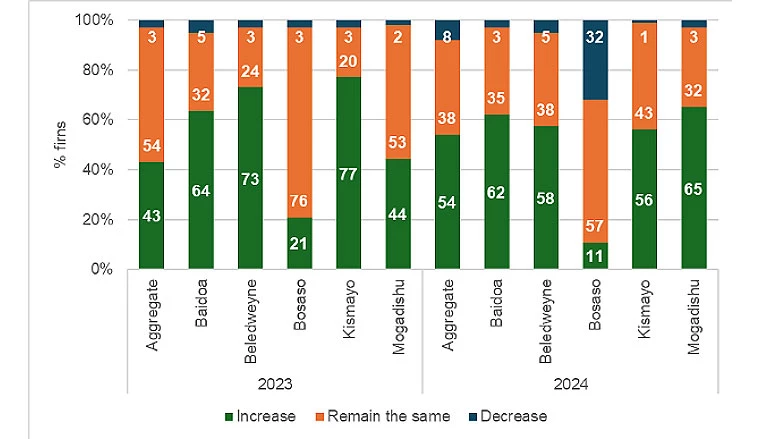
The survey data show some encouraging signs. Between 2023 and 2024, 54% of surveyed firms reported higher sales, and nearly three quarters expected sales to grow further in the months ahead. Across cities, business sentiment improved, and many entrepreneurs expressed cautious optimism about demand.
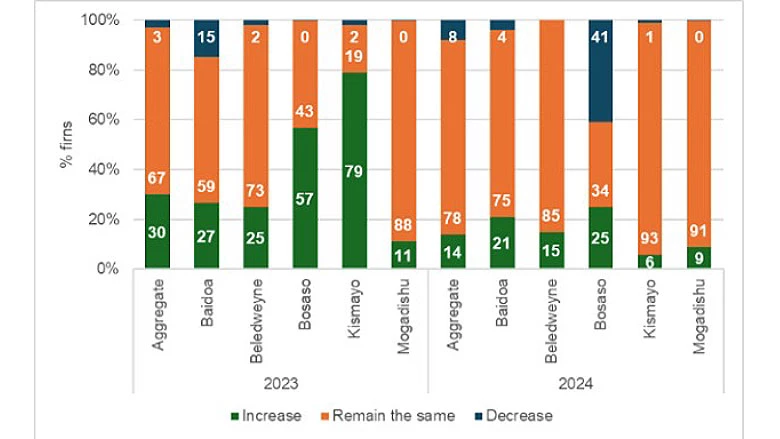
Yet we found other performance indicators were sobering. Only 14% of firms expanded their workforce in 2024, even as sales improved. Productivity growth remained modest and uneven, with gains concentrated among a subset of firms and locations. About a third of firms purchased fixed assets—slightly below benchmarks—often citing insufficient demand as a reason for not investing. Most enterprises are also locally oriented: 84% sell primarily to local markets, and only 7% export directly.
Percentage of firms that increased, decreased employment by city and year
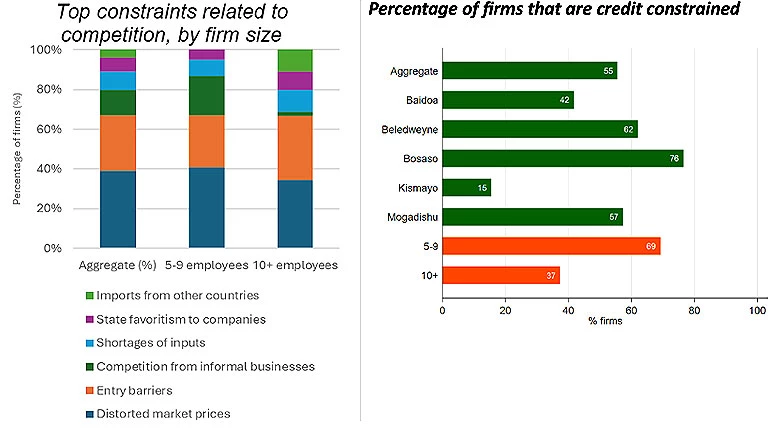
Firms also pointed to constraints that are holding back performance. Market competition was cited as the most binding constraint, reflecting price distortions, entry barriers, and competition from informal businesses. Access to finance also stands out as a major challenge, echoing findings from the CPSD. More than half of surveyed firms reported being credit constrained, well above regional averages, yet only 10% formally applied for a loan in 2024.
Women are underrepresented in business ownership and face steep challenges in operating and growing firms. Only 7% of surveyed firms are majority female-owned, and women own on average 8% of each firm (compared to 18% in Sub-Saharan Africa). Even as overall sales improved, just 4% of female-owned firms invested in new fixed assets, compared to 33% of male-owned businesses.
Policy Reforms are Critical for Private Sector Growth
A clear message emerging from the surveys, also consistent with the CPSD, is that the enabling environment matters as much as individual firm behavior.
In recent years, Somalia has begun to modernize some of the core policies and systems businesses rely on. Through the World Bank-funded Somalia Capacity Advancement, Livelihoods and Entrepreneurship Through Digital Uplift Project (SCALED-UP), government-led reforms have strengthened digital identification, introduced online business registration and licensing, and launched interoperable payment infrastructure. These reforms have helped firms spend less time dealing with administrative processes, reduce risks through more connected payments, and lower uncertainty and costs.
The same applies to access to finance. Under SCALED-UP, Somalia’s wholesale financing facility, Gargaara, has supported banks and microfinance institutions to extend credit to more than 4,000 enterprises, with over $42 million disbursed. While we see challenges in accessing finance do persist, this experience shows that lending to small and medium firms, including those in sectors often deemed risky by banks (such as agriculture), is possible through tailored incentives. It also demonstrated the measurable benefits of government partnership with the World Bank.
From New Systems to Better Functioning Markets
This is why the next phase of reform focuses less on launching new systems and more on strengthening and expanding the ones already in place so markets can function better. The Somalia Productive, Resilient and Inclusive Growth Project (SPRING) builds on the foundations established through SCALED-UP, and the CPSD’s recommendations. It will support stronger institutions, clearer and more consistent business rules, improved financial sector oversight, and business development services that reach beyond Mogadishu.
SPRING responds directly to what firms themselves are telling us: sustainable growth must be linked to broad-based productivity gains large enough to create demand for labor—and grounded in a business environment where firms that are ready to grow are not held back by the systems meant to support them.