

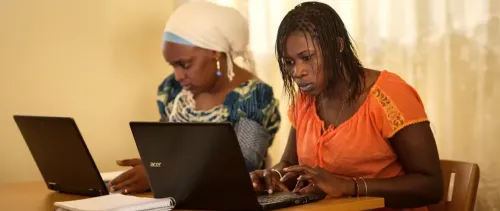
© Indah Lestari via Canva
WBG
Awful but lawful: Confronting technology-facilitated gender-based violence
The rise of technology-facilitated gender-based violence (TF-GBV) is a silent epidemic—widespread, devastating, and often “awful but lawful.”
In today’s interconnected world, women and girls are embracing digital platforms and artificial intelligence (AI) tools in every aspect of their lives—at home, in work, and in education. Yet, this digital integration also brings new risks. Cyber-harassment, online stalking, deepfakes, non-consensual image sharing, and gendered disinformation are disproportionately weaponized against women and girls. While the rapid growth of generative-AI and other innovations offer new opportunities, they simultaneously create new types of abuse and amplify existing ones at speed and scale.
The statistics are stark: the United Nations estimates that 95 percent of aggressive behavior, harassment, abusive language, and denigrating images in online spaces targets women. This online violence is forcing up to 60 percent of women and girls offline, widening the gender digital divide and limiting their civic and economic participation. The economic cost of online violence against women is also substantial, with the EU alone losing an estimated €49.0 to €89.3 billion annually through lower quality of life, reduced labor force participation, and substantive healthcare and legal costs.
Closing the legal gaps: the imperative for reform
Despite the pervasive nature of TF-GBV, legal protections lag far behind. The World Bank’s flagship report, Women, Business, and the Law 2024, finds that fewer than 40 percent of 190 economies worldwide have laws specifically addressing cyber-harassment. This leaves 1.8 billion women and girls vulnerable. Even where laws do exist, most economies offer only criminal remedies, leaving survivors without the ability to seek damages, injunctions, or content removal unless they enter the criminal-justice system. Furthermore, many existing laws suffer from overly narrow definitions of cyber-harassment, limiting their effectiveness.
Consider these examples:
- Portugal’s cybercrime law does not explicitly address cyber-harassment or cyber-stalking.
- Serbia’s criminal code exclusively protects minors from online abuse, but not adults.
- In Dominica and Kuwait, laws addressing cyber-harassment are confined to specific settings, such as the workplace or intimate relationships, failing to cover broader online contexts.
Fortunately, progress is being made. Countries are beginning to evolve their legal frameworks to comprehensively tackle these offenses. With support from the World Bank, the Republic of the Marshall Islands passed a 2025 bill criminalizing harmful digital communications. Lebanon’s Law on Criminalizing Sexual Harassment now explicitly includes “electronic means” in its definition, allowing for both criminal prosecution and compensation for psychological, moral, or material harm.
Fostering safety-by-design: tech innovations for survivors
Technology companies have a critical role to play in combating violence against women perpetuated on their platforms. This requires a fundamental shift towards ‘safety-by-design’ approaches that empower women and girls to navigate digital spaces with greater confidence and reduced risk.
‘Safety-by-Design’ is proactive, user-centric philosophy that embeds safety features directly into digital platforms and AI tools. The goal is to minimize the risk of online violence—or, ideally, to prevent it before it occurs. This can involve a range of features, from embedded reporting mechanisms within apps to sophisticated content moderation that immediately removes harmful material.
IREX and Development Gateway, supported by the Gates Foundation, are actively engaging local technology companies in Kenya to demonstrate how digital platforms can be built with safety at their core. TunzaMalkia, a sexual and reproductive health platform, has integrated an ‘escape button’ which instantly redirects users to a neutral site if they feel unsafe. BilaWoga, a personal safety app, leverages AI for discreet emergency assistance. Crucially, sensitive personal data, such as location, is processed locally on the user’s device, giving women full control over their information.
Beyond policy: forging strategic partnership for impact
Effective responses to TF-GBV require coordinated action across government, tech companies, civil society, and international organizations. Strategic multi-stakeholder partnerships are essential to address gender-based violence holistically, bridging both online and offline spaces.
Together, the World Bank and the Gates Foundation are doing just that. Online safety is a priority theme under the Digital Empowerment and Equity Program (DEEP), a three-year partnership dedicated to bridging the digital gender gap and empowering women and girls in developing countries. From ensuring digital literacy programs for women feature lessons on online safety, to building capacity for governments and law enforcement, DEEP is supporting World Bank clients in the fight for women’s online safety.
This vital work is already underway in several regions:
- In Latin America and the Caribbean, a pilot will collaborate with UN Women to strengthen regional capacity to prevent and respond to online violence. The project will establish minimum policy standards, build a repository of scalable solutions, and facilitate regional knowledge sharing.
- In Pakistan, work will support the design of women’s digital literacy programs that incorporate online safety training. The project aims to ensure women feel safe using digital devices, enabling their access to digital services and improving their economic inclusion and agency.
- A program in India will document and address gender-specific constraints facing women farmers in AgTech adoption. Through a safety-by-design approach, the program will incorporate strategies to prioritize farmers’ online safety, in collaboration with AI solution developers.
The way forward: creating safe digital spaces for all
Let’s move beyond “awful but lawful.” During and beyond the 16 Days of Activism against Gender-Based Violence, we must rally to tackle this issue head-on. By integrating comprehensive legal reform, championing survivor-centered technological innovation, and pooling our collective knowledge, expertise, and resources, we can—and must—create safe and accessible digital spaces for all.
RELATED NEWS



eTrade for Women is an initiative led by UN Trade and Development (UNCTAD), in collaboration with eTrade for all partners.
Keep in touch
Subscribe to our Newsletter
Get the eTrade for all monthly newsletter packed with our partners latest news, including on gender and the digital economy.
SUBSCRIBE