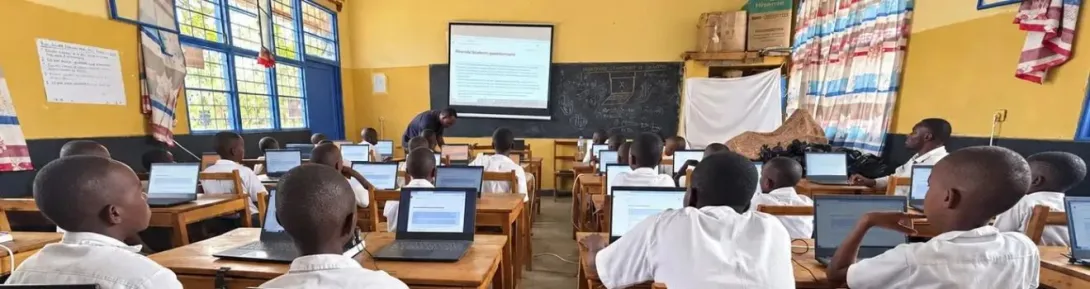
© S. Kleinmann / World Bank Group 2025
How Rwanda is moving beyond technology investments to strengthen school-level ICT integration, digital learning platforms, and education system resilience.
Rwanda has emerged as one of Africa’s leaders in education technology, with sustained investments in school connectivity, digital devices, e-learning platforms, and digital content as part of its broader vision for a knowledge-based economy. These efforts reflect a clear national commitment to using technology not only to expand access to education, but also to strengthen the quality, flexibility, and resilience of teaching and learning.
Yet Rwanda’s experience has also highlighted a reality faced by many countries: technology investments alone do not guarantee better learning outcomes or greater resilience. The real challenge is ensuring that teachers and students use digital tools effectively as part of everyday instruction, supported by strong, flexible systems that can ensure learning continuity during disruptions.
Through the World Bank–Mastercard Foundation partnership, Rwanda has been working to address this challenge. The partnership complements the World Bank’s large-scale EdTech investments in Rwanda’s education and skills systems, which included providing devices, training teachers in digital skills, and establishing key education and information management systems. To these investments, the partnership added a targeted layer of evidence generation, policy dialogue, implementation support and technical assistance to strengthen key systems. Together, these efforts are helping the country move from expanding access to technology toward building a more resilient and sustainable digital learning ecosystem.
Looking Beyond Devices
An important starting point was the study Learning Resilience in Rwanda’s Basic Education System, which examined the role of education technology in learning continuity and resilience. Resilience here refers to the education system’s ability to prepare for, withstand and recover from shocks and disruptions, including school closures of varying scale, while keeping learning going and adapting to emerging needs. The study found that Rwanda’s significant investments in EdTech created a strong foundation for learning continuity and resilience, but that their impact was limited by persistent challenges in teacher capacity, digital skills, system coordination, the effective use of technology in classrooms, and the ability to maintain learning during disruptions.
The study reframed resilience as a system-wide issue rather than a technology issue. It identified five interconnected pillars necessary for resilient learning: infrastructure, digital systems, digital resources, digital skills, and leadership and management.
As Tihtina Zenebe Gebre, Senior Education Specialist at the World Bank, explained:
“The Government of Rwanda has consistently prioritized EdTech, both as a tool to strengthen education service delivery and system management, and as a key investment for economic growth and transformation.”
This broader perspective helped shift the conversation from how many devices schools have to how technology can support learning quality, continuity, and equity to support the specific learning needs of children, including those with special needs.
Generating Evidence for Better Decisions
The resilience study was complemented by other analytical work that helped identify where Rwanda’s digital learning ecosystem was succeeding and where further action was needed.
A Rwanda Polytechnic E-Learning Evaluation, supported by the Priority Skills for Growth and Youth Empowerment (PSGYE) Program, found strong potential for blended and hybrid learning but identified barriers including limited internet access, insufficient computer facilities, limited digital content, and the need for stronger support for instructors and students.
At the system level, Rwanda also implemented the EdTech Readiness Index (ETRI) 2.0, a tool that assesses how prepared schools and education systems are to use technology effectively for teaching and learning, including the policies, resources, and capacities needed to support its use. ETRI 2.0 provided a comprehensive assessment of national readiness across multiple dimensions of education technology in Rwanda. The findings were shared with the Ministry of Education and the Rwanda Basic Education Board to inform future policy and investment decisions.
Together, these assessments pointed to a common lesson: technology delivers value only when schools, teachers, learners, and institutions are prepared to use it effectively.
Turning Evidence into Action
One of the study’s most significant outcomes was its influence on implementation. To begin moving its recommendations into practice, the partnership supported an ICT integration pilot in six model schools. Rather than distributing technology, the pilot focuses on how schools can systematically integrate ICT into teaching and learning through better school planning, head teacher training on school-based ICT integration, monthly monitoring and review, and AI literacy training for teachers. The aim was to use this small pilot to develop a practical model for integrating ICT that can be adapted and scaled across Rwanda’s education system.
As Tihtina Zenebe Gebre noted:
“There is a high level of connectivity in schools, electrification is almost at 100%, and there has been significant investment in devices. We supported the Ministry of Education and the Rwanda Basic Education Board to focus on using these resources for a more deliberate school-level ICT integration and use that pilot to document lessons and package it as a blueprint that can be scaled up across all schools.”
This represents an important shift—from investing in technology to investing in the systems and practices that make technology useful.
Strengthening the Digital Learning Infrastructure
At the same time, Rwanda has been strengthening the digital platforms that support blended and online learning across the education system.
In basic education, the Rwanda Basic Education Board (REB) upgraded its e-learning platform— Moodle, an online system for delivering and managing educational courses and learning materials—from version 3.1 to version 5.1. The initiative also introduced a mobile learning application, gamification features, content development guidelines, and a quality assurance checklist for digital learning materials. These improvements are already supporting English language training for pre-service teachers across 16 Teacher Training Colleges.
Progress is also visible at the post-secondary level. Rwanda Polytechnic has upgraded its own platform, accredited several blended programs under the Priority Skills for Growth and Youth Empowerment Program, and strengthened the enabling infrastructure for digital learning, including internet bandwidth and computer labs across campuses.
This connection between digital learning and skills development also reflects the World Bank Group’s broader Education and Skills agenda, which emphasizes building job-relevant skills and helping people put those skills to work. Strengthening the systems that support blended and digital learning can help expand the ways in which learners access and develop those skills.
Successful digital learning depends not only on access to a platform but also on content quality, usability, teacher support, and clear standards for implementation. By strengthening these foundations, Rwanda is helping ensure that digital learning becomes part of routine educational practice rather than a solution used only during emergencies.
“The Government of Rwanda has consistently prioritized EdTech, both as a tool to strengthen education service delivery and system management, and as a key investment for economic growth and transformation.”
Building Capacity for Sustainable EdTech Investments
Technology investments also require systems for maintenance, monitoring, and replacement.
To address this challenge, Rwanda participated in the EdTech Policy Academy, bringing together representatives from the Ministry of Education, the Rwanda Basic Education Board, the Rwanda TVET Board, Rwanda Polytechnic, the University of Rwanda, and the Rwanda Information Society Authority.
The discussions focused on a critical but often overlooked issue: how to sustain technology investments over time. Participants identified gaps in device management systems and monitoring frameworks and began developing approaches to strengthen long-term maintenance and accountability.
This work reflects a growing recognition that resilience depends not only on acquiring technology but also on ensuring that it remains functional, accessible, and effectively used.
From Technology Investments to System Resilience
Across these activities, a clear pattern emerges. Rwanda is moving beyond a focus on infrastructure and devices toward a more integrated approach that connects policy, evidence, platforms, school practice, and implementation capacity.
The partnership’s efforts are helping Rwanda answer a critical question: how can technology investments translate into better learning and greater resilience?
Rwanda’s experience suggests resilience is not built through devices alone. It is built through systems that can plan, monitor, adapt, and support teachers and learners over time.
By moving from investments to integration, Rwanda is creating the foundations for a digital learning system that is more coordinated, more sustainable, and better prepared to ensure learning continuity—whether education takes place in classrooms, online, or through blended approaches.