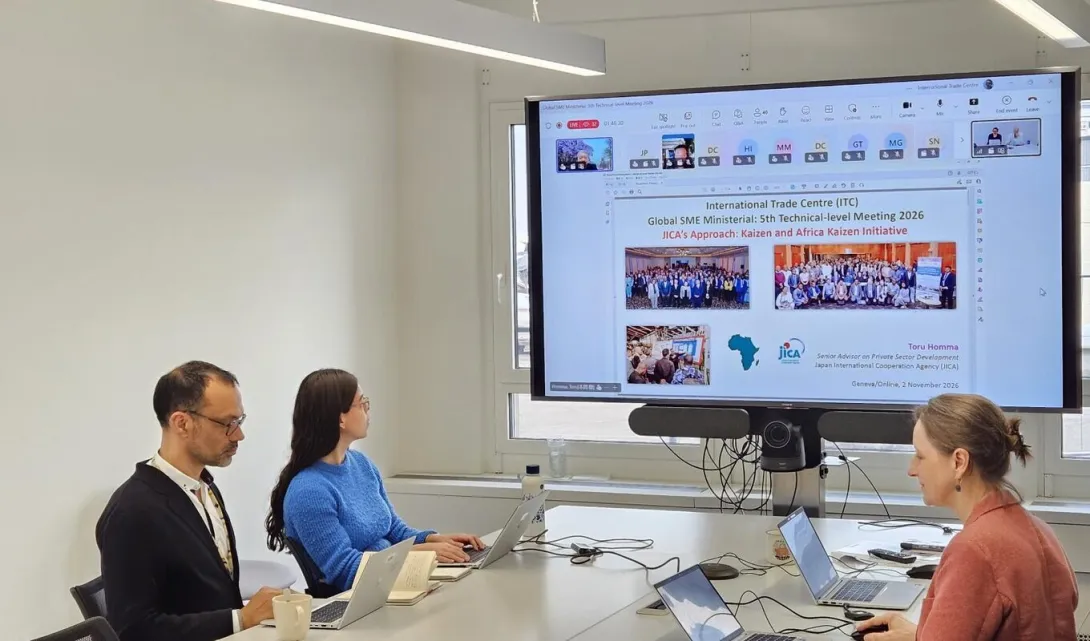
The latest technical meeting of the Global SME Ministerial community provided robust best practices from the Dominican Republic, Italy, Japan, and Mexico.
How do you help a million small shops start taking card payments? How do you raise factory productivity by two-thirds without big capital spending? Countries brought answers to questions like these to the fifth technical meeting of the Global SME Ministerial this year.
The meeting is one of a series of regular sessions between the biennial ministerial meetings. It is where officials compare notes on what has worked at home in three areas: access to finance, the green transition and digital transformation. This time Italy, Japan, Mexico and the Dominican Republic presented their programmes, with results attached.
The Dominican Republic's delegation was led by H.E. Jorge Morales Paulino, the Deputy Minister responsible for micro, small and medium-sized businesses. Having a senior government official in the (virtual) room showed that the process matters to decisionmakers as well as technical professionals. The country set out the obstacles its small businesses face, from meeting sanitary and quality standards abroad to getting formal credit. It also explained how it is tackling them. Promipyme, its specialised SME lender, has provided more than $120 million in financing. In addition, by law, 30% of government procurement must go to small and medium-sized enterprises. The Deputy Minister called for more international cooperation to help firms meet export standards and reach new markets.
Italy, via a senior policy officer from the Ministry of Enterprises and Made in Italy, described its SME Guarantee Fund, which has backed more than 4.5 million operations and mobilised over €560 billion in credit. Other measures include a single online portal for national and regional incentives with an AI assistant, and a new annual SME law to simplify regulation.
Italy's main point was that policy should help firms grow rather than reward them for staying small. It also said it was open to more cooperation with developing countries, particularly in Africa.
Japan shared results from its Africa Kaizen Initiative, presented by Toru Homma, Senior Advisor on Private Sector Development at the Japan International Cooperation Agency (JICA), which is expanding to 44 African countries.
Companies applying Kaizen methods, said Homma, have reported a 64% rise in productivity, 56% fewer defects and 38% shorter lead times. Japan also credited Cameroon with spreading the approach across francophone Africa through local consultants, which is a good example of countries learning from each other.
Then Mexico presented Crece tu MiPyME con Pagos Digitales, a partnership between the Ministry of Economy, VISA, 11 financial institutions and payment companies including BBVA, Mercado Libre and Clip.
Since its launch in December 2025, it has helped more than one million micro and small businesses adopt digital payments, meeting its 2026 target early. Card sales among participating firms are up 79%. The next goal is 3.24 million businesses by 2030.
These presentations add to the Ministerial Knowledge Sharing Platform. Launched in February 2026 on the mandate of the first Ministerial, it now holds good practices from more than 30 countries.
The next technical meeting of the SME Ministerial will take place in late January 2027.