To create deforestation-free, sustainable and transparent agricultural value chains, technology is not enough. It can even create challenges if not incorporated correctly. What producers need is a digital transformation that responds to their needs. Here is how.
Digital technologies are becoming increasingly important to deforestation-free, sustainable and transparent agricultural value chains. Geospatial data and forest-monitoring technologies can establish where commodities are produced, identify land cover changes and shorten the time between a potential deforestation event and action. Traceability systems can connect products to their origins, while data systems can facilitate information exchange among farmers, cooperatives, companies and public authorities.
The implementation of the European Union Regulation on Deforestation-Free Products (or short EUDR) is accelerating this transformation. Supply chain actors must increasingly demonstrate where products come from and under what conditions they were produced. Technology can support this by reducing the costs and errors involved in collecting, storing, managing and sharing information.
However, digitalization is not an end in itself. Technology cannot compensate for weak institutional arrangements, limited capacity or unclear responsibilities for collecting, verifying, updating and sharing data. If poorly designed, digital systems may impose disproportionate costs and administrative burdens on farmers, cooperatives and small businesses. They may also create dependencies when producers cannot access or reuse information collected by a buyer or service provider.
The focus should therefore be on combining technology and ensuring that it responds to real needs without creating new barriers for those expected to use it. This means designing digital transformation and digital infrastructures around producer-country realities so that it strengthens, rather than restricts, participation in agricultural value chains and deforestation-free trade.

Connecting information
At the European Forest Institute (EFI), we recognize that the challenge is often not the complete absence of information, but the difficulty of connecting and using information held by different actors. In the coffee sector of the United Republic of Tanzania, for example, farmer, farm, delivery and lot information is already collected through registration and geolocation initiatives, cooperative records, private sourcing programmes and downstream documentation.
However, these records remain fragmented, and farmers and cooperatives do not necessarily have access to geolocation or other information collected about them by the private sector. This limits their use for traceability and can create dependence on individual buyers or service providers.
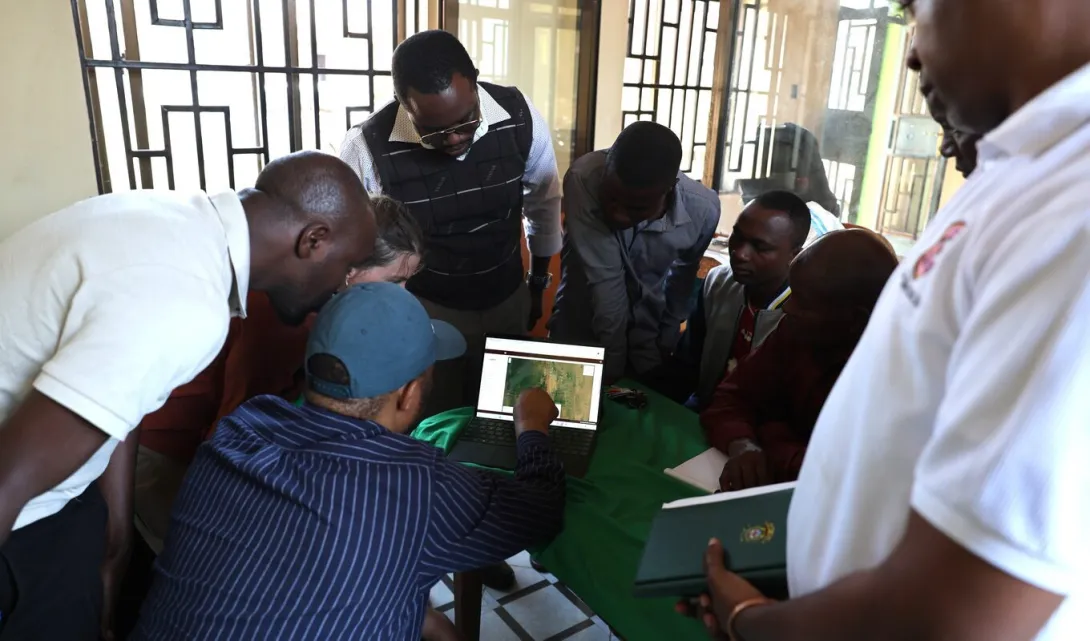
In Kenya, relevant forest maps, protected-area boundaries, land-cover information and deforestation-monitoring systems already exist. Our work has made it clear that the challenge lies in making this evidence sufficiently available and usable for the coffee sector.
This is why EFI is supporting the development of a coffee probability map and procedures for collecting and validating geolocation data, illustrating how technology can strengthen national information systems rather than create a separate compliance platform.
A similar lesson emerges from Thailand's rubber sector. The Rubber Authority of Thailand (RAOT) has added a component to its existing farmer-registration system, which provides for deforestation-free and legality checks, and traceability.
Rubber that meets the criteria for deforestation-free and legal production may be sold through RAOT Central Rubber Markets and is accompanied by all the EUDR-relevant transaction data needed for full traceability. This expands the national system, which pre-dates the EUDR, rather than starting from a new stand-alone compliance platform.
Strengthening inclusion
GIZ’s traceability system INATrace in Cameroon, made possible through the Sustainable Agriculture for Forest Ecosystems (SAFE) project, is one example of how digital tools can strengthen inclusion in agricultural value chains when adapted to local realities. By focusing on inclusive digitalization at the producer and cooperative level - often the least digitized part of the supply chain - INATrace has helped strengthen information flows throughout the wider chain.
In Cameroon, the aim is to register more than 10.000 farmers and 15.000 hectares of coffee and cocoa plots, to improve producer visibility and information management. What’s more, paper-based documentation is expected to be reduced by around 80%, and time to produce documentation by around half. Connecting interoperable, relevant tools, including WHIMO and FAO’s Ground and WHISP, enables additional data collection and sharing without managing separate tools.
Our experience shows that the benefit of INATrace lies not just in the technology itself, but in enabling people and organizations to use information more effectively, especially to make themselves more visible and build a community around the system.
Although challenges remain, inclusive trust-building, training and continuous support are essential to making the system work.
Similarly in Ecuador, INATrace has become a story of transformation driven by producers: the Digital Transformation Center Ecuador in partnership with SAFE Ecuador and the bilateral ELKE program (Deforestation-Free Supply Chains) connected the globally developed traceability solution to local realities by placing it in the hands of producers, young people, and local organizations. The approach was both technological and behavioral: reducing adoption barriers, building trust in rural areas, and ensuring that technology responded to concrete production realities.
In Ecuador, INATrace is used within three different value chains covering cocoa and shrimp, so far registering more than 8.000 producers and strengthening transparency from farm to market. In addition, ten producer associations in these sectors developed new capacities to manage digital systems and technological devices, while an academic institution incorporated data governance into agricultural value chains, consolidating learning that goes beyond individual projects.

Working together: Understanding systems, identifying gaps
Digital investments should start by understanding existing systems, records and responsibilities, and identifying where genuine gaps remain. Technology should address these gaps without creating parallel systems or excluding actors who are already part of the supply chain.
Interoperability and inclusion should always be central to digitalization. Systems need to communicate and exchange information through common standards and clear rules for data sharing and use, while being accessible and relevant to all users. Digital tools should always deliver value beyond compliance.
This approach can reduce duplication, enable the reuse of existing information and prevent fragmented systems that lock users into proprietary technologies. Ultimately, digitalization should connect actors and systems, not create digital divides. Inclusive digitalization also requires strong producer-country ownership, with priority given to systems developed through national and multi-stakeholder processes.
Achieving this requires collaboration beyond individual projects or technologies. The Digital Integration of Agricultural Supply Chains Alliance (DIASCA) is one such example. DIASCA is a multi-stakeholder network facilitated by a GIZ project, funded by the German Federal Ministry for Economic Cooperation and Development (BMZ) as part of the Sustainable Agricultural Supply Chains Initiative (SASI). It brings together organizations working on agricultural digitalization to exchange implementation experience, strengthen capacities and identify common challenges.
DIASCA’s approach to digital public infrastructure emphasizes a shared, interoperable, open and secure foundation connecting actors, data and digital services. The aim is not to promote a particular technology, but to create an enabling, inclusive ecosystem in which complementary solutions can work together.
The European Forest Institute is a contributor to DIASCA’s approach and implements several other projects related to the EUDR and other market requirements, through which it develops, shares and deploys different tools to support legality, geolocation and traceability as well as toolkits to facilitate the access and understanding of existing DPI tools.