
Nuku’alofa, Tonga – 19 August 2026 – Tonga Post is advancing its digital transformation through two complementary initiatives: the National Home Addressing System and TongaPay both aimed at strengthening digital infrastructure, improving financial inclusion and creating new opportunities for digital trade across Tonga.
The initiatives form part of Tonga Post’s transition from a traditional postal operator into a digital infrastructure provider, responding to key gaps in Tonga’s digital ecosystem, including the absence of a universal addressing system, limited commercial banking services.
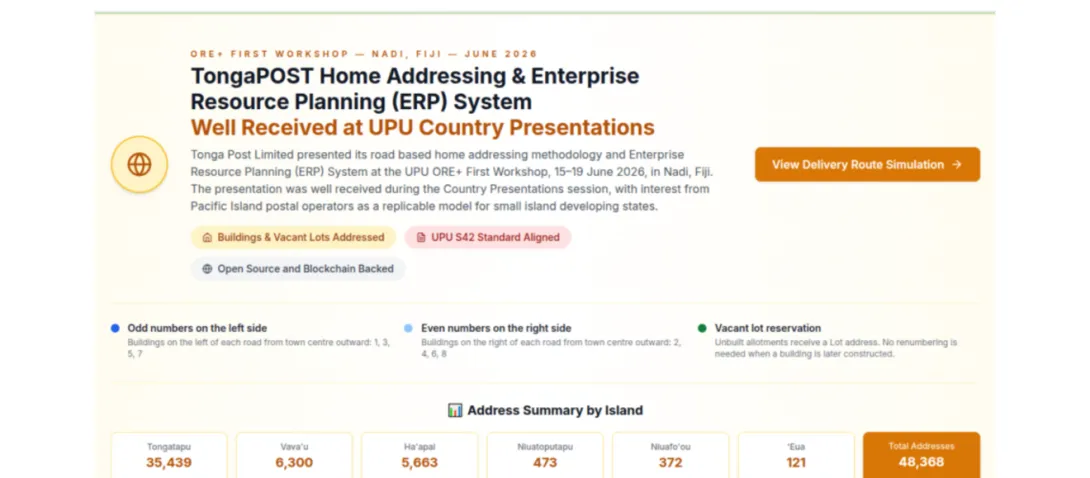
The National Home Addressing System is establishing a structured and verifiable national addressing framework, with the full national building inventory across Tonga’s five island divisions already captured. Developed with technical support from the Universal Postal Union (UPU), the methodology aligns with international best practices and the UPU’s S42 standard for postal address components.
The initiative contributes to Measure 3.3.2of the Pacific Regional E-commerce Strategy and Roadmap (the Strategy), which calls for countries to “adopt home addressing systems incorporating UPU standards to facilitate last mile delivery.” This is particularly important in the Pacific, where dispersed island communities, geographic challenges and high transport costs make last-mile delivery challenging and costly. A reliable addressing system can enable more efficient and affordable delivery of e-commerce and postal packages, while supporting emergency response, KYC and access to essential services.
Tonga Post has formally submitted its addressing methodology to the UPU for review, with UPU confirming that the methodology is sound and represents a significant step forward for addressing infrastructure in the Pacific. Further technical refinement and validation underway by the UPU and once finalised and validated by Tonga, the system could provide a model for adaptation in other Pacific countries facing similar addressing challenges.
Complementing the addressing system is TongaPay, an initiative aimed at providing an affordable and inclusive digital payment rail for communities that may be underserved by existing financial infrastructure. It contributes to Measure 5.2.1of the Strategy, strengthening electronic payment solutions so that people and businesses can make and receive digital payments more easily, securely and efficiently.
Foundational work has been supported by Tonga Post’s own resources and donor financing through the UPU and Pacific Digital Economy Programme. As the initiatives progress towards physical rollout and piloting, sustained investment and further funding will be important to support full implementation and scale. Key partners instrumental in the implementation of these initiatives include the UPU, the Government of Japan through the UPU MIC Future Together Fund, the National Reserve Bank of Tonga, the Government of Tonga and regional postal and digital economy programmes.
When asked what key lessons Tonga Post would share with other Pacific Island countries pursuing similar initiatives, Mr Edwin Liava’a, CEO of Tonga Post, emphasised the potential of postal operators to serve as digital enablers:
“Postal operators are an underused resource as digital enablers. By leveraging our existing networks and infrastructure, we can support addressing, payments, e-commerce, government services and last-mile delivery. Our experience also shows the importance of building sovereign infrastructure, aligning with international standards from Day 1, and using regulatory sandboxes to test and refine innovative services before moving towards full commercial rollout.”
Over the next three years, Tonga Post plans to progress TongaPay from its sandbox pilot towards commercial launch, complete the physical rollout of the national addressing system and secure a UPU-recognised postal code, with longer-term plans to explore regional payment corridors and share its experience with other Pacific countries.