
In 2027, Geneva will host the AI Summit. This global gathering arrives at a historical moment when societies worldwide embark on AI transformation.
Switzerland’s unique contribution can build on the way previous hosts of the summit brought their own distinctiveness. The first summit was held at Bletchley Park, the place where Enigma was deciphered, contributing to the defeat of Nazism. The venue communicated concern about AI as an existential risk to humanity at that time. The Seoul summit highlighted a Korean blend of economic innovation and security. Paris marked a shift from a focus on security and risks to the economic and societal aspects of AI, reflecting French uniqueness. The undertone of last week’s Delhi Summit was development and societal inclusion.
Ahead of the 2027 Summit, Switzerland can help focus on practical and impactful AI transformation centred around the so-called Swiss AI Trinity, a combination of innovative entrepreneurship, inclusive governance, and, most crucially, subsidiarity, a way of using technology as an enabler of citizens and their communities.
In this way, the Summit can bring more clarity in the confused AI discussion, which is increasingly centred on hype and false dichotomies between doomers, who see AI as an existential threat, and accelerationists, who consider the unlimited growth of AI to be fully beneficial for humanity.
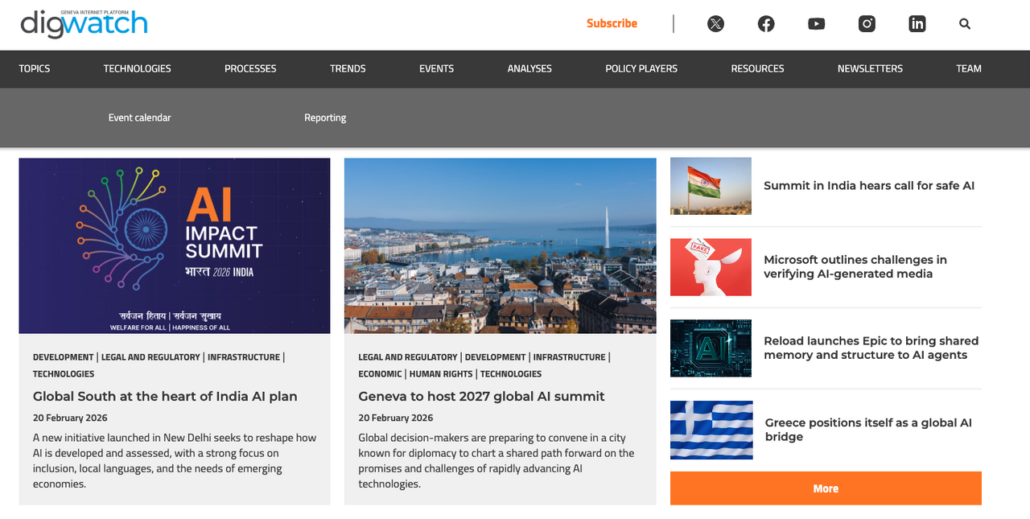
Swiss hype resistance, shaped by historical and cultural factors, will be beneficial in revitalising sound judgement in AI thinking, language, and action. Against this backdrop, this text suggests ten signposts on the Road to the 2027 Geneva AI Summit. Each signpost is explained in the context of the Swiss policy landscape and supported by DiploAI research, training, and policy monitoring via Dig.Watch portal.
1. Innovation
AI is fundamentally about innovation, both technological and, increasingly, societal. Switzerland has long ranked among the world’s top innovators, favouring grounded, low-hype developments that address real needs and unexplored niches.
Apertus, an open-source large language model (LLM), exemplifies this approach. At a time when over 1,000 LLMs are available, and models have become commonplace, Switzerland sets itself apart by making Apertus fully open source – including the data and model weights – unlike many so-called open-source alternatives.
Although Apertus does not compete with leading US and Chinese models that boast trillions of parameters, its 70 billion parameters are sufficient for practical applications in academia, business, and government. It is also fine-tuned for multilingual use, reflecting Switzerland’s linguistic diversity and societal values.
While LLMs are essential, they represent only one component of the broader AI pipeline. The next wave of innovation will involve activating the knowledge of citizens and institutions through data labelling, embedding reinforcement learning into pedagogical practices, and developing knowledge graphs.
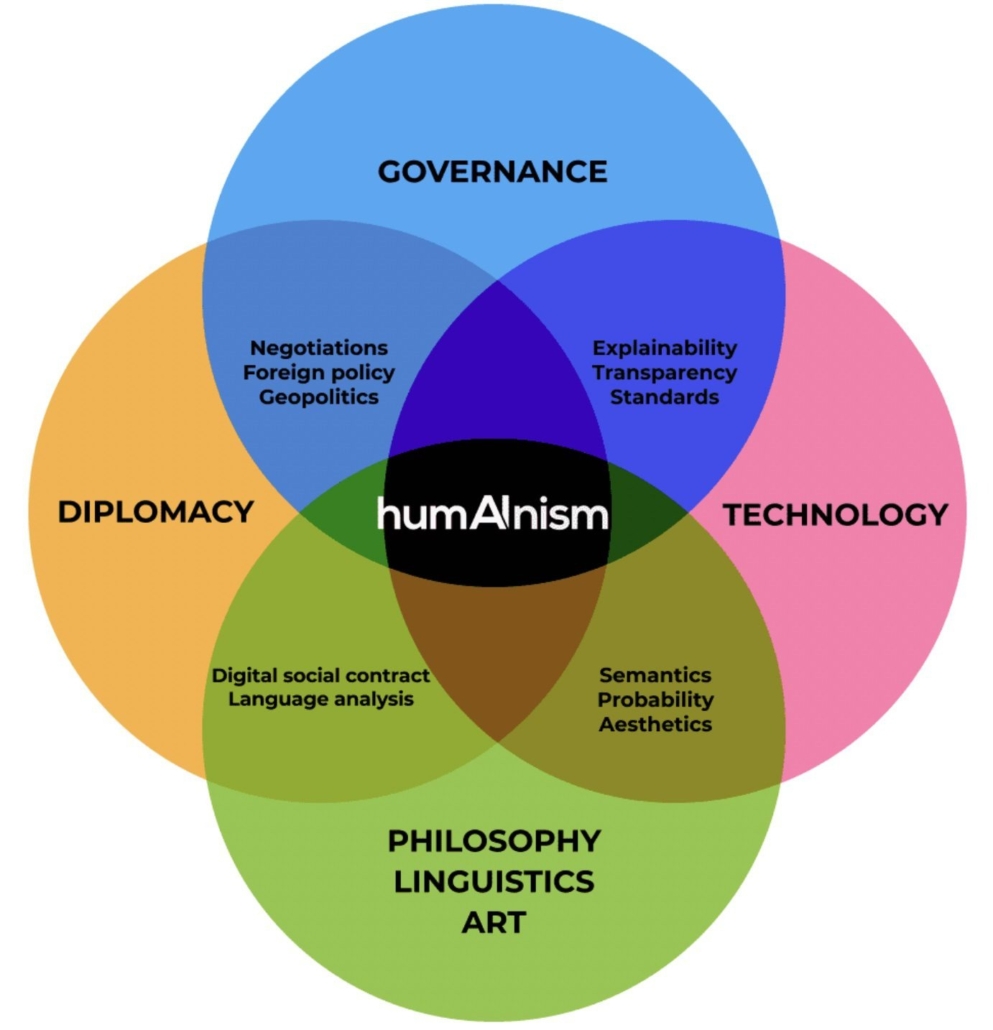
These efforts call for advances not only in technology but also in pedagogy and management. For AI to have a meaningful impact, innovative contributions will be essential from disciplines beyond engineering – including philosophy, linguistics, law, diplomacy, and the arts.
At Diplo, as illustrated below, the humAInism methodology anchors AI within a wider context that includes the arts, sociology, and philosophy.
2. Governance
At the recent Summit in New Delhi, enthusiasm for broad AI governance has waned, shifting away from the existential-risk framing that dominated earlier debates, especially during the first Summit in Bletchley Park. As a matter of fact, many critical AI impacts on society are already addressed by national and international rules such as those protecting intellectual property, data, human rights, commerce, and trade, as well as regulations against autonomous weapons and the use of AI in warfare. In many cases, the issue is not the absence of rules but a lack of political will to apply existing ones. Thus, AI governance will be more about implementing existing rules, with amendments when needed, than about drafting new ones.
In this context of a common-sense approach to AI governance, Switzerland and Geneva can make a significant contribution.
First, the application of existing international governance mechanisms to AI will naturally take place in Geneva, home to numerous organisations dealing with trade, health, telecommunications, labour, and security.
Second, the recently appointed International Scientific Panel on AI can draw on the experience of the Geneva-based IPCC (International Panel on Climate Change), which has long navigated the delicate intersection of climate science and diplomacy.
Third, Switzerland’s experience in bottom-up policy development offers a model for integrating citizen voices into AI debates, which will be essential for inclusive and legitimate governance.
Finally, Switzerland’s cautious regulatory approach, introducing new legislation only when existing rules fall short, resonates well with the emerging consensus on pragmatic AI governance.
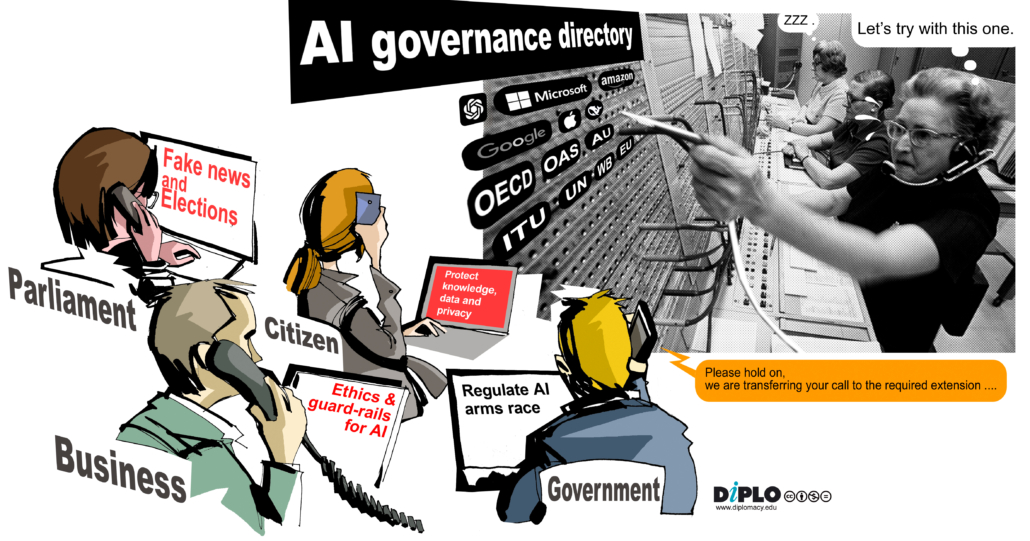
Diplo can support this shift towards common-sense and realistic AI governance, leveraging the organisation’s experience in the field of internet governance that boils down to a simple question: Whom can citizens, companies, and countries ‘call’ to address their AI problems? And even more importantly, who will ‘pick up the phone, as illustrated below.
3. Subsidiarity
The principle of subsidiarity, a cornerstone of Swiss societal organisation, stipulates that societal governance should take place as close as possible to the citizens and communities affected by it. In a careful check-and-balance system, education and many other policy areas are governed by cantons and, in many cases, even local communes.
The principle of subsidiarity is particularly relevant amid growing concern that AI capabilities are concentrated in the hands of a few major platforms.
AI subsidiarity offers a pathway to reverse this trend by anchoring AI development in the communities where knowledge is generated through daily interactions. Knowledge creation is not confined to traditional hubs like universities and think tanks; it happens everywhere in agriculture, tourism, entertainment, and countless other local contexts.
Together, they create a terroir savoir for AI. Just as terroir, the land and its characteristics, shapes the quality of wine and food, local dynamics shape knowledge or savoir. By bringing AI to those who generate and use knowledge, technology will become a genuine enabler anchored in local needs, circumstances, and cultural contexts.
Such bottom-up AI is technically feasible, financially affordable, and ethically desirable. It grounds AI in local realities, helping to counter the growing centralisation of human knowledge in a few distant AI mega-hubs.
4. EspriTech
AI holds a mirror to humanity as AI brings questions of our very humanity, free will, and ethics. In search of answers, societies worldwide are revisiting their cultural, religious, and philosophical roots.
Thus, emerging EspriTech, a way to understand society and technology, leads us to explore deeper layers of thought, particularly the Axial Age, when traditions such as Judaism, Buddhism, Christianity, Taoism, Greek philosophy, Hinduism, and later Islam placed human predicaments at the heart of spiritual and intellectual life. Closer in time, Englightemen ideas of human agency and progress are getting a new context in the AI era.

Many ideas and ways of thinking about society and technology can be traced to thinkers who lived in Geneva. At Villa Diodati on Lake Geneva, Mary Shelley wrote Frankenstein, offering a warning about the dangers of scientific curiosity untethered from ethical responsibility. Jorge Luis Borges, a citizen of Geneva, explored the limits of human knowledge in The Library of Babel. Jean-Jacques Rousseau grounded sovereignty in the individual, while Voltaire championed freedom and critical thought. Ferdinand de Saussure laid the groundwork for structural linguistics, a foundation for modern natural language processing. These and other lessons from the EspriTech de Genève can help fine-tune debate on AI and humanity.
5. Trust
Trust, or lack of it, is becoming critical for the adoption of AI, impacting people’s readiness to use AI technology and share their data and knowledge. The levels of trust and associated emotions vary globally, with high levels of excitement in Asia and nervousness in developed countries, according to the 2024 IPSOS study.
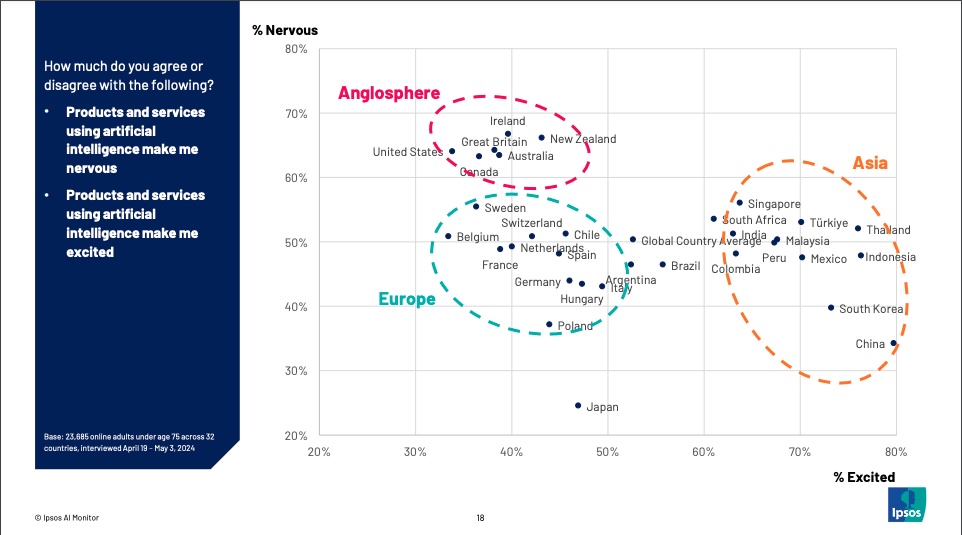
One reason for the lack of trust, especially in the United States, was the dominance of the AI doomer narrative in 2023 and 2024. Such narratives, amplified by the media, heightened the existential risk posed by AI. The societal reaction was predictable, resulting in low levels of trust in AI technology.
Switzerland, as a country with high trust capital, can foster a ‘trust but verify’ approach ahead of the 2027 Summit. Trust can be rebuilt through a fully informed and realistic discussion of AI risks, which have gradually recalibrated from 2023’s focus on existential risks (survival of humanity) to the current primacy of existing risks (education, disinformation, jobs) and growing concerns of exclusion risks (monopolisation of AI by a few actors).
6. Apprenticeship
The need for new skills and knowledge is often highlighted as the main challenge for AI transformation. Capacity development spans from understanding AI among political and business elites to adjusting professions that will be affected by AI developments. AI’s probabilistic nature requires a new pedagogical approach.
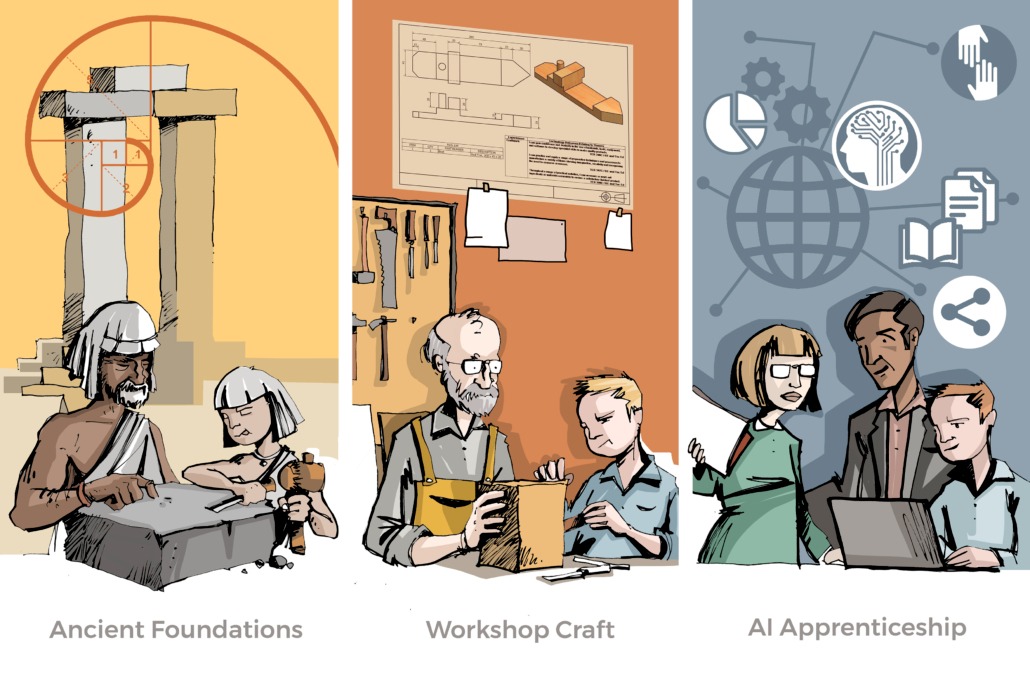
The apprenticeship approach of ‘learning by developing AI’ is emerging as an innovative and impactful way to train in AI. It is rooted in the Swiss apprenticeship tradition, which emphasises learning by doing, guided mentorship, and continuous education.
Diplo’s AI apprenticeship pedagogy has demonstrated in practice that knowledge of AI can be acquired through the development of necessary AI skills. This pedagogy has been tested in practice over the last 18 months with more than 100 participants.
In the build-up to the Geneva AI Impact Summit in 2027, AI Apprenticeship can help broaden and enhance substantive capacities of diplomats, civil society, and local communities for participation in AI processes.
7. Humanity
Humanity is one of the most frequently used words in AI debates. Almost every speech on AI at the UN meetings, the last WEF, and the India Impact Summit included the statement that AI must serve humanity. While this shared concern is positive, repetition could turn genuine concern into a truism without substance.
Thus, the 2027 AI Summit needs to give concrete meaning to the call for AI to serve humanity’s core interests.
Switzerland has been ‘walking the talk’ of human-centred society in politics, education, social care, and the economy. This centuries-long experience can help fine-tune the critical connections between AI and human civilisation by both sharing some lessons learned and experimenting with new approaches and practices for the AI era.
8. Institutions
Institutions are the core organisational setup of humanity. They have been taking shape since the dawn of civilisation through law, governments, and, in the last few centuries, international organisations. In the ‘efficiency era’, institutions have been under significant pressure and attacks questioning their efficiency and, often, vary purpose. AI accelerated anti-institutional trends as AI began automating text, a key resource for many institutions.
While criticisms of institutional efficiency are often justified, they tend to overlook the wider importance of institutions to humanity beyond just efficient service provision. Institutions facilitate social stability and a predictable environment for citizens and companies. Institutions are also carriers of legitimacy and representation on an international level. For example, the key function of diplomats is to represent their countries effectively with various degrees of efficiency.
Institutions are an important carrier of societal memory and knowledge. Most of the traces of ancient civilisations come to us on clay tablets, on accounting, law, or diplomatic exchanges such as the Tal Amarna letters from Ancient Egypt.
More recently, the impact of the US DOGE initiative has shown how the rushed dismissal of officials led to the loss of valuable, especially tacit, institutional knowledge.
Thus, there is a risk that we won’t see the forest (overall purpose of institutions) by focusing exclusively on the tree (institutional efficiency). This risk can be avoided if AI is considered as a creative change agent that can, among others, preserve institutional memory and strengthen the capacity to respond to societal needs.
Here, the Swiss rather lean administration demonstrates that institutions can be effective without being excessive. A case in point is Swiss digital diplomacy, a tiny team, which has contributed significantly in most of internet, digital and AI negotiations over the last few decades, including: co-leading WSIS process (2002-2005), leading the setting of the IGF (2006-2010), negotiating delicate IANA transition of the ICANN (2015), co-sponsoring the UN High Level Panel on Digital Cooperation, leading the negotiation process for the Council of Europe AI Convention.
At Diplo, the AI challenge for management and organisational dynamics is addressed through cognitive proximity approach to enhance cooperation among humans and between humans and AI systems. In this approach, technology is not an end in itself but a tool to help individuals to work better together. Creative solutions emerge through close human-machine interplays.
9. Multilateralism
On the international level, institutions emerged during the 19th century through the establishment of the first international organisations as permanent structures for negotiation and the peaceful resolution of conflicts. As we discuss the future of the UN, it is always important to get ‘back to basics’ by answering questions: Is multilateral cooperation needed for managing an interdependent world? If yes, should it be conducted through multilateral institutions? If we already have the UN, why not reform it, including through AI, instead of creating new structures?
The answer to these questions can show that many international organisations have purpose and relevance. For example, the International Telecommunication Union, founded in 1865, still has its original core purpose to facilitate electrical communication worldwide. In 1865, ITU ensured that telegraph operators did not need to retype messages on national borders. Today, ITU Regulations facilitate smooth connections between fibre-optic cables across the same borders. While technology has been changing, the institutional purpose of the ITU remains the same.
The AI Summit can help clarify the purpose of international organisations in the AI era. AI can, for example, help foster a new level of legitimacy for international processes by ensuring that contributions to public consultations are properly traced and reflected in policy documents.
When we are asked to provide feedback and ‘have our say’, our inputs will be properly considered. Such AI-supported practices can, for example, support the São Paolo Guidelines for inclusive and multistakeholder participation in AI and digital policymaking.
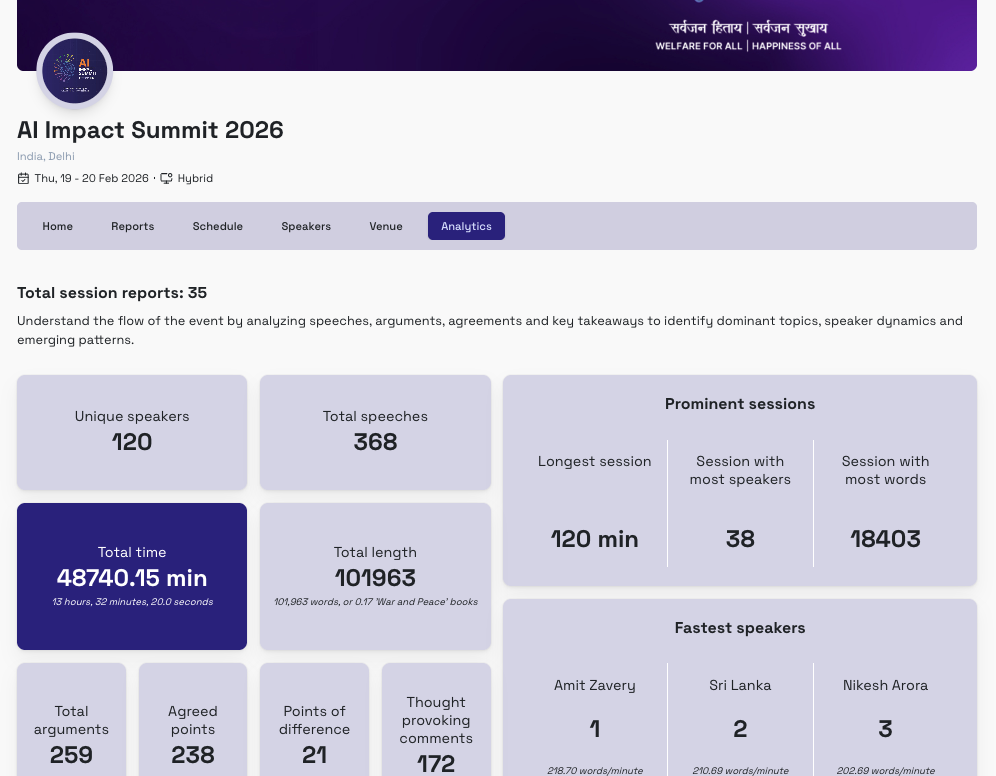
Diplo has experimented with online diplomacy since the 1990s, overcoming physical remoteness. During COVID-19, this expertise supported business continuity in Geneva. Diplo’s spin-off, fAIcon, uses AI to transcribe, structure, and preserve knowledge generated at events (see: fAIcon reporting from the New Delhi AI Summit).
10. Sovereignty
At a time of heightened geopolitical tension, questions of digital and AI sovereignty are becoming more and more relevant. In an interdependent world, sovereignty should not be framed as an isolationist pursuit but as a quest for agency, self-determination and fair stewardship of the knowledge that fuels AI systems.
AI sovereignty includes technical control over technical infrastructure, legal jurisdiction over digital activities, and stewardship of knowledge.
AI and digital sovereignty are carefully balanced approaches. For example, Swiss sovereignty has to support both country’s neutrality and dependence on international engagement, shaped by the country’s export-oriented economy and social fabric, with 1/4 of the population of foreign origin. Digital sovereignty is not about stopping the flow of data across national borders, but a full understanding of digital dependencies and tools to protect national security and prosperity.
Ahead of the 2027 Summit, Swiss experience can foster informed discussion anchored in a balanced and interdependence-based approach to AI and digital sovereignty.
Delicate trade-offs that societies worldwide will have to make in the coming years can help ensure a proper grasp of their data and knowledge while remaining connected to the global digital economy and networks.
Next steps
The 2027 AI Summit in Geneva can be far more than a single event. It has the potential to be the starting point of a new, more mature phase in the AI evolution, one that replaces false dichotomies with nuanced understanding and centralised AI with distributed empowerment.
By increasing clarity of debate, AI discourse can be elevated from an existential threat or a magical solution to a powerful, practical, and trustworthy instrument for human betterment.
At Diplo, together with our partners in Geneva, Switzerland, and worldwide, we will ‘walk the talk’ on the Road to 2027 AI Geneva by providing training, monitoring policy developments, reporting on events, developing new policy tools, and seeking new ideas beyond limited thinking ‘boxes’ and frames.
Make your first step on the Road to 2027 Geneva by joining the ‘First AI Tuesday of the Month’ luncheon, networking, and briefing (taking place on site only, in Geneva).
AI First Tuesday: The Summit, The Governance, The Technology
Make your first step on the Road to 2027 Geneva next Tuesday, 3 March 2025, at 13.00! Join us for a lunchtime networking session dedicated to the three AI vectors in Geneva today: the road to the Geneva AI Summit, the dynamics of AI governance, and the pulse of technological innovation. Mark your calendar for the first Tuesday at 13.00 for months ahead!