
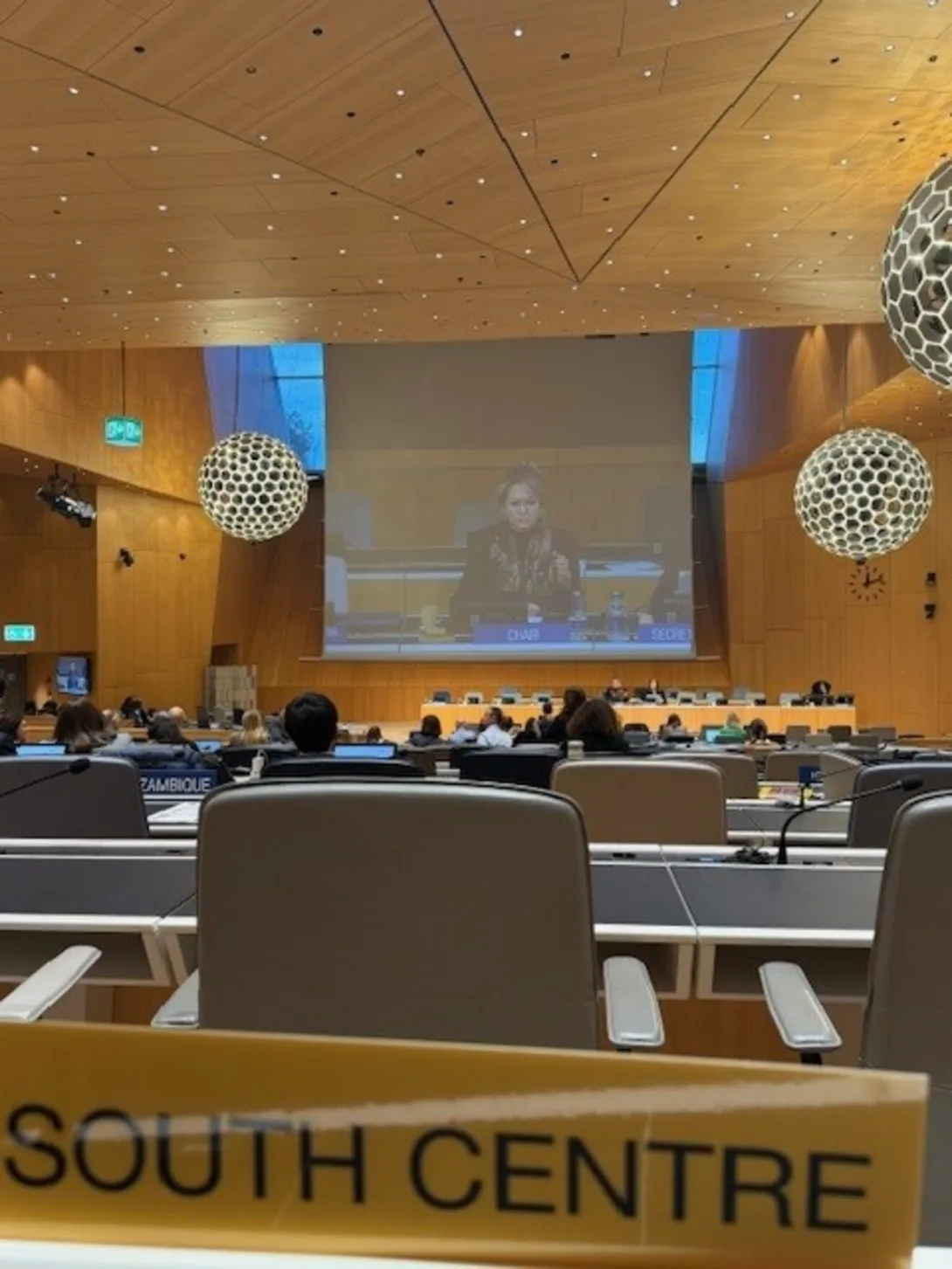
The 47th session of the Standing Committee on Copyright and Related Rights (SCCR) of the World Intellectual Property Organization (WIPO) was held from 1-5 December 2025 at the WIPO headquarters in Geneva. This session focused on advancing discussions on the protection of broadcasting organizations, limitations and exceptions for libraries, archives, education and research, and a range of copyright issues in the digital environment, including artificial intelligence and remuneration of creators.
At the outset Brazil pointed out that the agenda was not adequate for the work of the SCCR. Brazil contended that the agenda disproportionately prioritized discussions on the protection of broadcasting organizations, while relegating matters of high importance to developing countries, particularly the topic of “copyright and related rights in the digital environment”, to a miscellaneous item titled “other matters”, instead of specific agenda items to allow for substantive discussions. While it did not object to the adoption of the agenda as proposed, Brazil cautioned that such imbalance undermines the SCCR’s credibility and its ability to respond to rapidly evolving global challenges.
The emphasis on dedicated discussions on topics related to copyright and related rights in the digital environment was evident in the general statements of several developing countries. Indonesia called upon WIPO member States to advance and reinforce discussions for the development of a future legally binding international instrument on the governance of copyright royalties in the digital environment. Indonesia emphasized the necessity of addressing the problem of disproportionate global distribution of royalties, with creators, particularly in the global South, receiving only a fraction of the revenue generated by their own works. Saudia Arabia on behalf of the Asia and the Pacific Group (APG) stated that most members of the group supported the proposal by Indonesia to advance discussions for the future development of an international legal instrument to address this issue. The APG stressed that, “Such instrument must be a forward-looking framework that can establish minimum global standards for transparency and accountability, support equitable remuneration and fair negotiation between creators and platforms, facilitate cross-border royalty collection through effective data systems and respect and preserve each nation’s sovereignty over cultural policy and related-rights mechanisms.” The Group of Latin American and Caribbean Countries (GRULAC) emphasized the importance of developing guidelines on the use of protected forms of digital media with regard to generative artificial intelligence (AI), as well as transparency, contractual obligations and just remuneration. Algeria on behalf of the African Group also called for engagement on a previous proposal by the group for a study on remuneration of audiovisual performances under the topic on copyright and the digital environment. Brazil reiterated its earlier position on the imbalance in the agenda and stated that should consensus on the broadcasting treaty remain unattainable, the topic should be removed from the agenda of subsequent SCCR sessions until such time as sufficient convergence is reached among interested parties in informal consultations, as was done in the case of the Beijing Treaty on audiovisual performances. Iran, Pakistan and Nigeria also supported continued engagement on copyright and the digital environment, including the proposal by Indonesia and the workplan proposed by GRULAC. India called for engagement on the impact of AI on content creation, distribution and enforcement and noted the need to reinterpret or adapt copyright law in a way that protects the right of copyright holders while fostering AI innovation.
On the other hand, the Group of Central European and Baltic States (CEBS) stated that a standing agenda item on copyright in the digital environment should only be considered once one of the current standing agenda items (protection of broadcasting organizations, limitations and exceptions) is concluded.
The African Group also reiterated its position that discussions on the broadcasting treaty and on an international legal instrument for libraries, archives, museums, educational and research institutions and for persons with disabilities should advance in tandem. Accordingly, the African Group called for advancing discussions on limitations and exceptions so that it may be considered on equal footing with the broadcasting treaty. The Group also noted with concern that the proposed draft text of the broadcasting treaty went beyond a signal-based approach and certain provisions therein created risks of potential restrictions on free flow of information.
The CEBS Group stated that the protection of broadcasting organizations was a priority for the Group.
In the context of its call for taking the agenda of protection of broadcasting organizations out of the agenda if consensus remained elusive, Brazil pointed out that discussions had taken place for over two decades based on various texts and different formats and approaches with little progress. Brazil stressed that the draft broadcasting treaty text risks being overtaken by rapidly changing technologies and realities, making convergence on the text more unlikely. Iran and Pakistan stressed the need to narrow existing gaps and bring the text into alignment with the mandate set by the WIPO General Assembly in 2006 and 2007 – adopt a signal-based approach (so that the treaty protects broadcasting signals but not its content) and limit the beneficiaries of the treaty to traditional broadcasting organizations. Nigeria also stressed that the broadcasting treaty must be limited to the protection of broadcast signals and expressed concern that provisions beyond signal-protection may restrict access to information or legitimate use of broadcast content. India stated that the broadcasting treaty must strike a balance between the rights of broadcasting organizations and the rights of the content’s creators and authors.
On limitations and exceptions, the African Group called for the conclusion of a legal instrument which could take the form of a treaty, or of a joint recommendation or other appropriate form of an international legal instrument. To that end the African Group had submitted a draft text for the consideration of the SCCR. Iran welcomed the text proposed by the African Group as well as the draft text prepared by the Chair. Pointing to common elements in both texts, Iran considered that the proposal by the African Group provided a good basis for text-based negotiations. On the other hand, the CEBS Group stated that in its view the existing international framework provides sufficient flexibility to member States to introduce exceptions and limitations.
Protection of Broadcasting Organizations
Discussions on the protection of broadcasting organizations took place on the basis of a draft WIPO Broadcasting Organizations Treaty (SCCR/47/8) prepared under the Chair’s authority in cooperation with the Vice-Chair Peter Lábody and Facilitators Jukka Liedes and Hezekiel Oira. Positions remained divided throughout the discussion. Several developing countries, including the African Group, Nigeria, Egypt, Iran, and Brazil, argued that the treaty should be strictly confined to traditional broadcasting and cablecasting, as mandated by the 2006–2007 WIPO General Assembly, and cautioned that any inclusion of post-fixation rights would have to be accompanied by mandatory limitations and exceptions. In contrast, the European Union (EU) and CEBS called for a broader, technologically neutral scope that would cover digital transmissions. The United States also insisted on strict adherence to the original mandate of following a signal-based approach and the exclusion of post-fixation rights. China, Mexico, Russia, and the EU supported continuing negotiations to narrow differences and move toward an early diplomatic conference, while Egypt clarified that protection should only apply to first transmissions. The proposal by Brazil to temporarily set aside the topic from the SCCR agenda if consensus could not be reached, drawing on the approach used during the Beijing Treaty negotiations, was opposed by the United Kingdom. With no agreement in sight, delegations moved into informal consultations.
During informal consultations, delegations grouped the draft treaty articles into three blocks to structure discussions according to the level of convergence. The first block, covering articles 1, 9, 12, 13, 14, 16, and 17, raised no concerns in their current form, while the second block, comprising articles 3, 4, 6, and 10, received support in principle but was seen as requiring limited technical adjustments to the provisions or explanatory notes. The third block revealed the most divergence, with delegations calling for further in-depth discussions on the scope of rights and related definitions, exceptions and limitations, and the operation of national treatment and reciprocity principles. The Committee agreed to continue work on these issues at its next session, with a view to assessing whether to recommend the convening of a diplomatic conference, and the Chair will prepare a revised text for consideration at the forty-eighth session, where the protection of broadcasting organizations will remain on the agenda.
Limitations and Exceptions
The SCCR addressed two items relating to limitations and exceptions together – limitations and exceptions for libraries and archives, and limitations and exceptions for educational and research institutions and for persons with other disabilities (disabilities other than for visually impaired persons that are covered in the WIPO Marrakesh Treaty). The central discussion was on whether the work should proceed on the basis of the text proposed by the Chair in the framework of work towards the establishment of an international legal instrument or instruments on limitations and exceptions (SCCR/47/8), the African Group’s proposal (SCCR/47/5), or an updated US proposal on objectives and principles for exceptions and limitations for educational, teaching and research institutions (SCCR/47/9), and on objectives and principles for exceptions and limitations for libraries and archives (SCCR/47/10).
The African Group anchored its proposal in nearly two decades of work at the SCCR, recalling that the Committee has considered limitations and exceptions since endorsing Chile’s 2005 proposal and that the 2012 WIPO General Assembly mandated progress toward appropriate international legal instruments for libraries, archives, museums, educational and research institutions, and persons with disabilities beyond the scope of the Marrakesh Treaty. Emphasizing continuity rather than reinvention, the Group presented a draft instrument that consolidates existing SCCR texts and action plans, arguing that it reflects areas of convergence already identified and aligns with the WIPO Development Agenda. Cameroon, speaking for the Group, highlighted that the proposal is technology-neutral, provides national flexibilities through a mix of specific and general exceptions, supports cross-border uses, addresses gaps such as disabilities and technological protection measures, and is designed to facilitate consensus by bringing all prior work into a single negotiating text. Egypt, Kenya, Russia, Cameroon, Algeria, Zambia, Tunisia, and Iran supported using the African Group text as the basis for text-based negotiations, with Russia describing it as the most mature proposal before the Committee.
Brazil and China advanced more process-oriented approaches, with Brazil suggesting that discussions begin with less controversial issues such as preservation, and China calling for consensus-driven engagement that could gradually narrow differences. These approaches stood in contrast to the position of the US, the EU, Japan, Group B, and CEBS, which opposed using the African Group proposal as a basis for binding norm-setting and argued that the existing international framework, particularly the flexibility of the three-step test, already enables adequate national exceptions and limitations. They favoured non-binding outcomes, including guidance, best practices, and technical assistance, with the US underscoring that the General Assembly mandate does not require a treaty and that progress at WIPO must remain consensus-based. Civil society organizations, however, urged more concrete outcomes, pointing to real-world harms caused by weak limitations and exceptions regimes, including legal uncertainty for preservation and digitization, risks linked to AI training and misinformation, and growing economic pressures on creators, particularly in developing countries.
In view of these divergent positions, the SCCR agreed to work toward finding convergences at its next session in line with the 2012 mandate and the Work Program adopted by the Committee in 2023 taking into account all proposals by various delegations as well as the proposed Chair’s text.
The WIPO secretariat provided an update on access to copyrighted works and cultural heritage institutions under development by a panel of experts. The draft text of the toolkit will be published online in December 2025 and delegations have been invited to submit comments on the draft text by 27 February 2026. Based on the comments, a revised draft of the toolkit will be submitted to the next session of the SCCR in May 2026.
Other Matters
Under the agenda item on “Other Matters”, the SCCR discussed the following topics: copyright in the digital environment, rights of audiovisual authors and performers, resale royalty right, protection of theatre directors’ rights, copyright protection of technical standards, business models and economic opportunities created by and through implementation of technological protection measures (TPMs).
Copyright in the digital environment
Discussions on copyright in the digital environment focused on two parallel proposals and included an information session on generative AI, revealing growing urgency around creator remuneration and transparency in digital markets. Indonesia presented its proposal for a legally binding international instrument, arguing that rapid digitalization and cross-border exploitation of works have created challenges that individual States cannot address alone. Its proposal rested on three pillars: a global governance framework to improve transparency and cross-border royalty flows, exploration of alternative remuneration models better suited to digital markets, and minimum global safeguards to ensure fair, timely, and proportional payment to creators. Indonesia stressed that the initiative was intended to complement, not replace, regional and national efforts.
GRULAC, meanwhile, proposed a structured but non-binding SCCR work plan aimed at tackling persistently low remuneration for creators and performers on digital platforms, a problem it said has been exacerbated by generative AI. The proposal sought to ground discussions in evidence through economic studies, clarify applicable legal and contractual frameworks, and develop guidance tools for policymakers, while engaging with other WIPO initiatives such as the Artificial Intelligence Infrastructure Interchange. Many developing countries viewed the Indonesian and GRULAC proposals as complementary. Brazil supported the GRULAC approach, linking it to recent Group of Twenty (G20) commitments on AI transparency and fair remuneration, and called for copyright in the digital environment to become a stand-alone agenda item. Several countries from Africa and Asia also backed Indonesia’s proposal, with Nigeria urging the WIPO secretariat to take practical parallel steps such as developing model contracts, organizing regional consultations with creators, and studying unfair competition and contractual practices affecting artists’ livelihoods.
Clear divisions emerged with developed countries and rights-holder groups. Group B, CEBS, and the EU argued that the Committee’s priority should remain on existing standing agenda items, notably the broadcasting treaty and limitations and exceptions, and cautioned against elevating digital copyright to a new agenda item. The US firmly opposed Indonesia’s call for a binding global instrument, citing the territorial nature of copyright, the flexibility already allowed under existing treaties, concerns about undermining contractual freedom, and doubts that the SCCR is the right forum for addressing market-based remuneration issues. While acknowledging that GRULAC’s work plan did not seek new binding norms, the US said discussion was premature and should be deferred to allow more time for analysis. Overall, there was lack of consensus on both substance and process in addressing copyright challenges in the digital environment.
Several observers expressed strong support for the two proposals by Indonesia and GRULAC.
The South Centre welcomed the information session on generative AI and called for future sessions to place greater emphasis on the public interest aspects of AI and copyright. Furthermore, it urged the Committee to ensure broader geographical representation among invited experts in the future dialogues, particularly from developing and least-developed countries, to ensure a more balanced and inclusive dialogue. The South Centre called for convergence on advancing the agenda on copyright and the digital environment informed by the work plan by GRULAC. It also encouraged further discussion in the next session on the proposal by Indonesia on cross-border copyright and the African Group’s proposal.
The SCCR agreed to continue discussions on the proposals by Indonesia and GRULAC at its next session. It also asked the WIPO secretariat to prepare a study on policy or regulatory approaches to the relationship between AI training and copyright, and related rules, and applicable practices on authorization, enforcement and compensation for use, with the understanding that the preparation of this study does not imply any commitment on the SCCR Work Plan. The SCCR also welcomed an information session on copyright and generative AI that was held during this session and invited the secretariat to organize a follow-up information session on copyright and artificial intelligence at the next session of the SCCR as part of the agenda on copyright in the digital environment.
Audiovisual authors’ and performers’ rights
Discussions on audiovisual authors and performers centered on two study proposals put forward by the African Group: a revised study on the rights and payment mechanisms of audiovisual authors and a new study focusing on audiovisual performers. Both proposals attracted broad support from Brazil, Cameroon, Niger, Côte d’Ivoire, South Africa, Zambia, Russia, and the Philippines, while Indonesia signaled its readiness to engage constructively, linking the debate to the shared challenge of ensuring fair remuneration in the digital era. The EU supported moving ahead with the authors’ study and expressed openness to the performers’ study, suggesting that sequencing could be considered if needed, a position echoed by CEBS and Group B, which welcomed a constructive discussion. The United States, however, proposed strict conditions, insisting that any studies remain separate, neutral, factual, and without norm-setting implications, arguing that a performers’ study would be premature until the authors’ study is completed, and opposing any examination of contractual practices, market dynamics, or bargaining power as outside the SCCR’s mandate, while also calling for the exclusion of soundtrack musicians not appearing on screen. Japan similarly urged caution, stressing that any work should be non-binding and strictly limited to a factual review of national legal frameworks.
The SCCR requested the WIPO secretariat to prepare the study on audiovisual authors and agreed to continue discussions on the proposal for a study on audiovisual performers at its next session.
Resale royalty right
On the topic of resale royalty right, the SCCR considered a report on the African Regional Conference on Resale Right held in Rabat in October 2025. The Philippines also offered to host a regional meeting on the resale royalty right for the Asia Pacific region. Discussions on the topic will continue in the next session of the SCCR.
Theatre directors’ rights
Discussions on the rights of theatre directors were brief, with the WIPO secretariat providing an update on the status of an ongoing study on the rights of stage directors of theatrical productions. The Russian Federation, speaking on behalf of the Central Asia, Caucasus, and Eastern Europe (CACEEC) group, called for a new study to examine how different countries address directors’ rights in the context of modern technologies, with a view to identifying emerging needs and possible elements of an international protection framework. The African Group supported the proposal. Discussions will continue in the next session of the SCCR.
Copyright protection of technical standards
Discussion on a proposed study on copyright protection of technical standards centered on a proposal by Canada. The EU, Group B, CEBS, and the United States asked for additional time to consider the proposal, with the EU expressing general interest in a strictly factual and empirical study but proposing that the matter be deferred to the next SCCR session in light of ongoing internal discussions on access to and use of standards. The US indicated it could support the study provided it remains factual, objective, and open to comments from member States. The proposal will be discussed further at the next session of the SCCR.
Business models and economic opportunities created by and through technological protection measures
The US presented a proposal for a study on types of business models and economic opportunities created by and through technological protection measures. The SCCR agreed to undertake further discussions on the proposal in its next session.
Conclusion
Overall, the forty-seventh session of the SCCR exposed a widening gap between the priorities of developing countries and the pace and direction of norm-setting at WIPO, with the Global South consistently calling for balance, relevance, and responsiveness to contemporary realities. While developing countries pressed for concrete progress on limitations and exceptions, fair remuneration in the digital environment, and safeguards against the concentration of value in global digital markets, discussions remained heavily constrained by procedural caution and resistance from developed countries to binding outcomes. The continued prioritization of a long-stalled broadcasting treaty, alongside reluctance to elevate digital copyright issues to a standing agenda item, reinforced concerns that the SCCR risks falling behind technological change and the lived realities of creators, educators, libraries, and cultural institutions particularly in developing countries. As debates were repeatedly deferred or narrowed to studies and informal consultations, it is evident that without meaningful convergence on development-oriented outcomes, the SCCR’s credibility as a forum capable of addressing structural inequities in the global copyright system will remain in question.
Authors: Nirmalya Syam is a Senior Programme Officer, and Ningxiner Li is an intern, of the Health, Intellectual Property and Biodiversity Programme (HIPB) at the South Centre.
SouthNews is an e-newsletter service of the South Centre providing information and news on topical issues from a South perspective.
To view other articles in SouthNews, please click here.
To subscribe and for more information, please contact Anna Bernardo of the South Centre: Email [email protected].