
ILO
Building partnerships for decent work: The ILO's engagement with BRICS in 2026
The ILO contributed technical expertise to advance social protection, skills development, labour market formalization and digital transformation under India's 2026 BRICS Presidency.
NEW DELHI (ILO News) - The International Labour Organization (ILO) continued its longstanding engagement with the BRICS Labour and Employment process during India's 2026 Presidency, highlighting the importance of expanding social protection, investing in the care economy, strengthening skills systems and ensuring that digital transformation creates opportunities while protecting workers' rights.
Hosted in Hyderabad, the 3rd Employment Working Group (EWG) meeting (13-14 July 2026) and the 12th Labour and Employment Ministers' Meeting (LEMM) (15-16 July 2026) brought together ministers, senior officials and technical experts from BRICS member countries to explore collaborative approaches to building more inclusive, resilient and future-ready labour markets.
Under the theme “Building for Resilience, Innovation, Cooperation and Sustainability”, this year's agenda reflected many of the priorities at the heart of the ILO's Decent Work Agenda.
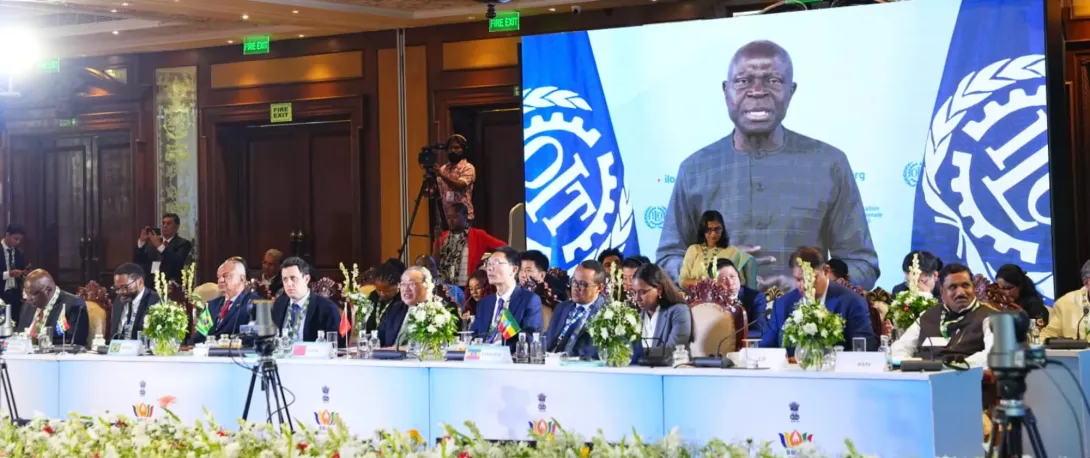
In a video message to the 12th BRICS Labour and Employment Ministers' Meeting, the ILO Director-General Gilbert F. Houngbo commended India’s leadership for placing labour and employment at the heart of the BRICS agenda.
“The priorities identified could not be more timely: expanding social protection and formal employment, increasing women’s participation in the workforce, strengthening skills and employability, and harnessing digital transformation to create better opportunities for all,” said Mr Houngbo.
The ILO delegation was led by Michiko Miyamoto, Director of the ILO Decent Work Technical Support Team for South Asia and Country Office for India, who represented the Organization throughout the Employment Working Group meetings and the Labour and Employment Ministers' Meeting.
Discussions focused on four priorities: expanding social protection and promoting labour market formalization; enhancing women's participation in the workforce; strengthening skills and employability; and leveraging digital technologies to improve labour market governance while protecting all workers, including those in the gig and platform economy. The preparatory discussions during the EWG meetings were instrumental in shaping the Ministerial outcomes, with member countries working through detailed technical proposals and building consensus ahead of the Ministers' Meeting.
Drawing on technical inputs prepared by relevant ILO headquarters departments, Ms Miyamoto presented the ILO's analysis and policy perspectives on the four priority areas and contributed to the technical discussions that informed the Ministerial outcomes.
ILO also shared progress on the feasibility study for an International Reference Classification of Occupations, undertaken with India and joined by Brazil and Germany, to support greater comparability of occupations in emerging sectors such as the digital, care and green economies.
The International Social Security Association (ISSA), the world’s leading international organization for social security institutions, government departments and agencies, worked closely with the ILO in preparing analytical inputs on social protection and digitalization. ISSA also contributed technical expertise during the Employment Working Group discussions, reflecting the long-standing partnership between the two organizations in advancing social protection and strengthening social security systems.
The Hyderabad meetings also showcased the value of peer learning. Case studies presented by BRICS countries highlighted practical approaches to expanding social protection, strengthening skills systems, promoting women's economic participation and using digital technologies to improve employment services and social security delivery. The participation of the United Nations Resident Coordinator's Office (UNRCO), United Nations in India, further underscored the importance of coordinated UN support in advancing key priorities on Decent Work and fostering collaboration across the multilateral system.
A key outcome of the meeting was the adoption of BRICS CONNECT, the BRICS Cooperation Network for Capacity Building, Employability, New Skills and Technology. Building on the existing BRICS Social Security Virtual Liaison Office, the initiative provides a platform for voluntary cooperation, peer learning and capacity building in the four areas. Ministers also adopted the 12th Labour and Employment Ministers' Declaration, reaffirming their commitment to expanding social protection, promoting labour market formalization, strengthening women's economic participation, improving skills systems and supporting a human-centred approach to digital transformation. They welcomed the technical support provided by the ILO and ISSA and expressed their intention to continue working closely with both organizations.
“The ILO welcomes initiatives that strengthen cooperation and knowledge exchange among BRICS members, including through platforms such as BRICS CONNECT,” said ILO Director-General Gilbert F. Houngbo.
“Through South-South cooperation and practical collaboration, BRICS can continue to develop innovative solutions to share challenges that benefit their people and the wider international community. The ILO looks forward to continuing its partnership with BRICS countries as we advance decent work and social justice for all,” Mr Houngbo added.
The BRICS Summit will take place in New Delhi in September 2026, after which the BRICS Presidency will pass to China in 2027.
eTrade for Women is an initiative led by UN Trade and Development (UNCTAD), in collaboration with eTrade for all partners.
Keep in touch
Subscribe to our Newsletter
Get the eTrade for all monthly newsletter packed with our partners latest news, including on gender and the digital economy.
SUBSCRIBE