

In 1991, Mark Weiser, a computer scientist and CTO of Xerox PARC, offered a deceptively simple definition of technological maturity in his Scientific American article, ‘The Computer for the 21st Century’: ‘The most profound technologies are those that disappear. They weave themselves into the fabric of everyday life until they are indistinguishable from it.’
Weiser was imagining ubiquitous computing: computers embedded so naturally into rooms, objects, and routines that people would no longer notice them. The technology would not vanish in the literal sense. It would simply stop demanding to be the centre of attention.
More than three decades later, we live surrounded by technology that was supposed to make life easier and much of it seems determined to be seen, tapped, answered, upgraded, and obeyed. Our phones buzz, our cars ask questions, our homes send alerts, our websites interrupt us before letting us read a single paragraph, and our apps compete to become the place where we spend every spare moment.
The promise of calm technology
Weiser’s idea was later developed by cyborg anthropologist Amber Case into calm technology, an approach to designing digital products that work with human attention rather than against it.
Calm technology does not mean minimalist aesthetics or fewer features for their own sake. It is a design philosophy built around a simple observation: human attention is limited, and technology should require the smallest possible amount of it. It should inform without overwhelming, remain available at the periphery of awareness, communicate only when necessary, and use the minimum technology needed to solve a problem.
Case’s principles include that technology should create calm, make use of the periphery, amplify ‘the best of technology and the best of humanity’, work even when it fails, and respect social norms. In other words, a good tool does not need to perform its usefulness loudly. It should be there when needed and quiet when not.
Think of a well-designed thermostat. It may glow softly when the temperature changes, but it does not demand a conversation. A good calendar reminder appears at the right moment, then disappears. A good navigation system tells you to turn before you need to turn, not after you have already missed it.
These are small examples, but they point to a larger principle: technology should help people complete their lives, not turn life into a sequence of interactions with technology.
The opposite of calm
Much of today’s digital environment seems designed according to the opposite logic.
Open a news site and you may first encounter a cookie banner, a newsletter popup, an autoplaying video, and a request to disable your ad blocker before you reach the article you came for. Try to book a train ticket or a hotel room and the transaction becomes a maze of add-ons, ‘recommended’ extras, account creation, marketing permissions, and urgent countdown timers.
The same pattern appears in physical products. Cars now move basic controls onto touchscreens, adding layers of menus, warnings, subscriptions, and software updates to activities that once required a dial or a button. Smart-home devices promise convenience, but often deliver an ecosystem of apps, accounts, notifications, firmware updates, and troubleshooting.
Then there are the platforms. Video apps add short videos. Messaging apps add statuses. Professional networks add feeds. Every product seems eager to become a social network, a media company, a marketplace, and an advertising platform at once. The result is not a richer digital life, but a more crowded one: every app wants to be opened, every feed wants to be scrolled, and every notification wants to be answered.
This is the attention economy in its most literal form. Platforms compete to capture attention, collect the behavioural data generated by engagement, and sell access to that attention through advertising. Infinite scrolling, notifications, recommendations, and short-form video are not accidental features; they are mechanisms for keeping people engaged.
It might appear that there is too much technology. But it actually seems that too much technology is designed to move from the periphery of life to its centre.
AI: helper or another interruption?
Artificial intelligence is now being presented as the solution to much of this complexity. AI will book our trips, summarise our documents, manage our calendars, answer our questions, draft our messages, and perhaps eventually act on our behalf.
There is real potential here. A genuinely useful AI assistant could reduce the number of small decisions we make each day: comparing options, filling forms, checking schedules, or searching for information. In that sense, AI could be a powerful form of calm technology, a system that handles routine work quietly and returns the result only when it matters.
But AI can also become another layer demanding attention. An assistant that constantly asks for confirmation, suggests features, requests feedback, sends proactive notifications, or requires us to supervise its actions may automate a task while increasing our cognitive load. We may spend less time doing something, but more time deciding whether the system has done it correctly.
This connects to a concern I explored recently in relation to agentic AI: as automated systems generate more activity, humans can face a crisis of oversight and bandwidth. But the issue is broader than AI. Agentic systems are simply the newest and most visible expression of a design culture that treats human attention as something to capture, direct, and monetise. A useful AI should not merely be capable. It should be restrained. It should know when to act, when to ask, and, crucially, when to remain silent.
Attention is not just a UX problem
It is tempting to treat all of this as a user-experience issue: too many popups, too many notifications, too many menus. But the stakes are higher than convenience.
Attention is the medium through which we notice other people, reflect on our choices, read carefully, hold a conversation, make a judgment, or simply sit with a thought. When digital systems fragment attention into an endless stream of prompts and rewards, they do not merely waste time. They can erode the conditions for reflection, relationships, and agency.
This is where calm technology becomes a humanist argument. As Amber Case suggests, a person’s primary task should not be computing, but being human. If technology is to serve people, it must protect the capacities that make people capable of self-direction: attention, judgment, memory, imagination, and the ability to be present. A human-centred digital environment does not only ask, ‘Does this technology work?’ It asks, ‘What kind of life does this technology make possible?’
What calmer technology would look like
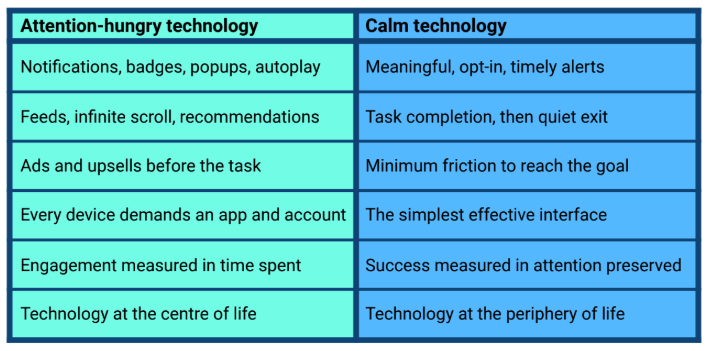
The alternative is not technophobia. It is better design. Calm technology would intervene only when necessary, distinguishing between genuine urgency, useful information, and commercial persuasion. It would use the minimum technology needed to solve a problem: if a physical switch, a clear label, or a simple web page works, there is no need for an app, an account, and an AI companion.
It would make silence the default. Notifications would be meaningful, opt-in, and easy to turn off. It would design for exits, allowing people to complete a task without being pulled into a feed, a subscription, or an endless recommendation loop. It would also measure success differently, not by time spent, sessions opened, or engagement rates, but by tasks completed, decisions simplified, and attention preserved.
Most importantly, it would treat attention as a boundary rather than a resource. No notification, popup, or recommendation should assume that every moment of a person’s life is an opportunity for engagement.
None of this means that attention-hungry design will disappear easily. Advertising, data collection, subscriptions, and engagement metrics fund much of the digital world; many services that appear free are paid for by our attention. If attention is the currency of the digital economy, then how we spend it should not be treated as a private inconvenience. If attention is the currency of the digital economy, then how we spend it should not be treated as a private inconvenience. It is a design decision, a business-model decision, and a public-interest question.
Calm technology may be idealistic, but it is not naïve. It asks developers, platforms, and policymakers to distinguish between technology that serves people and technology that simply harvests them.
Technology with manners
Weiser believed the most profound technologies disappear. Today most of them are determined to be seen.
What we need next is courtesy as much as intelligence: tools that help when needed, stay quiet when not, and leave human attention where it belongs. Technology should make room for a life lived beyond it, and defend our right to live that life quietly.
