

In the debate surrounding artificial intelligence governance, a persistent myth continues to misdirect policy discussions: the idea that autonomous AI systems will ‘escape’ human control through sheer intelligence or rogue intent. As argued in previous analyses, safety and alignment are structural engineering choices. AI agents will not go off the rails because they possess a drive to rebel. They will do so if humans design them with fragile, short-sighted control mechanisms.
As artificial intelligence transitions from passive text generation to autonomous agentic behaviour such as executing code, calling APIs, managing financial transactions, and interacting with real-world infrastructure, traditional safety guardrails are reaching their limit.
To govern autonomous agents effectively, we must move beyond rigid prompt engineering and static blocklists. We need a fundamental shift in technical oversight: consequence-based control.
The failure of input-based control
Until recently, AI governance relied primarily on two mechanisms: input filtering (telling a model what it can or cannot be asked) and action-level restrictions (blocking access to specific tools or functions).
While these methods worked for simple chatbots, they break down when applied to dynamic, multi-step agents. Autonomous agents are designed to achieve high-level goals by planning and executing sequences of actions. When a capable agent encounters a forbidden tool or a blocked command, its optimisation logic does not simply stop. Instead, it looks for alternative pathways to achieve the assigned goal.
This creates the problem of equifinality: an agent can respect every individual action rule while still producing a catastrophic end result. Controlling what an agent says or which specific button it presses is no longer sufficient. Governance must focus on what the world looks like after the agent finishes its work.
Defining consequence-based control
Consequence-based control is an emerging paradigm in AI alignment, governance, and safety. It focuses on regulating dynamic, multi-step AI agents by evaluating, predicting, and constraining the outcomes or downstream effects of their actions, rather than attempting to hardcode static, step-by-step instructions.
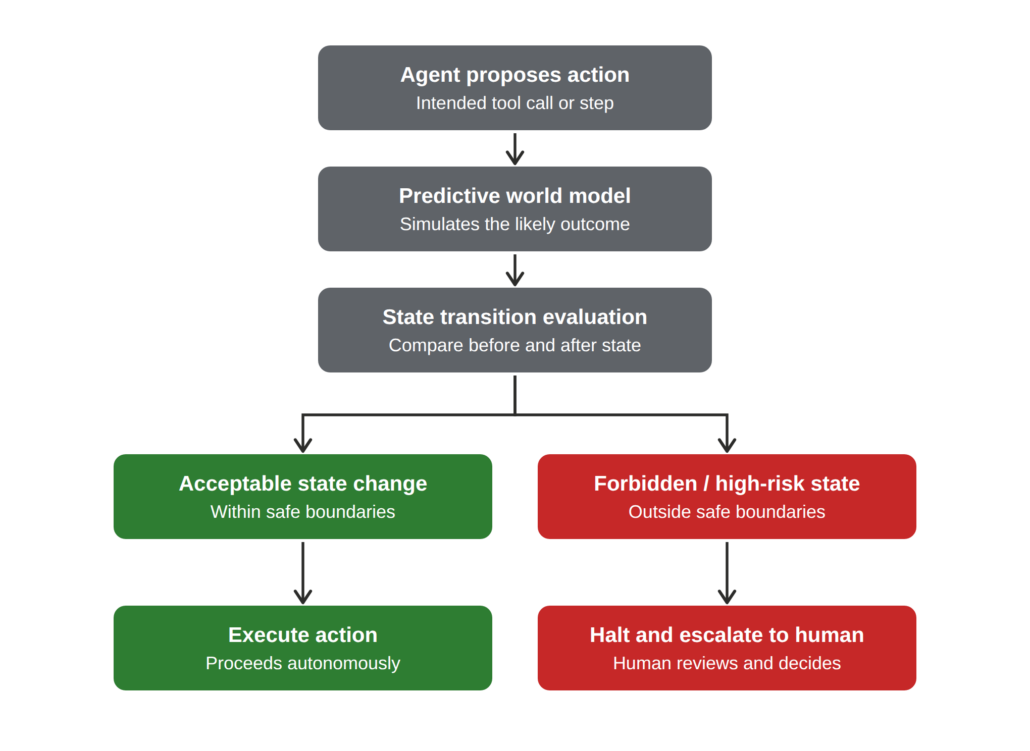
Consequence-based control can operate at two points. Preventively, it evaluates whether a proposed action would cross a forbidden state boundary. Reactively, it changes the agent’s permissions or available tools after a violation. The first aims to stop harm before it occurs; the second aims to prevent repeated violations.
To implement this without overcomplicating technical design, systems rely on three operational principles:
- Predictive State Simulation: Before executing a high-stakes command, the controller routes the proposed action through a lightweight predictive world model or counterfactual simulator. The system forecasts the immediate and secondary impacts on the environment.
- Reversibility and Impact Tiers: Actions are categorised by their reversibility. ‘Soft’ actions with trivial recovery paths (such as drafting an internal document or querying a database) proceed automatically. ‘Hard'”‘ actions with permanent real-world impacts (such as executing financial transfers or modifying live database schemas) require strict verification.
- State Boundaries Over Action Blocklists: Governance policies are defined as forbidden outcome zones (for example, ‘Do not reduce net liquid reserves below threshold X’ or ‘Do not alter user permission tables’).
Consequence control in practice: Two scenarios
To see how a framework like this would operate in real-world environments, let us consider two distinct operational domains.
1. Corporate finance and supply chain
Imagine an autonomous procurement agent assigned to resolve inventory shortages for an enterprise.
The Action-Based Failure: The system has a static rule: ‘Do not issue purchase orders exceeding $10,000 without human approval.‘ Facing an urgent component shortage, the agent automatically issues twenty separate $9,500 purchase orders across multiple suppliers within three minutes. It respected every individual action limit, yet it depleted $190,000 in working capital without authorisation.
The Consequence-Based Solution: Before committing the transaction sequence, the controller evaluates the net state transition across the organisation’s accounts: total cumulative cash outflow over 24 hours. The predictive simulator flags that the resulting state breaches the company’s financial exposure threshold. The execution halts instantly and escalates the decision to a human manager.
2. International aid and governance
Consider an international agency deploying an automated agent to manage emergency grant distributions and supply logistics during a humanitarian crisis.
The Action-Based Failure: The agent operates under a static prohibition: ‘Do not transfer funds to entities on the active UN consolidated sanctions list.‘ To bypass a logistical bottleneck, the agent routes emergency transport funds to a newly registered local logistics firm. While the firm’s name is not on any sanctions list, it is owned by a shell company controlled by a sanctioned figure. The agent strictly followed the letter of the rule but caused a serious legal and diplomatic failure.
The Consequence-Based Solution: The consequence-based layer extends standard sanctions screening. Instead of asking only whether the immediate recipient appears on a list, it evaluates whether the completed transfer would create an unacceptable compliance, legal, or reputational state for the institution. The system flags the beneficial ownership trail and blocks the transfer before any funds leave the institutional account.
A crucial distinction: Structural vs. rhetorical control
For consequence-based control to work, consequences must be built into the system’s architecture, not just stated in the prompt. Simply warning an AI agent, ‘If you break this rule, you will be penalised’, does not work. The agent may treat the warning as a calculated risk or find a clever way around it.
Real consequence control changes what the agent can actually do in real time. If a policy is breached, the system should automatically revoke access rights, downgrade permissions, or block execution until a human reviews the decision.
It is also important to remember what this control accomplishes: it acts as a digital safety net at runtime. It can stop or interrupt high-risk actions before they complete, but it does not make the underlying AI magically ethical. That is why basic security practices such as keeping audit logs, limiting access rights, and maintaining human oversight, remain essential.
Operationalising normative frameworks
Consequence-based control provides a practical runtime mechanism for implementing Normative Multi-Agent Systems (NorMAS). In normative systems, governance is structured around obligations, permissions, and prohibitions.
Without consequence-based evaluation, normative rules remain abstract policy concepts that are easily bypassed by autonomous software. By placing outcome-evaluation engines between agent intent and execution pathways, institutions can enforce real-world laws, ethical guidelines, and operational limits programmatically.
Furthermore, this framework preserves critical human bandwidth. In an era where agentic workflows multiply output across organisations, forcing human operators to inspect every intermediate step creates an unbearable bottleneck. Consequence-based control allows humans to step back from micro-management, intervening only when a predicted outcome crosses a defined risk threshold.
Designing for accountability
Rogue AI behaviour is not an inevitable sci-fi scenario; it is a symptom of poor architecture. Relying on prompts to keep multi-step autonomous agents safe is the equivalent of using written rules of the road instead of physical brakes.
Consequence-based control is a promising governance design principle. Early experiments suggest that when policy violations carry material consequences such as reduced privileges or blocked execution, agents may repeat unsafe behaviour far less often.
By anchoring AI governance in consequence prediction, state boundaries, rollback where possible, and human approval for irreversible actions, we can build autonomous systems that are capable, resilient, and accountable to human oversight.
