
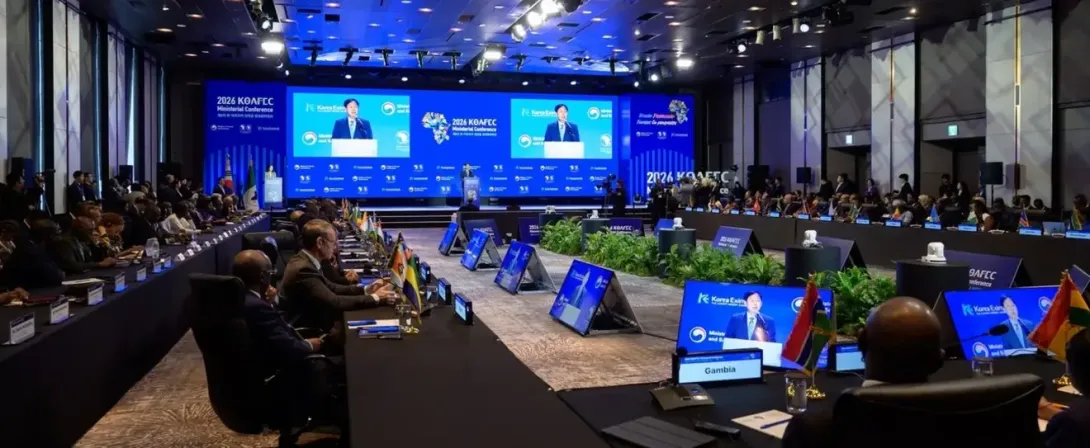
By adopting the Joint Declaration and the Action Plan, participants at the 8th KOAFEC are opening a new chapter in the partnership between Korea and Africa.
Twenty years after its creation, KOAFEC is moving into a new phase, with a greater focus on implementation and investment.
On Wednesday 9 September in Seoul, the Republic of Korea, African countries and the African Development Bank Group adopted a Joint Declaration and an Action Plan for 2027–2028, which place artificial intelligence (AI), digital infrastructure and human capital development at the heart of the partnership between Africa and Korea.
Participants at the 8th Korea-Africa Economic Cooperation (KOAFEC) Ministerial Conference, with the theme, ‘Harnessing Artificial Intelligence and Digital Infrastructure for Africa’s Transformation’, reaffirmed their commitment to making AI a catalyst for inclusive growth, industrialisation and job creation on the continent.
The Joint Declaration, adopted following the official opening of the Ministerial Conference, emphasises that artificial intelligence, combined with robust digital infrastructure and investment in human capital, offers “unprecedented opportunities to accelerate Africa’s economic transformation”.
Citing data from the African Development Bank, various partners estimate that AI could contribute as much as $1 trillion to Africa’s GDP from 2035 onwards, if necessary, investments are made in energy, connectivity, data centres, digital skills and trust frameworks.
Korean and African leaders therefore agreed to strengthen cooperation to build an inclusive global AI ecosystem, enabling countries on the continent to not only adopt new technologies but also to participate in their development. Both sides committed to supporting the creation of modular data centres tailored to local conditions, developing AI models that reflect African languages and cultures, and promoting ‘safe and responsible’ artificial intelligence.
Prioritising infrastructure, the Declaration recognises that access to electricity, telecommunications networks and computing capacity is an essential prerequisite for the development of Africa’s digital economy. Conference participants pledged to mobilise further public and private funding to reduce infrastructure gaps and support the continent’s industrialisation.
Beyond the digital sector, partners identified several strategic sectors where AI can have rapid and tangible impact. In agriculture, precision technologies are expected to help improve productivity and food security in the face of the effects of climate change. In healthcare, AI-assisted diagnostic solutions and smart information systems can help broaden access to care and strengthen the resilience of healthcare systems. Other priority areas include education, public governance, and skills development.
KOAFEC Action Plan 2027–2028
To translate these ambitions into concrete projects, the KOAFEC Action Plan 2027–2028 has identified thirteen initiatives across five key areas. These include a regional ‘Data Embassy’ project in Sierra Leone; a computing credit programme for African start-ups specialising in AI; a smart city platform in Kigali; an urban digital governance project in Kenya; and an artificial intelligence talent accelerator in The Gambia. In addition, an agency in Egypt will deploy artificial intelligence to strengthen African supreme audit institutions (SAIs) and transform public audits.
Other projects focus on telemedicine in Central Africa; the digital transformation of agricultural systems in Zimbabwe and Angola; a Digital Water Academy in Egypt; and the strengthening of electricity and digital infrastructure in Zambia and Rwanda.
The partners also welcomed the growing role of the New African Financial Architecture for Development (NAFAD), a pillar of the ‘Four Cardinal Points’ strategic vision of the President of the African Development Bank Group, Dr Sidi Ould Tah.
Twenty years after its creation, KOAFEC is entering a new phase, with a greater focus on implementation and investment. Through the Joint Declaration and its accompanying Action Plan, Korea and Africa are affirming a shared ambition to transform technological advances into concrete opportunities for development, industrialisation and shared prosperity.
Government representatives from 45 African countries took part in conference, alongside Korean public authorities, private sector and start-up leaders, and representatives from multilateral development institutions.
Dr Sidi Ould Tah, President of the African Development Bank Group, led the institution's delegation to the four-day conference, during which the Bank signed several agreements to strengthen investment and co-financing for major projects across the continent.
Contact:
Romaric Ollo Hien, Communications and External Relations Department, [email protected]