

Photo credit: Gemini/Sakshi John
Human-induced climate change is a “code red for humanity”. It is a perilous reality threatening our lives, livelihoods, and ecosystems. Amid this global challenge, Artificial Intelligence (AI) is emerging as a transformative tool, capable of acting as a force multiplier when harnessed effectively.
AI is already reshaping industry, education and healthcare sectors; and AI-backed tech has demonstrated significant potential to support climate change adaptation and mitigation. AI’s ability to process astronomical datasets and identify patterns offers a proactive data-driven approach and delivers actionable insights to tackle climate change challenges.
However, technology alone is not enough. The success of AI and other similar technologies is dependent on us – including on the digital native youth and budding entrepreneurs.
Youth leading climate action
Youth are considered the primary architects of climate tech and AI solutions. A growing number of youth-led firms are leading the way in AI based climate tech solutions such as decentralized energy sharing and localized crisis warnings. Their digital fluency is needed to bridge intricate climate research with practical localized or community-level solutions.
Youth bring an innovative mindset that is crucial for going beyond traditional institutional structures. They have a nuanced understanding of the predicaments their generation faces from eco-anxiety to climate-induced displacement. They turn data into tools for activism and enterprise that are not only technically sound but also socially relevant. Examples include satellite data for air pollution monitoring, AI-based disaster prediction, IoT sensors for precision agriculture and AI for carbon credit tracking.
Despite their significant contributions, the bottleneck remains as young people don't always receive the support they require to present and upscale their solutions. Given that today’s youth will face the brunt of climate change tomorrow, their real-life experiences can help shape policies that are more responsive, practical, inclusive and data backed. Thus, it is important that policy makers and youth come together at one platform to discuss challenges and opportunities to reshape the climate change response.
A platform to connect youth to climate tech opportunities
The innovative potential of young people, combined with the power of technology, is a powerful force for climate action and strengthening resilience, and achieving the Sustainable Development Goals. To harness this potential, the ecosystem to support young innovators and entrepreneurs’ needs to be strengthened by key players - Governments, R&D institutions, industries and investors.
Structured spaces for dialogue and collaboration are necessary to turn this promise of AI-enabled climate solutions into sustained impact. Climate challenges in Asia and the Pacific vary, and are deeply linked across the region. Consequently, regional cooperation on the technology development, adaptation and deployment of solutions is particularly called for. Coordinated approaches ensure that innovations cannot be built in isolation. They allow solutions to be shaped by shared experiences, cross-border learning, and region-specific climate realities.
Collaborative platforms are vital for building capacity, ensuring alignment between innovative solutions and development priorities, and facilitating the transition of innovative solutions from pilot phases to the next stage. These platforms also provide opportunities for interaction between young innovators, scientists, policymakers, and industry stakeholders for the purpose of responsible innovation, technology transfer, and scaling AI innovations for climate change.
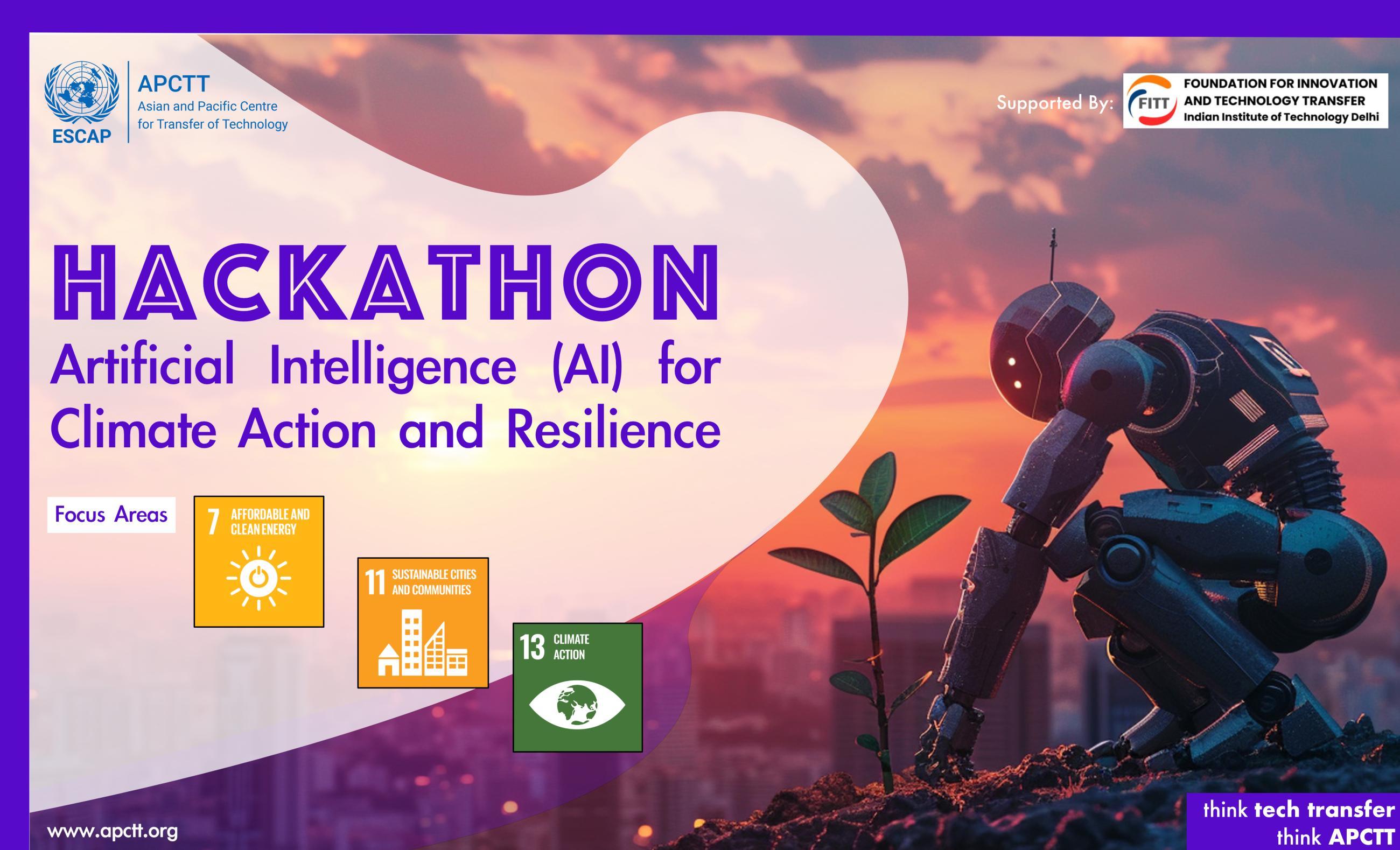
The Technology and Innovation Conclave 2.0 and Hackathon on AI for Climate Action and Resilience, convened by the Asian and Pacific Centre for Transfer of Technology (APCTT) in collaboration with the Department of Scientific and Industrial Research (DSIR), Government of India, is one such platform that fosters dialogue, early-stage innovation, and regional collaboration.
Collaborative platforms can give a kick-start to AI-driven climate action. They create an easy opportunity for direct interaction between policymakers and young innovators. Innovators share advanced AI-backed models (e.g. applications for emission predictions) and policymakers, in turn, offer real-time guidance on national regulations and funding priorities. This kind of support can then be used to make innovation in alignment with national climate policies. It also bridges the gap between idea fruition and implementation. This bi-directional exchange helps break data silos and supports the joint creation of scalable solutions. These solutions can then be further designed to cater to the requirements of vulnerable regions, such as AI tools for farming in drought-prone areas. Virtual marketplaces, capacity-building initiatives, tech transfer platforms and joint hackathons can speed up the optimal usage of innovations.
Looking ahead with purpose
AI provides the cognitive depth needed to manage a planet in flux. The synergy between human innovation and machine intelligence is our potent weapon in the fight for a livable future. AI, when guided by the energy of youth and the rigor of international cooperation, offers a transformative path forward. The Conclave will provide a platform for young entrepreneurs, policy makers and other stakeholders to build capacities, provide networking opportunities, and identify and support measures to develop and scale up AI solutions for climate resilience across the Asia Pacific region.
Learn more about AI for climate action and resilience: https://apctt.org/