

Photo by Dominic Chavez, IFC
Artificial Intelligence (AI) is reshaping how businesses operate worldwide. AI adoption has mostly been featured in boardrooms and workflows in advanced economies. However, relatively little is known about whether and how firms in emerging markets are embedding AI. At the same time, the technology has the potential to change not just business practices but also development outcomes in emerging markets.
To fill that knowledge gap, in June 2025, IFC surveyed over 2,200 companies, across more than 85 countries, backed directly and by private equity (PE) or venture capital (VC) funds in IFC’s portfolio (and excluding the following IFC funds: Startup Catalyst, SME Ventures, Sector Funds and Private Capital Funds). The findings reveal a mixed picture. Early adopters are making significant strides, while many other firms remain on the sidelines.
Roughly 40 percent of firms in emerging markets report some form of AI adoption, whether in internal operations (e.g., back-office processes) or external offerings (e.g., customer-facing products) – which is expected to be below figures cited for developed markets (see reports from McKinsey, Bain, Microsoft, Open AI, Anthropic, and World Bank Group researchers). The others report no AI adoption at all, which underscores how early the technology’s use by industry remains.
Among adopters, some tread lightly. A minority (9 percent) embed AI solely for internal operations or apply it only externally (7 percent). Nearly a quarter of firms use AI for both internal and external purposes, suggesting a more comprehensive integration. This distinction in the intensity of AI integration is important. Companies that deploy AI in depth across multiple business functions are better placed to reap cumulative gains in productivity and other business outcomes. Instead, firms limiting themselves to a single function and point-specific AI solution are more likely to capture only modest efficiencies.
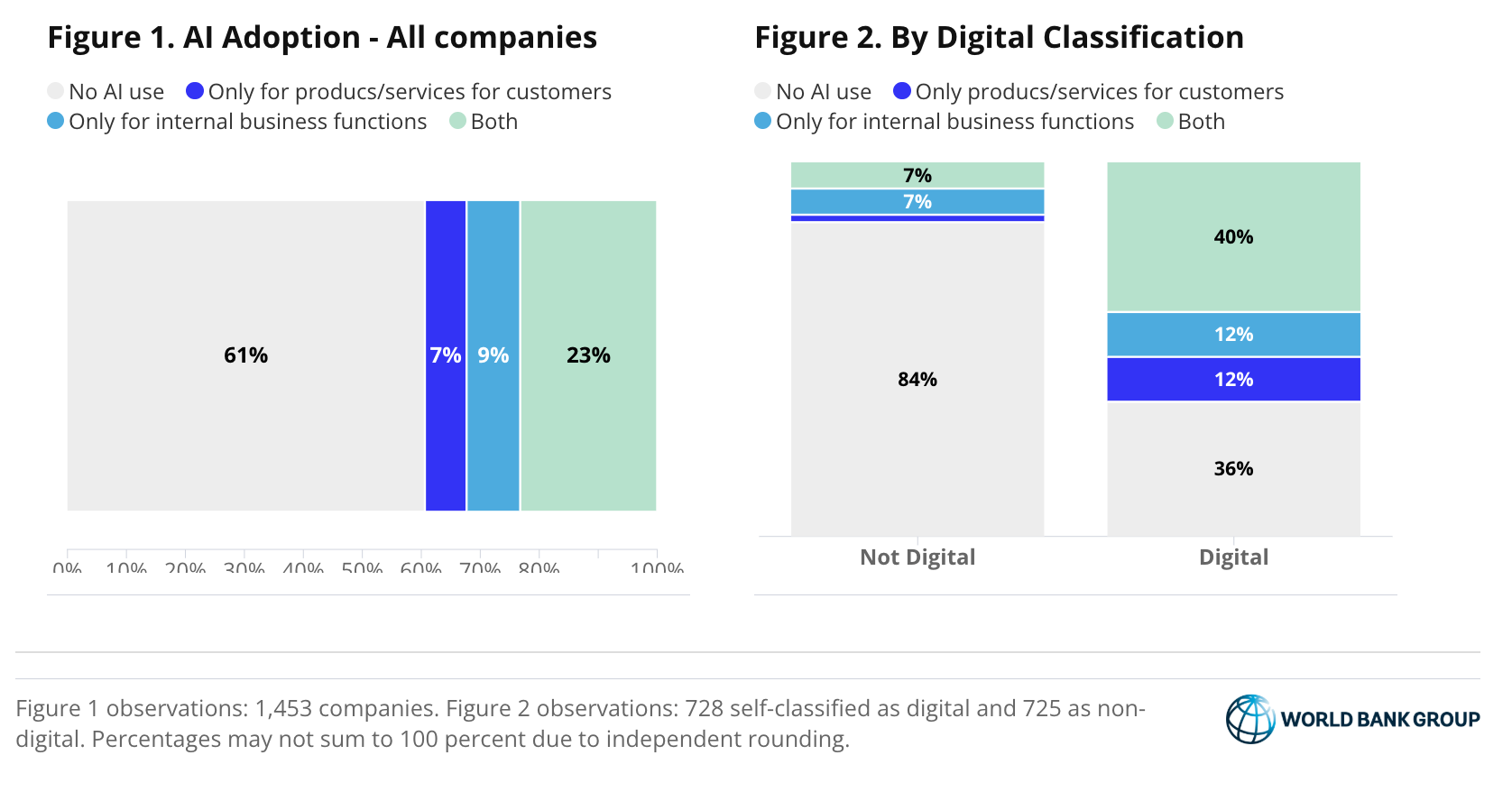
The survey also shows that “digital-first” firms –those that define their industry as primarily technology--are, unsurprisingly, far more likely to embed AI than those rooted in analogue operations. Only 16 percent of companies that are “non-digital” indicate using AI, compared with 64 percent of “digital” firms. This divide likely reflects the nature of today’s AI technologies: conversational AI, such as chatbots built on large language models (LLMs), are easier to integrate into firms already operating online. Embedding AI also becomes a logical step in a landscape of intense pressure among tech companies. By contrast, embodied AI, that is, AI integrated into physical systems, such as robotics and computer vision in factories, remains in incipient stages of development and is harder to deploy.
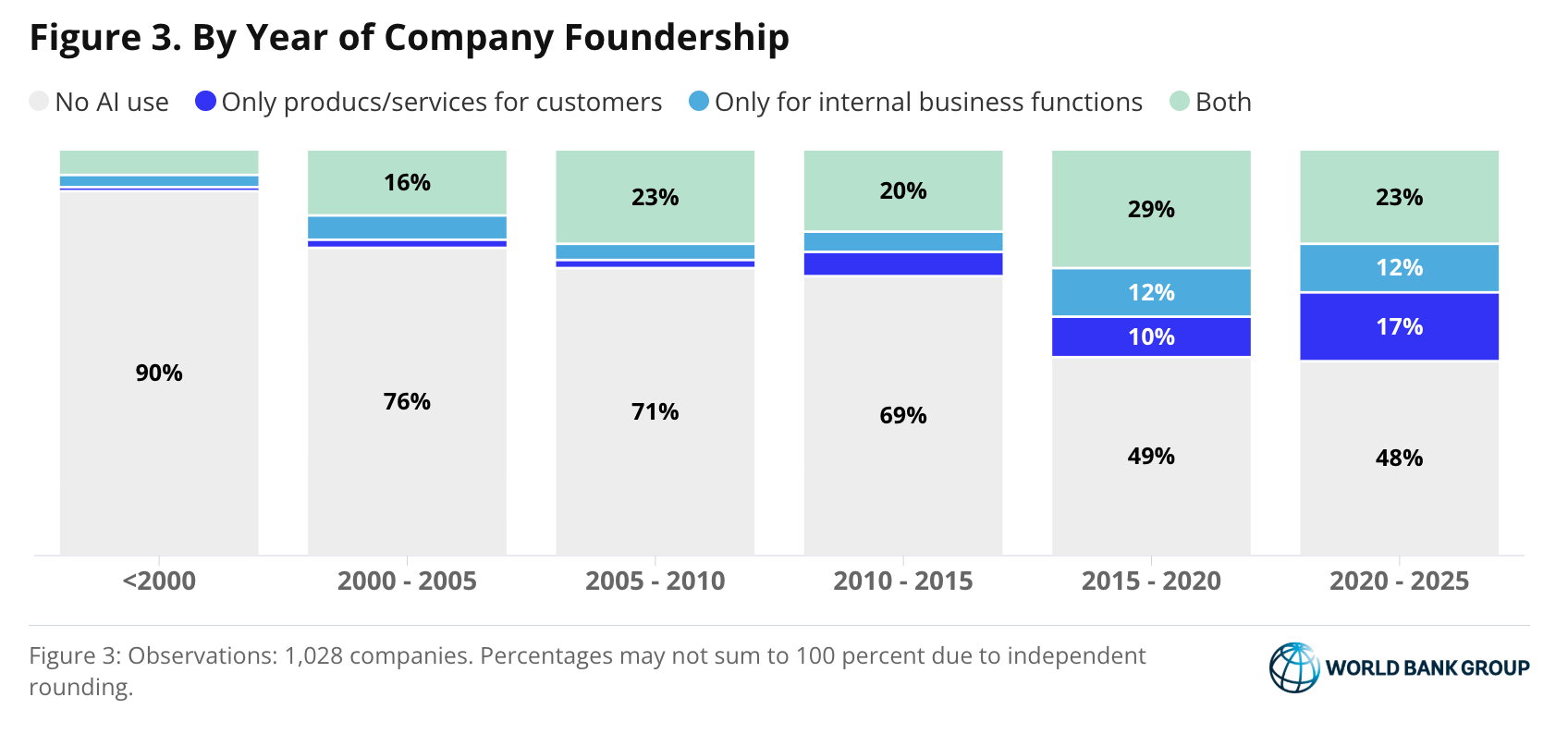
Younger companies are far more likely to use AI. Among firms founded before 2000, only 10 percent report using AI, but that share rises steadily to more than half for firms launched after 2015. The data shows a generational shift: each new wave of companies is increasingly born digital and embedding AI from the start (“AI-native”).
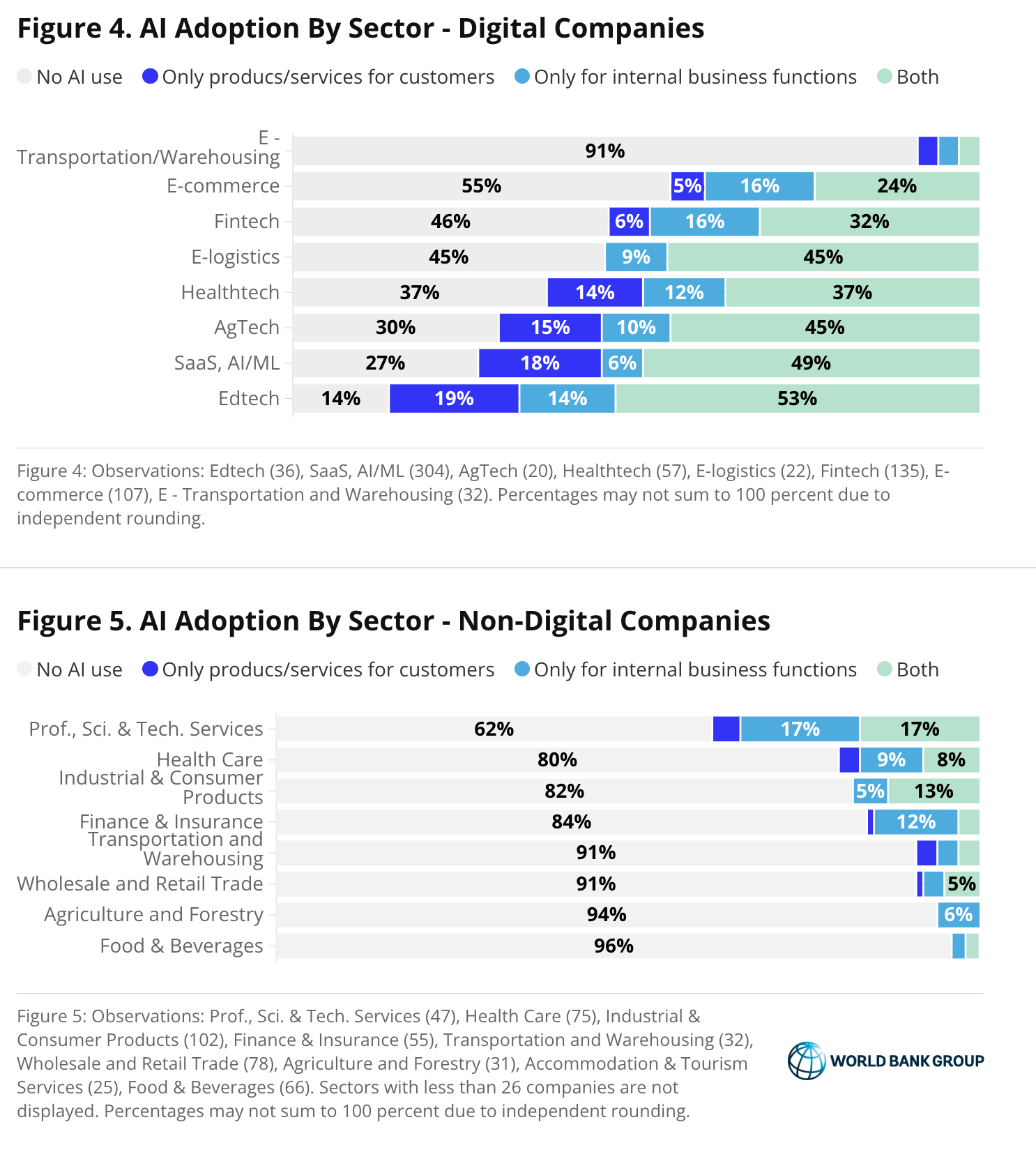
Among digital firms, software industries and those handling large volumes of transactions lead the way. These are natural candidates for AI because they produce abundant training data, face operational complexity, and can see productivity improve with automation and prediction. The majority of firms in EdTech (86%), SaaS (73%), AgTech (70%), HealthTech (63%) and Fintech (54%) report AI integration. EdTech emerges as the most active adopter, especially for external AI, which could suggest adaptive and customized learning platforms may already be reshaping the vertical.
Among traditional or “non-digital” companies, professional services are ahead. Thirty-eight percent of firms in this sector report AI use, compared with 3 to 20 percent among other traditional sectors. This is consistent with recent literature that finds tasks performed in these industries are particularly well suited to automation and augmentation by AI.
Finally, the spread of firm AI adoption is uneven across regions. Adoption is lowest among surveyed firms in Sub-Saharan Africa and the Middle East, and thereafter in South and East Asia. By contrast, firms in emerging economies in Europe and Central Asia and Latin America and the Caribbean are closest to adoption rates at the frontier, with roughly half of firms reporting AI integration. One anomaly is East Asia, which ranks lower in this dataset than in other surveys, potentially because the IFC portfolio underrepresents the region’s advanced digital hubs.
Businesses are the main way technologies are used to make goods and services. This makes them a key driver of productivity gains, which in turn help economies grow and develop over time. This survey offers only an early snapshot of AI adoption among firms. Broader coverage is needed, along with research on adoption drivers, usage intensity, and business outcomes.
The survey highlights that AI’s spread through firms in emerging markets is still in its early stages, marked by significant experimentation among a few firms and slow uptake among the rest. While the jury is still out on the exact impact of AI, the firms in our survey that are early adopters see advantages in enhancing the efficiency of their business processes and opportunities to engage in product innovation. If this results in improvements in competitiveness at the firm-level, these businesses may find greater opportunities to increase market share and enter new markets – with potentially important implications for economic growth.