
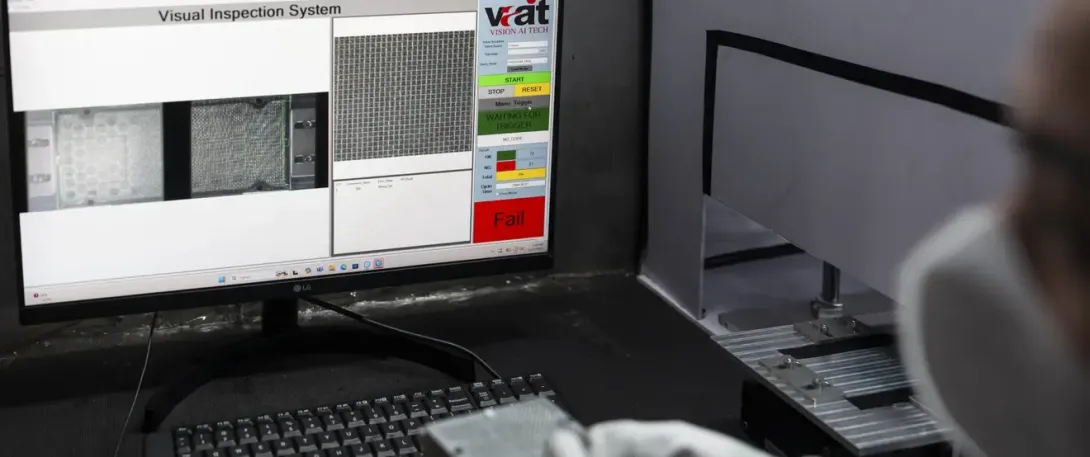
AI system © ILO/Nguyen Duc Hieu
Insights from HITI’s real-world pilot under the ILO’s Productivity Ecosystems for Decent Work Programme.
HA NOI (ILO News) - At Hanoi Industry Trading Investment Joint Stock Company (HITI), an AI-enabled vision system recently cut inspection time from 20 seconds to just 5 and boosted defect-detection accuracy from 95% to 99%. This pilot - implemented under the ILO’s Productivity Ecosystems for Decent Work Programme - shows how Vietnamese enterprises can adopt artificial intelligence responsibly while improving both productivity and job quality.
The ILO’s Productivity Ecosystems for Decent Work Programme identifies technology adoption as a key driver of firm-level productivity, competitiveness, and decent work. Guided by on-site assessments and workflow mapping conducted by the Research Institute for Digital Economy and Organization (RIDE), five enterprises were selected to pilot AI-driven solutions tailored to their operational needs.
Among them, HITI stands out for its strategic and thoughtful approach to integrating AI into quality control processes.
With RIDE’s technical support, HITI developed and deployed a custom AI Vision system to inspect mechanical mesh components. The results were transformative:
- Inspection time reduced from 20 seconds to 5 seconds
- Accuracy increased from 95% (human only) to 99% (human + AI)
- Quality control team reorganized from 10 workers to 3 senior high-tech supervisors
- Seven workers retrained and reassigned to higher-value roles
This combination of efficiency and job redesign offers a practical example of how AI can help enterprises modernize while strengthening -not displacing - the workforce.
As the transition unfolded, some inspectors initially expressed concerns about whether the new technology would replace their jobs. But experience on the factory floor demonstrated that AI performs best when paired with human oversight, feedback and practical knowledge.
“Optimal productivity depends on close collaboration between human operators and the AI tool. The technology relies on workers’ insights and supervision,” shared Director of RIDE, Karl Tran. “Building this kind of human - AI partnership requires thoughtful change management - transparent communication, awareness-raising, and honest conversations about reskilling and role evolution. Only then can AI truly enhance productivity while supporting workers.”
Building this kind of human - AI partnership requires thoughtful change management - transparent communication, awareness-raising, and honest conversations about reskilling and role evolution. Only then can AI truly enhance productivity while supporting workers.
Director of RIDE, Karl Tran
On 17 November, during a mission to Viet Nam, representatives from the State Secretariat for Economic Affairs (SECO), together with the ILO programme team, visited HITI to observe the pilot first hand. The discussion with the company focused on how AI adoption is improving performance, workflows and job design.
“Quality control is an area where automation and AI are advancing rapidly. It is very positive to see factories in Viet Nam taking these opportunities seriously,” noted Etienne Jenni, Programme Manager, SECO Headquarters. “However, such transitions also come with challenges. It is vital that workers are not displaced and that policies support upskilling and reskilling. The ILO plays a crucial role in ensuring that innovation improves productivity while keeping workers protected and included.”
The success of the HITI pilot - made possible through the sustained support of our donors: the SECO and the Norwegian Agency for Development Cooperation (NORAD) - illustrates how Vietnamese enterprises can integrate AI in ways that strengthen both competitiveness and decent work. As more SMEs explore digital transformation, HITI offers a compelling example: AI works best not when replacing workers, but when empowering them.