
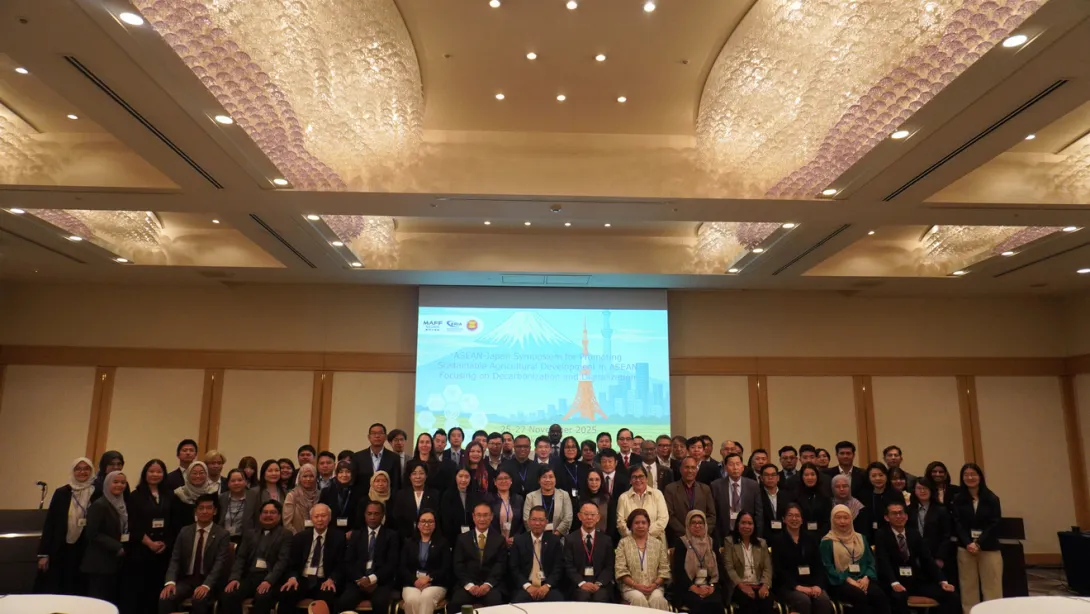
Tokyo, 27 November 2025: ERIA, in partnership with Japan’s Ministry of Agriculture, Forestry, and Fisheries (MAFF) and the ASEAN Secretariat (ASEC), co-organised the ASEAN–Japan Symposium on Promoting Sustainable Agricultural Development in ASEAN: Focusing on Decarbonisation and Digitalisation from 25–27 November 2025 in Tokyo.
The symposium gathered government officials from ASEAN Member States (AMS) and Japan, representatives from the private sector, and experts from academia and international organisations. Discussions underscored the strategic importance of decarbonisation and digitalisation as shared priorities for ASEAN and Japan in transforming regional agri-food systems. These themes align with the ASEAN Food, Agriculture, and Forestry Sectoral Plan (FAF–SP) 2026–2030, which aims to foster a decarbonised, digitally enabled, and regenerative agricultural landscape. ERIA Research Associate Ms Siti Mustaqimatud Diyanah served as Master of Ceremony for the event.
In his opening remarks, ERIA Senior Policy Fellow Mr Masanori Kozono reaffirmed ERIA’s commitment to supporting sustainable economic development in ASEAN through close collaboration with ASEC and AMS. He highlighted ERIA’s contributions to major regional initiatives planned for next year, including the ASEAN Implementation Plan for Regenerative and Resilient Agriculture Systems and the ASEAN Guidelines on Biochar. He also encouraged active engagement in the business pitching session, which provided a platform for Japanese companies to present innovative technologies suited to ASEAN contexts and for AMS delegates to communicate their technical needs directly to potential partners.
Two technical sessions examined regional and country-level policy frameworks and initiatives that promote digitalisation and reduce greenhouse gas (GHG) emissions in agriculture and food systems.
During the digitalisation session, Mr Kozono presented key findings from ERIA’s regional study on the opportunities and challenges of digital agriculture, referencing the recent policy brief Digitalisation in Agriculture and Food Systems in ASEAN: Pathways to Its Resilience and Sustainability. The study found that economic objectives – such as productivity gains, cost reduction, and improved labour efficiency – remain the primary drivers of digital technology adoption. Barriers include inadequate internet connectivity, low digital literacy, high upfront costs, and gaps in policy frameworks. The discussion highlighted the importance of targeted interventions to address these challenges and accelerate digital innovation across ASEAN. Participants emphasised the need to ensure that advanced technologies are accessible and affordable for smallholder farmers and called for deeper ASEAN–Japan collaboration to support inclusive digitalisation.
The session on GHG emissions reduction, moderated by ERIA Senior Research Fellow Dr Venkatachalam Anbumozhi, reviewed AMS efforts to advance agricultural decarbonisation through national climate initiatives, farmer-focused interventions, and technology pilots. ERIA and FAO provided regional overviews of GHG emissions reduction pathways. Discussions underscored the need for greater policy coherence across ASEAN and suggested deepening ASEAN–Japan collaboration under Japan’s MIDORI Strategy to promote climate-smart technologies and strengthen regional decarbonisation efforts.
Another session focused on promoting biochar development in ASEAN, part of an ERIA-led initiative involving regional assessments and the development of an ASEAN Biochar Production and Application Guideline. ERIA Energy and Agriculture Economist Dr Phetkeo Poumanyvong presented the draft outline of the guideline and sought feedback from AMS delegates. He highlighted biochar’s potential to reduce air pollution (smoke and PM2.5), support decarbonisation, improve sustainable farming practices, and unlock carbon credit opportunities. JIRCAS, NARO, and CABI shared updates on their biochar research and implementation activities in ASEAN. AMS representatives expressed strong support for the guideline’s development while underscoring the need to ensure its practicality and affordability for farmers.
The symposium concluded with study visits to the Toyosu Market and the Agribusiness Creation Fair 2025, where delegates explored digital and climate-smart technologies relevant to ASEAN agricultural transformation.
Through this symposium, ERIA reaffirmed its commitment to strengthening regional co-operation, supporting sustainable technologies, and advancing innovation in ASEAN agriculture.
.jpg/)
.jpg/)
.jpg/)
.jpg/)
.jpg/)
.jpg/)