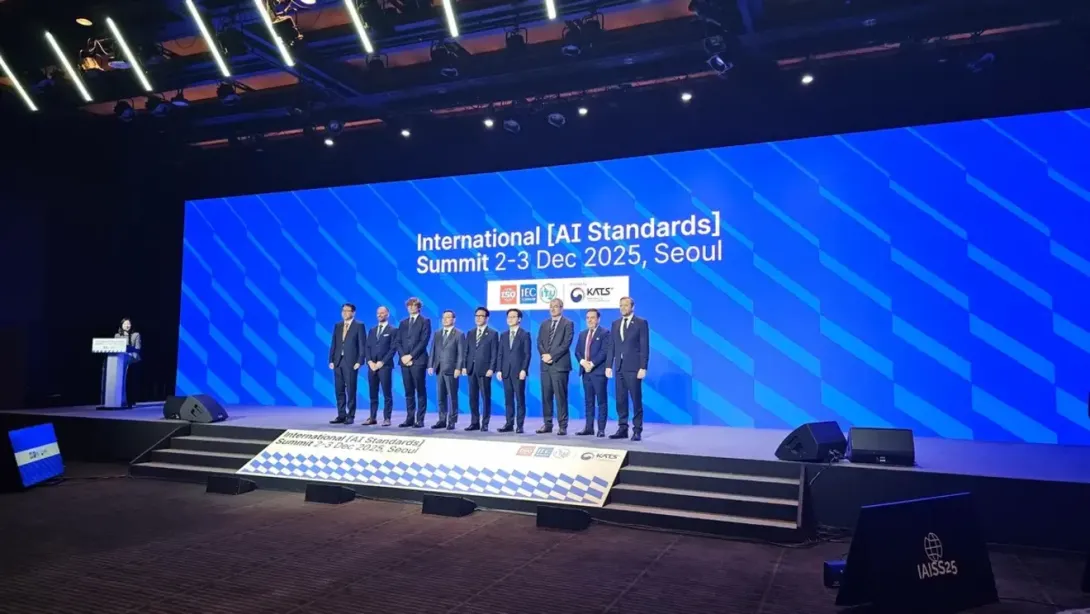
Header image credit: ITU (Representatives of IEC, ISO and ITU at the International Summit on AI Standards)
International standardization bodies have pledged to cooperate on standards for artificial intelligence (AI), aiming to help build an open, sustainable and secure future for all.
The International Electrotechnical Commission (IEC), the International Organization for Standardization (ISO), and the International Telecommunication Union (ITU), at their latest global conference in Seoul, Republic of Korea, issued a joint commitment to advance the well-being of humanity through AI standards.
The International Summit on AI Standards, taking place on 2-3 December, explores the complex challenges posed by AI and the opportunity to bridge digital divides through effective international standards.
The Seoul Statement, issued today, enshrines a joint by the three organizations to advance AI standards for the benefit of everyone worldwide.
“Standards are technical tools to uphold the principles we want to live by,” said Seizo Onoe, Director of the Telecommunication Standardization Bureau at ITU. “The vision set out by this joint statement calls for diverse expertise and global commitment to collaboration and consensus – exactly what drives our standards work and exactly the spirit needed to create the future we want.”
A shared vision of AI for humanity
The statement sets out a joint vision and commitments from ITU, ISO and IEC on how technical standards can support the development and deployment of trustworthy AI systems that benefit society, drive innovation, and uphold fundamental rights.
“AI has the potential to bring profound benefits to people and economies across the globe,” said ISO President Sung Hwan Cho. “But to ensure this potential is realized equitably and responsibly, International Standards are essential. This joint statement reflects our commitment to strengthening cooperation across our organizations to deliver relevant, robust and human-centric standards that guide the responsible design and use of AI technologies.”
The summit brought together over 300 participants from 65 countries to share perspectives from government, industry, academia, civil society, the public and private sectors, international organizations and UN agencies.
Reliability and sustainability are crucial for standards to advance the global good. So is respect for human rights.
“The rapid rise of AI confirms a basic truth: technology is always about people,” said IEC President Jo Cops. “As AI becomes central to the global economy, we must urgently establish a guiding framework. This joint commitment underscores the value of international standards as the blueprint for safe, trustworthy, and people-centered AI development.”
Key commitments
The Seoul Statement outlines four key commitments to advance sustainable development and allow everyone to benefit from the AI revolution.
Together, IEC, ISO and ITU have pledged to:
- Actively incorporate socio-technical dimensions in standards development.
- Deepen the understanding of the interplay between international standards and human rights, recognizing both their importance and universality.
- Strengthen an inclusive, dynamic multistakeholder community to develop and apply international standards for the design, deployment, and governance of AI.
- Enhance public-private collaboration on AI capacity building.
Complementary contributions
IEC, ISO and ITU uphold AI as a tremendous opportunity to advance the well-being of humanity.
Through their complementary mandates and longstanding collaboration, the three organizations aim to ensure that AI standards reflect global needs, support regulatory alignment, and foster interoperability, trust and inclusion in the digital age.
The three work together as the World Standards Cooperation, aligning collaborative standards for digital technologies with broader sustainability goals.
Find out more about the World Standards Cooperation